Home
Class 12
MATHS
Let ABCD be a square with sides of unit ...

Let ABCD be a square with sides of unit lenght. Points E and F are taken on sides AB and AD, respectively,so that `AE=AF`. Let P be a point inside the squre ABCD.
Let a line passing through point A divides the sqaure ABD into two parts so that the area of one portion is double the other. then the length of the protion of line inside the square is

A

`sqrt(10)//3`

B

`sqrt(13)//3`

C

`sqrt(11)//3`

D

`2//sqrt3`

Text Solution

Verified by Experts

The correct Answer is:
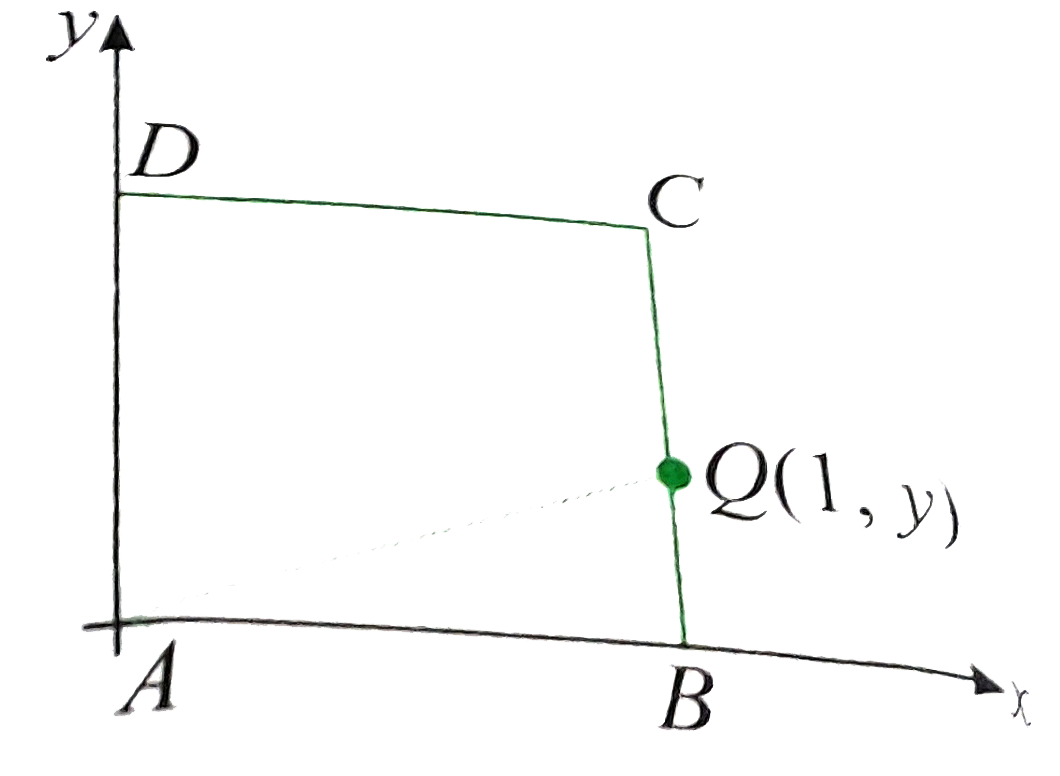
B

`(1)/(2)y(1)=(1)/(3)(1)`
or `y=(2)/(3)`
`therefore AQ=sqrt((1)^2+(2/(3))^2) =(sqrt13)/(3)`
Promotional Banner

Topper's Solved these Questions

  • COORDINATE SYSYEM

    CENGAGE PUBLICATION|Exercise Matrix match type|4 Videos
  • COORDINATE SYSYEM

    CENGAGE PUBLICATION|Exercise Numerical value|12 Videos
  • COORDINATE SYSYEM

    CENGAGE PUBLICATION|Exercise Multiple correct|13 Videos
  • COORDINATE SYSTEM

    CENGAGE PUBLICATION|Exercise Multiple Correct Answers Type|2 Videos
  • CROSS PRODUCTS

    CENGAGE PUBLICATION|Exercise DPP 2.2|13 Videos

Similar Questions

Explore conceptually related problems

Let ABCD is a square with sides of unit lenghts . Points E and F are taken on sides AB and AD respectively so that AE =AF . Let P be a point inside the square ABCD. Let a line passing throught point A divides the square ABCD into two parts so that area of one part is double to another , then lenght of the line segment inside the square is -

Let ABCD be a square with sides of unit lenght. Points E and F are taken on sides AB and AD, respectively,so that AE=AF . Let P be a point inside the squre ABCD. The value of (PA)^2-(PB)^2+(PC)^2-(PD)^2 is equal to

Let ABCD is a square with sides of unit length. Points E and F are taken om sides AB and AD respectively so that AE= AF. Let P be a point inside the square ABCD.The maximum possible area of quadrilateral CDFE is-

Let ABCD is a square with sides of unit lenghts . Points E and F are taken on sides AB and AD respectively so that AE =AF . Let P be a point inside the square ABCD. The maximum area of quandrilateral CDFE will be -

Let ABCD is a square with sides of unit lenghts . Points E and F are taken on sides AB and AD respectively so that AE =AF . Let P be a point inside the square ABCD. The value of (PA)^(2)-(PB)^(2)+(PC)^(2)-(PD)^(2) is equal to -

A 45 cm long copper wire is bent to from a square. Let's find the length of one side of the square.

Let A B C be a given isosceles triangle with A B=A C . Sides A Ba n dA C are extended up to Ea n dF , respectively, such that B E*C F=A B^2dot Prove that the line E F always passes through a fixed point.

ABCD is a square Points E(4,3) and F(2,5) lie on AB and CD, respectively,such that EF divides the square in two equal parts. If the coordinates of A are (7,3) ,then the coordinates of other vertices can be

If each of sides of the square ABCD be a cm, then the length of each of the sides of the square, formed by joining the mid-points of the sides of ABCD is

In a parallelogram ABCD, E and F are the midpoints of the sides AB and DC respectively. Show that the line segments AF and EC trisect the diagonal BD.

