Home
Class 12
MATHS
Let A(z(1)) and B(z(2)) are two distinct...

Let `A(z_(1))` and `B(z_(2))` are two distinct non-real complex numbers in the argand plane such that `(z_(1))/(z_(2))+(barz_(1))/(z_(2))=2`. The value of `|/_ABO|` is

A

`(pi)/(6)`

B

`(pi)/(4)`

C

`(pi)/(2)`

D

None of these

Text Solution

Verified by Experts

The correct Answer is:
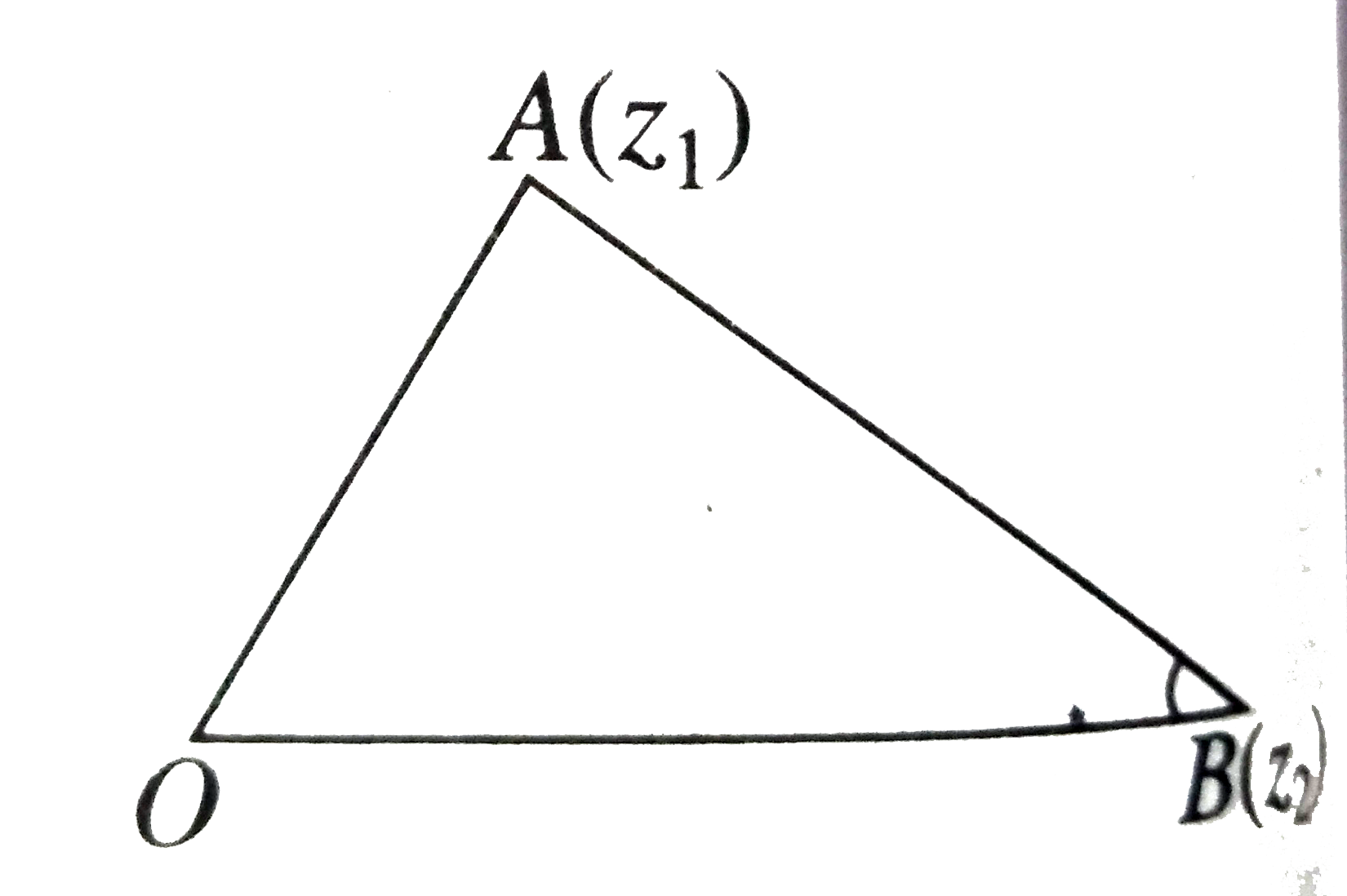
C

`(c )` `(z_(1))/(z_(2))+(barz_(1))/(barz_(2))=2`
`impliesRe((z_(1))/(z_(2)))=1`
Let `(z_(1))/(z_(2))=x+iyimpliesx=1`
Now, `arg((z_(1)-z_(2))/(-z_(2)))=arg(1-(z_(1))/(z_(2)))=arg(-iy)=+-(pi)/(2)`
`/_ABO=(pi)/(2)`
Promotional Banner

Topper's Solved these Questions

  • COMPLEX NUMBERS

    CENGAGE PUBLICATION|Exercise Multiple Correct Answer|11 Videos
  • COMPLEX NUMBERS

    CENGAGE PUBLICATION|Exercise Matching Column|1 Videos
  • CIRCLES

    CENGAGE PUBLICATION|Exercise Comprehension Type|8 Videos
  • CONIC SECTIONS

    CENGAGE PUBLICATION|Exercise All Questions|102 Videos

Similar Questions

Explore conceptually related problems

Let z_(1) and z_(2) be any two non-zero complex numbers such that 3|z_(1)|=2|z_(2)|. "If "z=(3z_(1))/(2z_(2)) + (2z_(2))/(3z_(1)) , then

If z_(1)and z_(2) are conjugate complex number, then z_(1)+z_(2) will be

Let z_(1),z_(2) be two fixed complex numbers in the Argand plane and z be an arbitrary point satisfying |z-z_(1)|+|z-z_(2)|=2|z_(1)-z_(2)| . Then the locus of z will be

If z_(1)and z_(2) be any two non-zero complex numbers such that |z_(1)+z_(2)|=|z_(1)|+|z_(2)| then prove that, arg z_(1)=arg z_(2) .

If z_(1)andz_(2) be two non-zero complex numbers such that (z_(1))/(z_(2))+(z_(2))/(z_(1))=1 , then the origin and the points represented by z_(1)andz_(2)

If z_(1) and z_(2) are two complex numbers, then which of the following is true ?

z_(1) and z_(2)( ne z_(1)) are two complex numbers such that |z_(1)|=|z_(2)| . Sho that the real part of (z_(1)+z_(2))/(z_(1)-z_(2)) is zero.

If z_(1),z_(2) are two complex numbers , prove that , |z_(1)+z_(2)|le|z_(1)|+|z_(2)|

If z_1, z_2, z_3 are distinct nonzero complex numbers and a ,b , c in R^+ such that a/(|z_1-z_2|)=b/(|z_2-z_3|)=c/(|z_3-z_1|) Then find the value of (a^2)/(z_1-z_2)+(b^2)/(z_2-z_3)+(c^2)/(z_3-z_1)

z_(1) and z_(2) are two non-zero complex numbers, they form an equilateral triangle with the origin in the complex plane. Prove that z_(1)^(2)-z_(1)z_(2)+z_(2)^(2)=0

