Home
Class 12
MATHS
If the points A(z),B(-z),C(1-z) are the ...

If the points A(z),B(-z),C(1-z) are the vertices of an equilateral triangle ABC then Re(z) is

A

`tan^(-1)((sqrt(15))/(5))`

B

`tan^(-1)(sqrt(15))`

C

`tan^(-1)((5)/(sqrt(15)))`

D

`(pi)/(2)`

Text Solution

Verified by Experts

The correct Answer is:
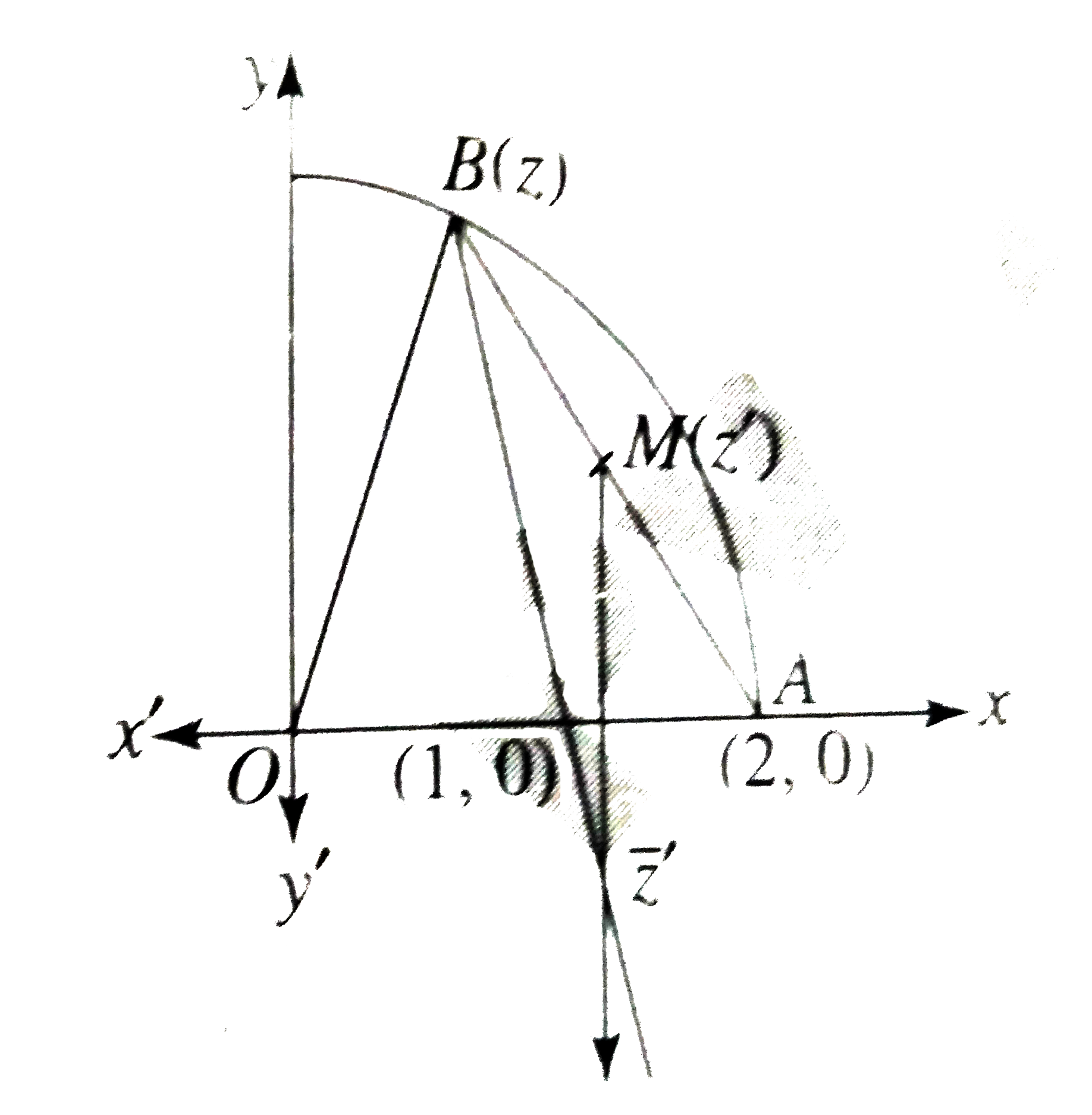
A

`(a)` `M(z')` is mid point of `AB`, so `z'=(z+2)/(2)`

`impliesbarz'=(barz+2)/(2)`
Now `z`, `1`,`(barz)/(2)+1` are collinear
`implies|{:(z,barz,1),((barz)/(2)+1,(z)/(2)+1,1),(1,1,1):}|=0`
`impliesz((z)/(2)+1-1)-barz((barz)/(2)+1-1)+1((barz)/(2)-(z)/(2))=0`
`implies(z^(2))/(2)-(barz)^(2)/(2)+(barz-z)/(2)=0`
`implies(z-barz)(z+barz-1)=0`
`impliesz-barz=0` or `(z+barz-1)=0`
`impliesz+barz=1` or `Re(z)=(1)/(2)`
`|z|=2implies(1)/(4)+(Im(z))^(2)=4`
`impliesIm(z)=(sqrt(15))/(2)`
`impliesz=(1)/(2)+(isqrt(15))/(2)`
`impliesarg(z')=tan^(-1)((sqrt(15))/(5))`
Promotional Banner

Topper's Solved these Questions

  • COMPLEX NUMBERS

    CENGAGE PUBLICATION|Exercise Multiple Correct Answer|11 Videos
  • COMPLEX NUMBERS

    CENGAGE PUBLICATION|Exercise Matching Column|1 Videos
  • CIRCLES

    CENGAGE PUBLICATION|Exercise Comprehension Type|8 Videos
  • CONIC SECTIONS

    CENGAGE PUBLICATION|Exercise All Questions|102 Videos

Similar Questions

Explore conceptually related problems

If A(z_1), B(z_2), C(z_3) are the vertices of an equilateral triangle ABC, then arg((z_2+z_3-2z_1)/(z_3-z_2)) is equal to

Suppose that z_(1),z_(2),z_(3) are three vertices of an equilateral triangle in the Angand plane . Ley alpha=(1)/(2)(sqrt(3)+i)andbeta be a non-zero complex number . The points alphaz_(1)+beta,alphaz_(2)+beta,alphaz_(3)+beta will be -

Suppose that z_(1), z_(2), z_(3) are three vertices of an equilateral triangle in the Argand plane. Let alpha=(1)/(2) (sqrt(3) +i) and beta be a non-zero complex number. The point alphaz_(1) +beta, alpha z_(2)+beta, az_(3)+beta will be

If z_1, z_2 and z_3 , are the vertices of an equilateral triangle ABC such that |z_1 -i| = |z_2 -i| = |z_3 -i| .then |z_1 +z_2+ z_3| equals:

If the complex numbers z_(1),z_(2),z_(3) represents the vertices of an equilaterla triangle such that |z_(1)|=|z_(2)|=|z_(3)| , show that z_(1)+z_(2)+z_(3)=0

If A(z_1),B(z_2),C(z_3) and D(z_4) be the vertices of the square ABCD then

Suppose that z_1, z_2, z_3 are three vertices of an equilateral triangle in the Argand plane let alpha=1/2(sqrt3+i) and beta be a non zero complex number the point alphaz_1+beta,alphaz_2+beta,alphaz_3+beta wil be

If z_1,z_2,z_3 are the vertices of an equilateral triangle with z_0 as its circum centre, the changing origin to z_0 new vertices become z_1',z_2',z_3' show that z_1'^2+z_2'^2+z_3'^2=0

Let the complex numbers z_1,z_2 and z_3 be the vertices of an equilateral triangle let z_0 be the circumcentre of the triangle then prove that z_1^2+z_2^2+z_3^2=3z_0^2

if z_1, z_2, z_3 are the vertices pf an equilateral triangle inscribed in the circle absz=1 and z_1=i , then

