Home
Class 12
MATHS
Let P denotes a complex number z=r(costh...

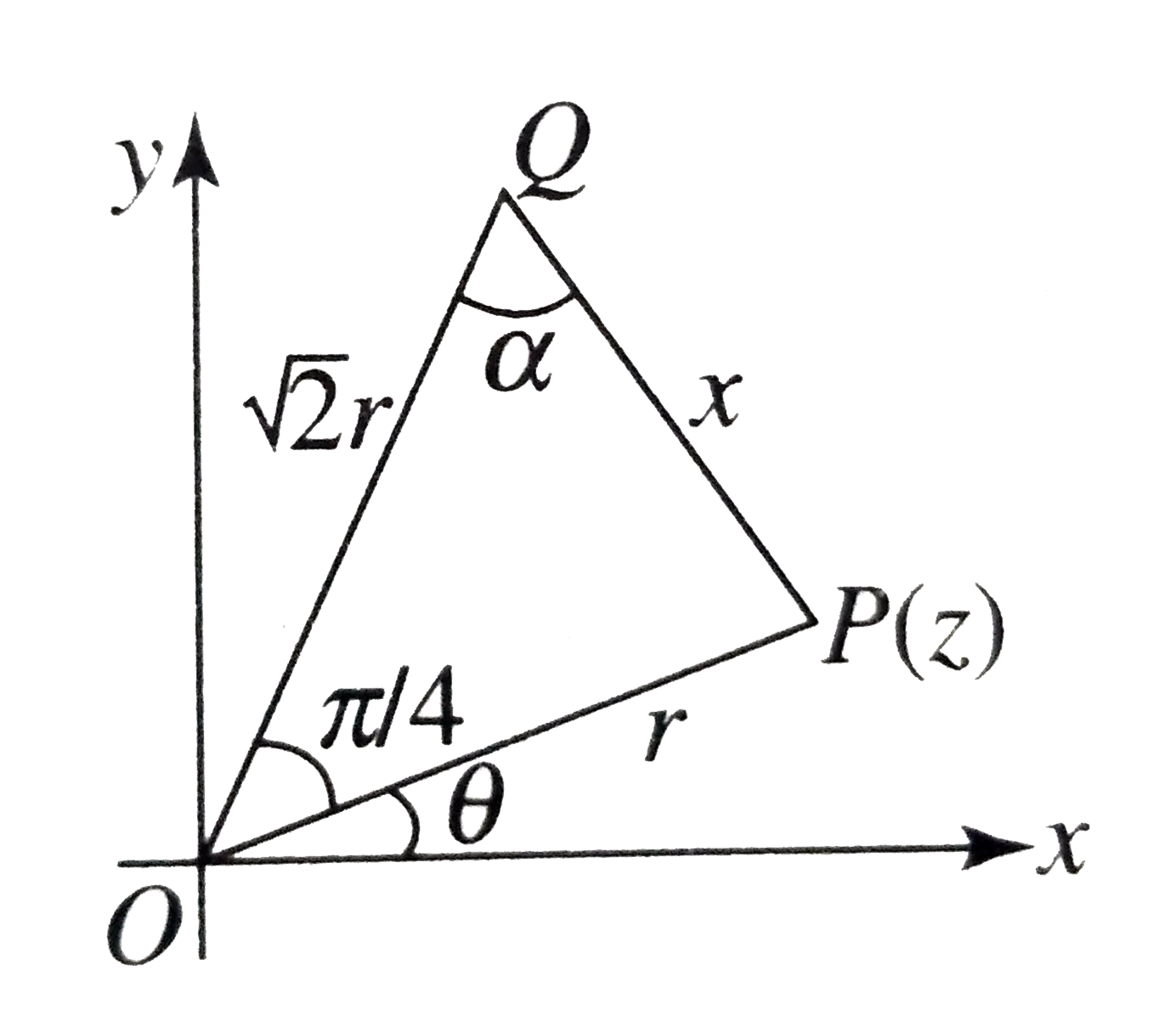
Let `P` denotes a complex number `z=r(costheta+isintheta)` on the Argand's plane, and `Q` denotes a complex number `sqrt(2|z|^(2))(cos(theta+(pi)/(4))+isin(theta+(pi)/(4)))`. If `'O'` is the origin, then `DeltaOPQ` is

A

isosceles but not right angled

B

right angled but not isosceles

C

right isosceles

D

equilateral

Text Solution

Verified by Experts

The correct Answer is:
C

`(c )`
`Z_(P)=r(costheta+isintheta)`
`Z_(0)=sqrt(2|z|^(2))(cos(theta+(pi)/(4))+isin(theta+(pi)/(4)))`
`=sqrt(2)r[cos(theta+(pi)/(4))+isin(theta+(pi)/(4))]`
From the figure,
`cos"(pi)/(4)=(2r^(2)+r^(2)-x^(2))/(2*sqrt(2r)*r)=(3r^(2)-x^(2))/(2sqrt(2)r^(2))`
`:.1=(3r^(2)-x^(2))/(2r^(2))`
`impliesr^(2)=x^(2)impliesx=rimplies` Triangle is right isosceles.
Promotional Banner

Topper's Solved these Questions

  • COMPLEX NUMBERS

    CENGAGE PUBLICATION|Exercise Multiple Correct Answer|11 Videos
  • COMPLEX NUMBERS

    CENGAGE PUBLICATION|Exercise Matching Column|1 Videos
  • CIRCLES

    CENGAGE PUBLICATION|Exercise Comprehension Type|8 Videos
  • CONIC SECTIONS

    CENGAGE PUBLICATION|Exercise All Questions|102 Videos

Similar Questions

Explore conceptually related problems

Find the modulus of the complex number z=cos theta+i sin theta

If z=3/(2+costheta+isintheta) then show that z lies on a circle in the complex plane

Let z be a complex number satisfying |z+16|=4|z+1| . Then

If z is a complex number such taht z^2=( barz)^2, then find the location of z on the Argand plane.

Convert the complex number z=(1-i)/(cos pi/3 + I sin pi/3) in the polar form.

Consider the complex number z=(1-isin theta)/(1+icos theta) The value of theta for nuber z is purely real is

Convert the complex number z=(i-1)/(cos(pi/3)+isin(pi/3)) in the polar form.

Consider the complex number z=(1-isin theta)/(1+isin theta) The value of theta for which z is purely imagianry is

If x/(costheta)=y/(cos(theta-(2pi)/3))=z/(cos(theta+(2pi)/3)) then x+y+z is

Consider the complex number z=(1-isin theta)/(1+icos theta) If argument of z is (pi)/(4) , then

