Home
Class 8
BIOLOGY
Study the given figures and select the c...

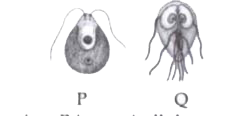
Study the given figures and select the correct statements regarding these.

(i) Organism P is a unicellular green alga.
(ii) Organism Q is a parasitic protozoan.
(iii) Organism Q causes diseases in human beings.
(iv) Both the organisms P and Q cannot synthesise their own food.

A

(i) and (ii) only

B

(ii), (iii) and (iv) only

C

(i), (ii) and (iii) only

D

(i), (ii), (iii) and (iv)

Text Solution

Verified by Experts

The correct Answer is:

C

P is Chlamydomonas, a unicellular green alga that synthesise its own food. Q is Giardia, a parasitic protozoan, that causes disease giardiasis in human beings.
Promotional Banner

Topper's Solved these Questions

  • MICROORGANISMS : FRIEND AND FOE

    MTG IIT JEE FOUNDATION|Exercise Exercise (Subjective Questions) (Long Answer Type)|5 Videos
  • FOOTSTEPS TOWARDS NEET

    MTG IIT JEE FOUNDATION|Exercise MCQs|90 Videos
  • REACHING THE AGE OF ADOLESCENCE

    MTG IIT JEE FOUNDATION|Exercise Olympiad/ HOTS Corner|12 Videos

Similar Questions

Explore conceptually related problems

Study the given flow chart and select the incorrect statement regarding P, Q, R and S.

Refer to the given Venn diagram and select correct statement regarding P and Q.

Refer to the given Venn diagram and select the correct statement regarding P, Q and R.

Identify the given organisms (P-T) and select the incorrect statement regarding them. (i) Organisms P, Q and T show tissue level of body organisation. (ii) Organisms P, S and T are triploblastic animals. (iii) Organisms R, S and T are eucoelomates. (iv) Organisms P, R, S and T' possess notochord at some stage of their life.

The given figures show two types of epithelial tissue (P and Q). Select the correct option regarding these figures.

Refer to the given dichotomous key. Identi fy P -T and select the incorrect statement. I. (a) It is unicellular organism. - Go to II (b) It is multicellular organism. Go to IV II. (a) It possesses well organised nucleus. Go to III (b) It lacks well organised nucleus. -P III. (a) Nutrition is parasitic. -Q (b) Nutrition is mixotrophic. -R IV. (a) It possesses chlorophyll. - S (b) It lacks chlorophyll. -T

Refer to the given dichotomous key and select the incorrect option regarding organisms P, Q, R and S. I. (a) Animals with cellular level of body organisation. - __P__ (b) Animals with tissue/organ/ organ system level of body organisation. - Go to II II. (a)Animals possessing bilateral symmetry. - Go to III (a) (b)Animals possessing radial symmetry.- Go to III (b) III. (a) True coelom is present. - Go to IV (a) True coelom is absent. - Go to IV (b) IV. (a) Notochord is present. __Q__ (b) Notochord is absent. - Go to V V. (a) It is represented by medusa form. ____R___ (b) It is represented by polyp form. - ___S___

Refer to the given diagrammatic represention of parts of two different types of tissues , P and Q. Read the following statements regarding these tissues and select the correct statements . (i)P is a plant whereas Q is an animal tissue. (ii)P is the major water conducting tissue in vascular plants and provides mechanical strength to plant body. (iii)Q is a specialised tissue in animals for receiving stimuli and transmitting messages . (iv) P is composed of all dead cells whereas Q is composed of all living cells.

There are four tiny organisms A, B, C and D. The organism A is a parasitic protozoan which causes a disease known as kala-azar. The organism B is a microscopic single-celled animal which causes malaria disease in human beings. The organism C is a unicellular animal which can change its body shape according to need, it has no fixed shape. The organism D is also a unicellular animal which is slippershaped having a large number of tiny hair all around its body. Name the organisms A, B, C and D
