Home
Class 10
PHYSICS
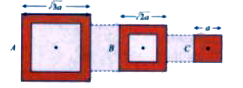
Following figure shows cross-sections th...

Following figure shows cross-sections through three long conductors of the same length and material, with square cross-section of edge lengths as shown. Conductor B will fit snugly within conductor A, and conductor C will fit snugly within conductor B. Relationship between their end to end resistance is

A

`R_A=R_B=R_C`

B

`R_AgtR_bgt R_C`

C

`R_AltR_BltR`

D

Information is not sufficient

Text Solution

Verified by Experts

All the conductors have equal lengths. Area of cross-section of A is `{(sqrt3a)^2-(sqrt2a)^2}=a^2`
Similarly area of cross-section of B = Area of crosssection of `C=a^2`
Hence according to formula `R=p1/A,` resistances of all the conductors are equal i.e., `R_A=R_B=R_C`
Promotional Banner

Topper's Solved these Questions

  • CURRENT ELECTRICITY

    CENGAGE PHYSICS|Exercise CHALLENGING EXERCISE|2 Videos
  • ATOMIC AND NUCLEAR PHYSICS

    CENGAGE PHYSICS|Exercise OLYMPIAD AND NTSE LEVEL EXERCISES |8 Videos
  • ELECTROMAGNETIC INDUCTION

    CENGAGE PHYSICS|Exercise OLYMPIAD AND NTSE LEVEL EXERCISES|10 Videos

Similar Questions

Explore conceptually related problems

Following figure shows cross-section through three long conductors of the same length and material, with square cross-section of edge lengths as shown. Conductor B will snugly within conductor B . Relationship between their end to end resistance is

How is electrical conductance of a conductor related with length and area of cross section of the conductor ?

The length and area of cross-section of a conductor are doubled, its resistance is

A conductor of length l and area of cross-section A has a resistance R then its specific resistance is

A conductor of length l and area of cross-section A has n number of electrons per unit volume of the conductor. The current flowing through conductor in time t is given by

When the area of cross-section of a conductor is doubled, its resistance becomes:

A conductor of length of l and area of cross section A has n number of electrons per unit volume of the conductor. The total charge carried by the conductor is

How does the resistance of a conductor depend on: (a) length of the conductor? (b) area of cross-section of the conductor? (c) temperature of the conductor?

