Home
Class 10
PHYSICS
l-V characteristic of a copper wire of l...

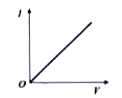
l-V characteristic of a copper wire of length Land area of cross-section A is shown in figure. The slope of the curve becomes

A

More if the experiment is performed at higher temperature

B

More if a wire of steel of same dimension is used

C

More if the length of the wire is increased

D

Less if the length of the wire is increased

Text Solution

Verified by Experts

Slope of V-i curve = `R =((pI))/A` But in given curve axis of i and V are interchanged. So slope of given curve `=1/R (=A/(pI)` i.e.,. with the increase in length of the wire. Slope of the curve will decrease.
Promotional Banner

Topper's Solved these Questions

  • CURRENT ELECTRICITY

    CENGAGE PHYSICS|Exercise CHALLENGING EXERCISE|2 Videos
  • ATOMIC AND NUCLEAR PHYSICS

    CENGAGE PHYSICS|Exercise OLYMPIAD AND NTSE LEVEL EXERCISES |8 Videos
  • ELECTROMAGNETIC INDUCTION

    CENGAGE PHYSICS|Exercise OLYMPIAD AND NTSE LEVEL EXERCISES|10 Videos

Similar Questions

Explore conceptually related problems

I-V characterstic of a copper wire of length L and area fo cross-section A is shown in Fig. The slope of the curve becomes

An aluminium rod of length L and cross-sectional area 2A is joined with a copper rod of length 2L and area of cross-section is A as shown in figure. Find the temperature of aluminium-copper junction in the steady state of the system. Given thermal conductivity K_(Al)=240J//m//s//.^(@)C, K_(Cu)=400J//m//s//.^(@)C

The V – I graph for a wire of copper of length L and cross -section area A is shown in the figure below . The slope of the graph will be

The current -voltage - variation for a wire of copper of length (L) and area (A) is shown in fig. The slope of the line will be

If the area of cross-section of a resistance wire is halved, then its resistance becomes:

When length of a metal wire is doubled and area of cross-section is reduced to half, then its resistance becomes

The resistance of wire of length l and area of cross-section a is x ohm. If the wire is stretched to double its length, its resistance would become:

A metal wire of length L, area of cross-section A and Young's modulus Y behaves as a spring of spring constant k.

Resistance of a conductor of length l and area of cross-section A is R. If its length is doubled and area of cross-section is halved, then find its new resistance.

