Home
Class 12
MATHS
Solve the equation x^(3)-[x]=3, where [x...

Solve the equation `x^(3)-[x]=3`, where `[x]` denotes the greatest integer less than or equal to `x`.

Text Solution

Verified by Experts
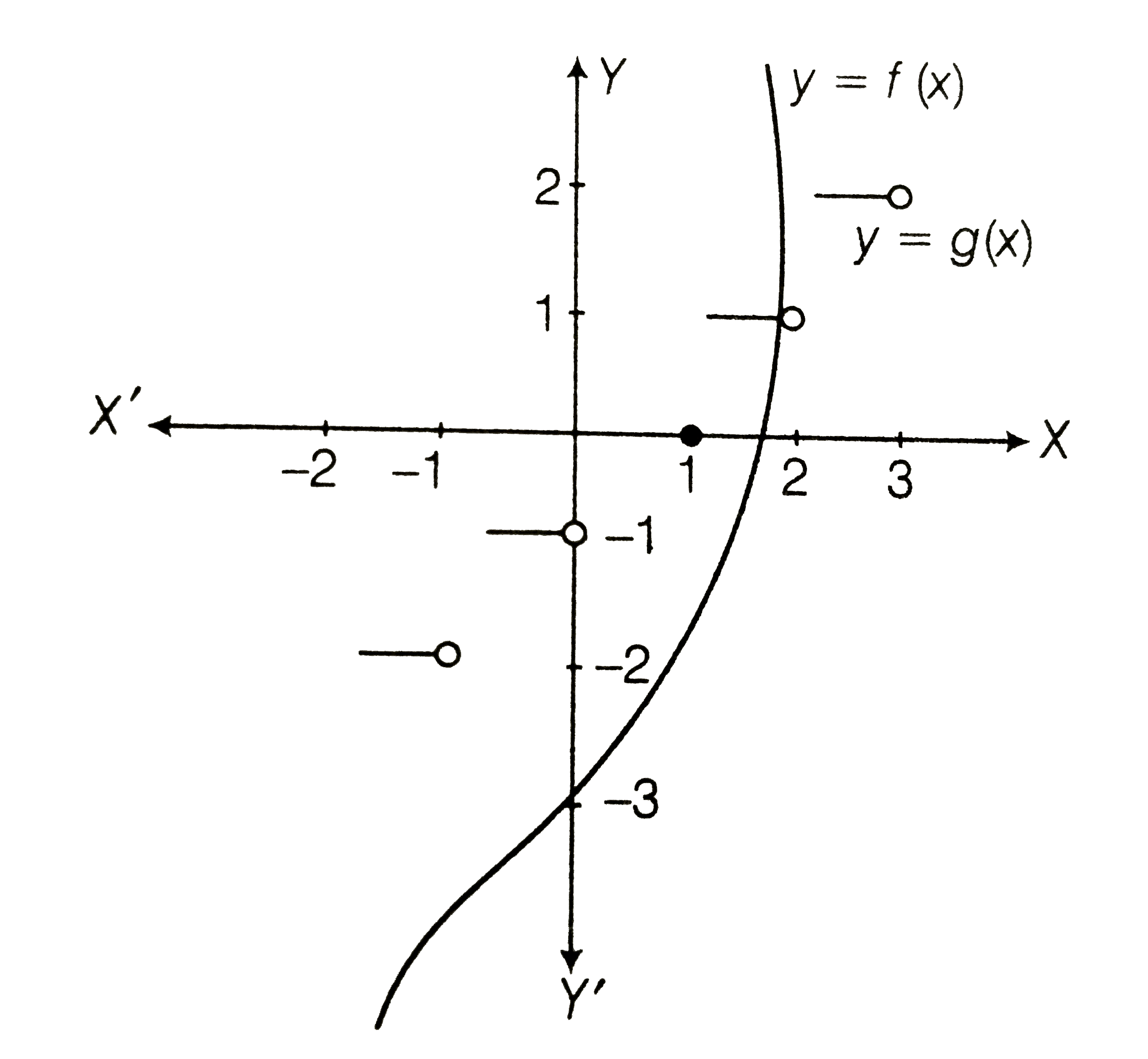
We have `x^(3)-[x]=3`
`impliesx^(3)-3=[x]`
Let `f(x)=x^(3)-3` and `g(x)=[x]`
It is clear from the graphs, the point of intersection of two curves `y=f(x)` and `y-g(x)` lies between (1,0) and (2,0).

`:.1ltxlt2`
We have `f(x)=x^(3)-3` and `g(x)=1`
or `x^(3)-3=1impliesx^(3)=4`
`:.x=(4)^(1//3)`
Hence `x=4^(1//3)` is the solution of the equation `x^(3)-[x]=3`
Aliter
`:'x=[x]+f,0leflt1`
Then given equation reduces to
`x^(3)-(x-f)=3impliesx^(3)-x=3-f`
Hence it follows that
`2ltx^(3)-xle3`
`implies2ltx(x+1)(x-1)le3`
Further for `xge2`, we have `x(x+1)(x-1)ge6lt3`
For `xlt-1`, we have `x(x+1)(x-1)lt0lt2`
For `x=-1`, we have `x(x+1)(x-1)=0lt2`
For `-1ltxle0`, we have `x(x+1)(x-1)le-xlt1`
adn for `0ltxle1`, we have `x(x+1)(x-1)ltxltx^(3)le1`
Therefore `x` must be `1ltxlt2`
`:.[x]=1`
Now the original equation can be written as
`x^(3)-1=3impliesx^(3)=4`
Hence `x=4^(1//3)` is the solution of the given equation.
Promotional Banner

Topper's Solved these Questions

  • THEORY OF EQUATIONS

    ARIHANT MATHS|Exercise Exercise For Session 1|11 Videos
  • THEORY OF EQUATIONS

    ARIHANT MATHS|Exercise Exercise For Session 2|10 Videos
  • THE STRAIGHT LINES

    ARIHANT MATHS|Exercise The Straight Lines Exercise 8 : (Questions Asked in Previous 13 years Exams)|1 Videos
  • THREE DIMENSIONAL COORDINATE SYSTEM

    ARIHANT MATHS|Exercise Three Dimensional Coordinate System Exercise 12 : Question Asked in Previous Years Exam|2 Videos

Similar Questions

Explore conceptually related problems

Solve the equation [x]=x, where [] denote the greatest integer function.

Find all the points of discontinuity of the greatest integer function defined by f(x) = [x] where [x] denotes the greatest integer less than or equal to x.

If f(x)=x-[x], where [x] is the greatest integer less than or equal to x, then f(+1/2) is:

If f(x)=e^([cotx]) , where [y] represents the greatest integer less than or equal to y then

Prove that greatest integer function f: RrarrR , given by f (x) = [x] , is neither one-one nor onto where [x] denotes the greatest integer less than or equal to x .

The equation x^2 - 2 = [sin x], where [.] denotes the greatest integer function, has

Find the area in the 1^(st ) quadrant bounded by [x]+[y]=n , where n in N and y=k (where k in n AA k<=n+1 ), where [.] denotes the greatest integer less than or equal to x.

If f(x) = {{:((sin[x])/([x]),[x] != 0),(0,[x] = 0):} , where [x] denotes the greatest integer less than or equal to x, then lim_(x to 0) equals

Show that the function defined by g(x) = x-[x] is discontinuous at all integral points. Here [x] denotes the greatest integer less than or equal to x.

f(x)= 1/sqrt([x]-x) , where [*] denotes the greatest integeral function less than or equals to x. Then, find the domain of f(x).

ARIHANT MATHS-THEORY OF EQUATIONS-Exercise (Questions Asked In Previous 13 Years Exam)
  1. Solve the equation x^(3)-[x]=3, where [x] denotes the greatest integer...

    Text Solution

    |

  2. In the quadratic equation ax^2 + bx + c = 0. if delta = b^2-4ac and al...

    Text Solution

    |

  3. Let S denote the set of all polynomials P(x) of degree lt=2 such th...

    Text Solution

    |

  4. If the roots of x^2-b x+c=0 are two consecutive integers, then b^2-4c ...

    Text Solution

    |

  5. If the equation a(n)x^(n)+a(n-1)x^(n-1)+..+a(1)x=0, a(1)!=0, n ge2, ha...

    Text Solution

    |

  6. If both the roots of the quadratic equation x^(2)-2kx+k^(2)+k-5=0 are ...

    Text Solution

    |

  7. Let a and b be the roots of the equation x^2-10 c x-11 d=0 and those ...

    Text Solution

    |

  8. Let a,b,c be the sides of a triangle. No two of them are equal and lam...

    Text Solution

    |

  9. All the value of m for which both the roots of the equation x 2 −2mx...

    Text Solution

    |

  10. If the roots of the quadratic equation x^2+p x+q=0 are tan30^0a n dtan...

    Text Solution

    |

  11. Let alpha,beta be the roots of the equation x^2-p x+r=0a n dalpha//2,2...

    Text Solution

    |

  12. If the difference between the roots of the equation x^2+a x+1=0 is les...

    Text Solution

    |

  13. Let a ,b , c ,p ,q be real numbers. Suppose alpha,beta are the roots o...

    Text Solution

    |

  14. The quadratic equations x^2""-6x""+""a""=""0""a n d ""x^2""-c x""+""...

    Text Solution

    |

  15. How many real solutions does the equation x^7+14 x^5+16 x^3+30 x-560=0...

    Text Solution

    |

  16. Suppose the cubic x^(3)-px+q has three distinct real roots, where pgt0...

    Text Solution

    |

  17. Find the discriminant of the quadratic equation 2x^2-4x+3=0, and hence...

    Text Solution

    |

  18. If the roots of the equation b x^2+""c x""+""a""=""0 be imaginary, t...

    Text Solution

    |

  19. Let p and q real number such that p!= 0,p^3!=q and p^3!=-q. if alpha a...

    Text Solution

    |

  20. solve 0=-1+2x+3x^2

    Text Solution

    |

  21. Find the roots of x^2-6x-2=0

    Text Solution

    |

