Home
Class 12
PHYSICS
Explain the construction , principle and...

Explain the construction , principle and working of a D.C. motor. Find the expression for its efficiency.

Text Solution

Verified by Experts
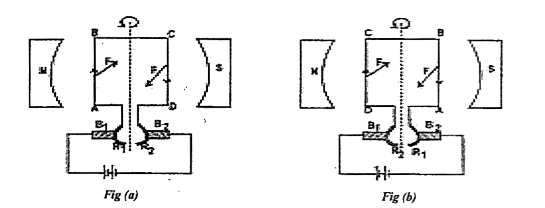
A.D. Motor : It is an electrical device which is used to convert electrical energy in to mechanical energy.
Principle : It is based on the fact that when a current carrying coil is placed in a mgnetic field then it experiences a torque. This torque rotates the coil.
Construction : It consists of following main parts:
1. a Armature coll : The armature coil (ABCD) consists of a large number of turns of insulated copper wire wound on a soft iron core.
2. Field magnets : The field magnet NS is an electromagnet or a permanent magnet in the field of which the armature rotates.
3. Split ring or commutator : It consists of two halves of a single ring. The two ends of the armature coll are connected to these rings `R_(1)` and `R_(2)`.
4. Brushes : Brushes `B_(1)` and `B_(2)` with carbon tips press against the split rings `R_(1)` and `R_(2)`.
5. Battery : A battery of certain emf is connected across the brushes. It supplies the required current to the coil.
Working : When the battery sends current through the armature coil in the direction ABCD [Fig.(a)], AB experiences a force directed downwards and perpendicular to the plane of coil and CD experiences an equal force directed upward and perpendicular to the plane of the coil (applying Fleming.s left hand rule). These two forces being equal, unlike and parallel constitute a couple nad set the armature rotating in the anticlockwise direction with AB moving downward and CD upward. After the coil has rotated through `180^(@)`, the direction of the current in AB and CD is reversed. Now, AB experiences a force directed upward and CD experiences a force directed downward. The armature coil then continues to rotate in the same, i.e., anticlockwise direction as shown in Fig. (b). The speed of the motor depends on the strength of the magnetic field, the current and on the number of turns in the armature.
Efficiency of D.C. motor : It is defined as the ration of output mechanical power to input mechanical power.
Let V= Voltage applied across `B_(1)` and `B_(2)`
I = Current flowing through the armature coil
R = Resistance fo armature coil
When the armature coil rotates, an induced emf (E) is set up across it.
Effective emf across `B_(1)` and `B_(2)` = V-E
This effective emf sends the current I through the armature coil of resistance R.
` I = (V-E)/(R)`
IR = V - E
E = V - IR
Output mechanical power = Input mechanical power - Power wasted in heating the armature
`P_(o) = VI - I^(2) R`
= (V - IR) I
`P_(o) = El`
Efficiency of transformer ` = (P_o)/(P_i) = (El)/(VI)`
`eta = (E)/(V)`
Promotional Banner

Topper's Solved these Questions

  • ELECTRICAL DEVICES

    BETTER CHOICE PUBLICATION|Exercise NUMERICAL PROBLEMS|3 Videos
  • ELECTRICAL DEVICES

    BETTER CHOICE PUBLICATION|Exercise (MOST EXPECTED QUESTIONS 1 MARKS)|7 Videos
  • ELECTRICAL DEVICES

    BETTER CHOICE PUBLICATION|Exercise SHORT ANSWERS TYPE QUESTIONS (3/4 MARKS)|5 Videos
  • ELECTRIC FIELD

    BETTER CHOICE PUBLICATION|Exercise NUMERICAL PROBLEMS (MOST EXPECTED QUESTIONS)|4 Videos
  • ELECTRICAL MEASUREMENTS

    BETTER CHOICE PUBLICATION|Exercise Most Expected Questions|7 Videos

Similar Questions

Explore conceptually related problems

Explain the construction and working of a Galvanic cell.

Explain the construction and working of an astronomical telescope. find an expression for its magnifying power in normal adjustment.

Explain the principle, construction and working of a Nuclear reactor.

Explain principal,construction and working of D.C.generator.

Give the principle, construction and working of an a.c. generator.

Explain with the help of labelled diagram, the construction, working and theory of ac generator. Obtain an expression for induced e.m.f.

With the help of ray diagram describe construction and working of refracting type Astronomical telescope. Find an expression for its magnifying power when final image is formed at infinity.

