Home
Class 12
CHEMISTRY
Give the construction and working of Zn/...

Give the construction and working of Zn/`CuSO_(4)` or Daniel cell.

Text Solution

Verified by Experts
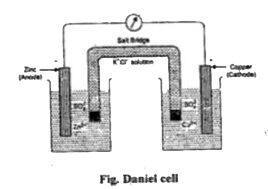
`Zn//CuSO_(4)` or Daniel cell : This cell is based upon following spontaneous redox reaction.
`Zn(s)+Cu^(2+)(aq) to Zn^(2+)(aq)+Cu(s)`

The arrangement consists of two beaker, one of which contains a solution of zinc sulphate (say 1.0 M) and the other contains a solution of copper sulphate (say 1.0 M). A zinc rod is dipped in `ZnSO_(4)` solution while a copper rod id dipped into `CuSO_(4)` solution. these metallic rods are known as electrodes.
The two solutions are connected by means of salt bridge. A salt bridge is an inverted U-tube containing an aqueous solution of some `i` nert0 electrolyte, such as `KCl,KNO_(3) or K_(2)SO_(4)` to which some agar-agar or gelatin has been added to convert it into semi-solid paste. the ends of the U-tube are plugged with glass wool. when the two metallic rods are connected toa galvanometer by means of wire through a key, the reaction takes place on closing the key and the following observations are made:
(i) There is adeflection in the galvanometer which indicates the flow of electrons through connecting wires.
(ii) The direction of diflection indicates the flow of electrons is from zinc to copper.
(iii) The zinc rod loses mass, whereas copper road gains mass.
(iv) The concentration of `Zn^(2+)` ions in zinc sulphate solution increases while that of `Cu^(2+)` ions in copper sulphate solution decreases.
(v) The solutions in the two beakers remain electrically neutral
(vi) The reaction as well as flow of electrons stops after sometimes.
(vii) There is no evolution of heat during the process.
(viii) The masses of zinc dissolved and copper precipitate are in the ratio of their equivalent masses.
`("Mass of zn dissolved")/("Mass of Cu deposited")=("Eq. mass of Zn")/("Eq. mass of Cu")`
Let us now consider the above mentioned observations in terms of of the cell. as zinc atoms undergo oxidation and get oxidised into `Zn^(2+)` ions by loss of electrons the mass of the zinc rod decrease.
`Zn(s)toZn^(2+)(aq)+2e^(-)` (Oxidation)
The electrons so produced are pushed through the connecting wires to the copper electrode, there these are taken by the `Cu^(2+)` ions which get reduced to copper.
`Cu^(2+)(aq)+2e^(-) to Cu(s)` (Reduction)
The copper atoms so formed get deposited on the copper electrode. thus mass of the copper rod increases.
The overall reaction taking place int he cell is as follows:
`Zn(s)+Cu^(2+)(aq)toZn^(2+)(aq)+Cu(s)`
The electrode at which oxidation takes place is called anode and the electrode at which reduction takes place is called cathode. in the above metioned cell, oxidation occurs at zinc electrode, therefore, zinc is anode, and reduction occurs at copper electrode, therefore copper is cathode. it may be noted that in an electrochemical cell anode constitutes negative termmeans and cathode constitutes positive terminal. by convention, the direction of flow of current is from positive terminal to negative terminal, which is opposite to the direction of flow of electrons.
Promotional Banner

Topper's Solved these Questions

  • ELECTROCHEMISTRY

    BETTER CHOICE PUBLICATION|Exercise NERNST EQUATION|4 Videos
  • ELECTROCHEMISTRY

    BETTER CHOICE PUBLICATION|Exercise CONDUCTANCE OF ELECTROLYTIC SOLUTIONS|21 Videos
  • ELECTROCHEMISTRY

    BETTER CHOICE PUBLICATION|Exercise Numerical Problems|69 Videos
  • CO-ORDINATION COMPOUNDS

    BETTER CHOICE PUBLICATION|Exercise QUESTION FROM PREVIOUS BOARD EXAMINATION|59 Videos
  • GENERAL PRINCIPLES AND PROCESS OF ISOLATION OF ELEMENTS

    BETTER CHOICE PUBLICATION|Exercise Question Bank (6.6 OXIDATION-REDUCTION)|15 Videos

Similar Questions

Explore conceptually related problems

Explain the construction and working of a Galvanic cell.

Give the principle, construction and working of an a.c. generator.

With the help of labelled diagram, describe the principle,construction and working of a transformer.

Discuss the construction and working of a lighting conductor.

Explain with the help of a labelled diagram, the principle, construction and working of a moving coil galvanometer.

