Home
Class 12
CHEMISTRY
Predict the shape of hexafluoroferrate(I...

Predict the shape of hexafluoroferrate(III) on the basis of valence bond theory.

Text Solution

Verified by Experts
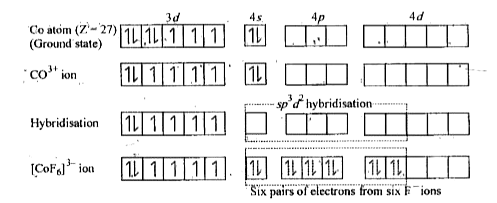
Outer electronic configuration of Co (Z = 27) in ground state is `4s^2 3d^7`. Cobalt hi this complex is in +3 oxidation state. This is achieved by the loss of two 4s and one 3d electron. The resulting `Co^(3+)` ion has `3d^6` outer electronic configuration. It has been experimentally observed that this complex is highly paramagnetic thus suggesting the presence of a number of unpaired electrons. To account for these observed facts, it is proposed that in this complex the six equivalent hybrid orbitals are obtained by the `sp^3 d^2` hybridisation of one 4s, three 4p and two 4d vacant atomic orbitals. Six pairs of electrons, one from each fluoride ion, occupy the six vacant hybrid orbitals so formed, The resulting complex ion has an octahedral geometry and is strongly paramagnetic due to the presence of four unpaired electrons. The hybridisation and the formation of the complex is illustrated below.

The formation of this complex involves dorbitals of the outer shell and hence is called outer orbital or high spin or hypoligated complex.
Promotional Banner

Topper's Solved these Questions

  • CO-ORDINATION COMPOUNDS

    BETTER CHOICE PUBLICATION|Exercise QUESTION FROM PREVIOUS BOARD EXAMINATION|59 Videos
  • CHEMISTRY IN EVERYDAY LIFE

    BETTER CHOICE PUBLICATION|Exercise QUESTIONS|76 Videos
  • ELECTROCHEMISTRY

    BETTER CHOICE PUBLICATION|Exercise Numerical Problems|69 Videos

Similar Questions

Explore conceptually related problems

Explain the formation of H2 molecule on the basis of valence bond theory.

Discuss the nature of bonding in the following coordination entity on the basis of valence bond theory : [FeF_6]^(3-)

Discuss the nature of bonding in the following coordination entities on the basis of valence bond theory: [Fe(CN)_6]^(4-)

Discuss the nature of bonding in the following coordination entities on the basis of valence bond theory: [CoF_6]^(3-)

Discuss the nature of bonding in the following coordination entities on the basis of valence bond theory: [FeF_6]^(3-)

Discuss the nature of bonding in the following coordination entities on the basis of valence bond theory: [Co(C_2O_4)_3]^(3-)

Discuss the main postulates of valence bond theory.

BETTER CHOICE PUBLICATION-CO-ORDINATION COMPOUNDS-QUESTION FROM PREVIOUS BOARD EXAMINATION
  1. Predict the shape of hexafluoroferrate(III) on the basis of valence bo...

    Text Solution

    |

  2. Write the IUPAC name of corordination compound [Co(NH3)3ONO]Cl2.

    Text Solution

    |

  3. How many isomers are possible for the netural complex [Co(NH3)3Cl3]? D...

    Text Solution

    |

  4. Discuss the nature of bonding in the following coordination entities o...

    Text Solution

    |

  5. Write the IUPAC name for the corordination compound. [Zn(NH3)4]2+

    Text Solution

    |

  6. Explain: [Ni (CN)4]^(2-) is diamagnetic while [Ni(Cl)4]^(2-) is parama...

    Text Solution

    |

  7. Write IUPAC name of the following K2[Zn(OH)4]

    Text Solution

    |

  8. Write IUPAC name of the following K3[Al(C2O4)]3

    Text Solution

    |

  9. Write IUPAC name of the following K2[Cu(CN4)]

    Text Solution

    |

  10. Write IUPAC name of the following [Co(NH3)3Cl]Cl2

    Text Solution

    |

  11. Write IUPAC name of the following [Co(en)2Br2Cl

    Text Solution

    |

  12. Write IUPAC name of the following [Co(NH3)5Br]Cl2

    Text Solution

    |

  13. Write IUPAC name of the following K3[Fe(C2O4)3]

    Text Solution

    |

  14. Write IUPAC name of the following Na[Au(CN)2]

    Text Solution

    |

  15. Write IUPAC name of the following K2[Fe(CN)6]

    Text Solution

    |

  16. Write IUPAC name of the following K2[Fe(CN)6]

    Text Solution

    |

  17. Write the IUPAC name of the following : K3[Fe (CN)5 NO]

    Text Solution

    |

  18. Write IUPAC name of the following K3[Cr(C2O4)3]

    Text Solution

    |

  19. Write IUPAC name of the following K3[Cr(C2O4)3]

    Text Solution

    |

  20. Write IUPAC name of the following K[PtCl3(NH3)]

    Text Solution

    |

  21. Write IUPAC name of the following K2[Fe(CN)6]

    Text Solution

    |

