Home
Class 12
CHEMISTRY
Using valence bond theory predict the ge...

Using valence bond theory predict the geometry and magnetic behaviour of `[Pt(CN)_4]^(2-)`.

Text Solution

Verified by Experts
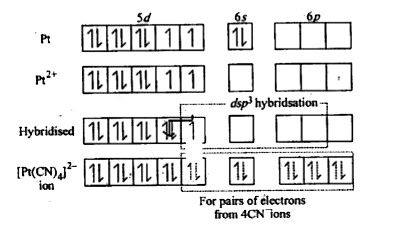
`""_(78)Pt` lies in Group 10 with the ground state outer electronic configuration `5 d^9 6 s^(1)`. Hence `Pt^(2+)` has the configuration `d^8`. X-ray studies have shown that the complex has a square planar shape. For square planar shape, the hybridisation is `dsp^2`. Hence, the unpaired electrons in 5 d pair up to make one d-orbital empty for `dsp^2`-hybridization. It is also supported by the fact that `CN^(-)` a strong ligand can pair up the unpaired delectrons. Thus, there is no unpaired electron and the complex is diamagnetic.

Geometry : Square planar , Hybridisation : `dsp^2`, Magnetic Character : Diamagnetic. It is inner orbital or low spin complex.
Promotional Banner

Topper's Solved these Questions

  • CO-ORDINATION COMPOUNDS

    BETTER CHOICE PUBLICATION|Exercise QUESTION FROM PREVIOUS BOARD EXAMINATION|59 Videos
  • CHEMISTRY IN EVERYDAY LIFE

    BETTER CHOICE PUBLICATION|Exercise QUESTIONS|76 Videos
  • ELECTROCHEMISTRY

    BETTER CHOICE PUBLICATION|Exercise Numerical Problems|69 Videos

Similar Questions

Explore conceptually related problems

By using valence bond theory discuss the geometry aud magnetic nature of [Cr(NH_3)_6]^(3+) ion.

Using valence bond theory explain the geometry and magnetic behaviour of pentacarbonyl iron (0).

Based on VBT, explain geometry and magnetic behavior of [Fe(CN)_6]^(-4) ion.

Using valence bond theory of complexes, explain the geometry and diamagnetic nature of the ion [Cr(NH_3)_6]^(3+) . Given the atomic number of Cr=24 .

Using valence bond theory of complexes, explain the geometry and diamagnetic nature of the ion [Cr(NH_3)_6]^(3+) . Given the atomic number of Cr=24 .

Using valence bond theory of complexes, explain the geometry and diamagnetic nature of the ion [Cr(NH_3)_6]^(3+) . Given the atomic number of Cr = 241.

Onthe basis of valence bond theory explain the structure and magnetic nature of [Fe(CN)_6]^(3_) complex ion.

On the basis of valence bond theory explain the structure and magnetic nature of [Fe(H_2O)_6]^(3+) complex ion.

On the basis of valence bond theory explain the shape and magnetic character of K_4[Fe(CN)_6] or Fe(CN)_6]^(4-) ion.

Using valence bond theory, write the type of hybridisation involved, geometry and magnetic behaviour of [CoF_6]^(3-) and Co(NH_3)_6]^(3+) complexes.

BETTER CHOICE PUBLICATION-CO-ORDINATION COMPOUNDS-QUESTION FROM PREVIOUS BOARD EXAMINATION
  1. Using valence bond theory predict the geometry and magnetic behaviour ...

    Text Solution

    |

  2. Write the IUPAC name of corordination compound [Co(NH3)3ONO]Cl2.

    Text Solution

    |

  3. How many isomers are possible for the netural complex [Co(NH3)3Cl3]? D...

    Text Solution

    |

  4. Discuss the nature of bonding in the following coordination entities o...

    Text Solution

    |

  5. Write the IUPAC name for the corordination compound. [Zn(NH3)4]2+

    Text Solution

    |

  6. Explain: [Ni (CN)4]^(2-) is diamagnetic while [Ni(Cl)4]^(2-) is parama...

    Text Solution

    |

  7. Write IUPAC name of the following K2[Zn(OH)4]

    Text Solution

    |

  8. Write IUPAC name of the following K3[Al(C2O4)]3

    Text Solution

    |

  9. Write IUPAC name of the following K2[Cu(CN4)]

    Text Solution

    |

  10. Write IUPAC name of the following [Co(NH3)3Cl]Cl2

    Text Solution

    |

  11. Write IUPAC name of the following [Co(en)2Br2Cl

    Text Solution

    |

  12. Write IUPAC name of the following [Co(NH3)5Br]Cl2

    Text Solution

    |

  13. Write IUPAC name of the following K3[Fe(C2O4)3]

    Text Solution

    |

  14. Write IUPAC name of the following Na[Au(CN)2]

    Text Solution

    |

  15. Write IUPAC name of the following K2[Fe(CN)6]

    Text Solution

    |

  16. Write IUPAC name of the following K2[Fe(CN)6]

    Text Solution

    |

  17. Write the IUPAC name of the following : K3[Fe (CN)5 NO]

    Text Solution

    |

  18. Write IUPAC name of the following K3[Cr(C2O4)3]

    Text Solution

    |

  19. Write IUPAC name of the following K3[Cr(C2O4)3]

    Text Solution

    |

  20. Write IUPAC name of the following K[PtCl3(NH3)]

    Text Solution

    |

  21. Write IUPAC name of the following K2[Fe(CN)6]

    Text Solution

    |

