Home
Class 12
CHEMISTRY
[Ti (H2O)6]^(3+) is coloured while [Sc(H...

`[Ti (H_2O)_6]^(3+)` is coloured while `[Sc(H_2O)_6]^(3+)` is colourless. Explain.

Text Solution

Verified by Experts
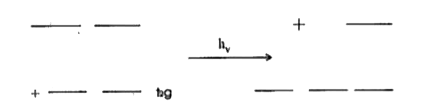
O.S. of Ti in `[Ti(H_2O)_6]^(3+)` is +3, E.C. of Ti(Z = 22) and `Ti^(3+)` are as Ti(z=22): `[Ar]^(18) 3d^2 4s^2`, `Ti^(3+)` : `[Ar]^(18)3d^(1)`
In the presence of six molecules of water which acts as ligand, the five degenerate 3d-orbitals split up into two set of orbitals, one with lower energy `(t_(2g))` and the other with higher energy `(e_g)`.
In the ground state, the single 3d-electrons lower is present in the `t_(2g)` level. The next higher state available for the electrons is `t_(g)` level. If light corresponding to the energy of blue green region is absorbed by the complex, it would excitive electron from `t_(2g)` level to `e_g` level `(t_(2g)^(1) eg^(o) rarr t_(2g)^(o)e_g^(1)`. Hence the complex appear violet in colour (voilet is the complementry colour of blue green).

According to crystal field theory the colour of the complex is due to d-d transition of electron.
In case of `[Sc(H_2O)_6]^(3+)` the `Sc^(3+)` has no electron as in 3d-subshell as explained below.
Sc(Z=21): `[Ar]^(18) 3d^(1) 4s^2, Sc^(3+) : [Ar]^(18) 3d^(0)`
With no eleciron in 3d-subshell, d-d transition of electron is not possible in `[Sc(H_2O)_6]^(3+)` and hence it is colourless.
Promotional Banner

Topper's Solved these Questions

  • CO-ORDINATION COMPOUNDS

    BETTER CHOICE PUBLICATION|Exercise QUESTION FROM PREVIOUS BOARD EXAMINATION|59 Videos
  • CHEMISTRY IN EVERYDAY LIFE

    BETTER CHOICE PUBLICATION|Exercise QUESTIONS|76 Videos
  • ELECTROCHEMISTRY

    BETTER CHOICE PUBLICATION|Exercise Numerical Problems|69 Videos

Similar Questions

Explore conceptually related problems

Explain why [Ti (H_2O)_6]^(3+) is violet while [Ti (H_2O)_6]^(4+) is colourless.

Sc^(3+) ion is colourless while Cr^(3+) Ion is coloured. Explain.

A solution of [Ni(H_2O)_6]^(2+) is green but a solution of [Ni(CN)_4]^(2-) is colourless.Explain.

Explain Co^(2+) is coloured whereas Ti^(4+) is colourless. Why ?

[Sc(H_2O_6)_6]^(3+) and [Ti(H_2O)_6]^(3+) ions are coloured why ?

[Fe(CN)_6 ]^-3 is low spin complex but [Fe(H_2O)6]+3is high spin complex. Explain.

CuSO_4 .5H_2O is blue in colour while CuSO_4 is colourless. Why ?

CuSO_4 .5H_2O is blue in colour while CuSO_4 is colourless. Why ?

BETTER CHOICE PUBLICATION-CO-ORDINATION COMPOUNDS-QUESTION FROM PREVIOUS BOARD EXAMINATION
  1. Discuss structure of [Co(NH3)6]^(3+) ion the basis of V.B.T.

    Text Solution

    |

  2. What is the state of hybridisation and geometry in [Ni(CN)4]^(-2)

    Text Solution

    |

  3. What is the state of hybridisation and geometry in [Ni(CN)4]^(-2)

    Text Solution

    |

  4. Explain [Fe(H2O)6]^(3+) is paramagnetic.

    Text Solution

    |

  5. With the help of crystal field theory, predict the number of unpaired ...

    Text Solution

    |

  6. predict the number of unpaired electrons in [CoF6]^(3-) and [Co(NH3)6]...

    Text Solution

    |

  7. With the help of the crystal field theory predict the number of unpair...

    Text Solution

    |

  8. Account for the different magnetic behaviour of hexacyanoferrate (III)...

    Text Solution

    |

  9. Explain : [Co(CN)6]^(3-) is diamagnetic while [CoF6]^(3-) is paramagne...

    Text Solution

    |

  10. Draw the geometrical isomers of [Co(en)2CI2]^+ ion.Which of these is o...

    Text Solution

    |

  11. Draw the geometrical isomers of [Co(en)2CI2]^+ ion.Which of these is o...

    Text Solution

    |

  12. Discuss the main postulates of valence bond theory.

    Text Solution

    |

  13. Write the name of ionisation isomer of the compound [Co(NH3)5 Br]SO4.

    Text Solution

    |

  14. Draw the geometrical isomers of [Co(en)2CI2]^+ ion.Which of these is o...

    Text Solution

    |

  15. Write the name of ionisation isomer of the compound [CO(NH3)4 Cl2]NO2

    Text Solution

    |

  16. Draw the geometrical isomers of [Pt(NH3)2.CI2]. Which of these is opti...

    Text Solution

    |

  17. Draw the geometrical isomers of [Pt(NH3)2.CI2]. Which of these is opti...

    Text Solution

    |

  18. Explain the difference between a weak field ligand and a strong field ...

    Text Solution

    |

  19. Write the structure and hybridisation of the central atom in [CoCl2 (N...

    Text Solution

    |

  20. [Ti (H2O)6]^(3+) is coloured while [Sc(H2O)6]^(3+) is colourless. Expl...

    Text Solution

    |

