Home
Class 12
PHYSICS
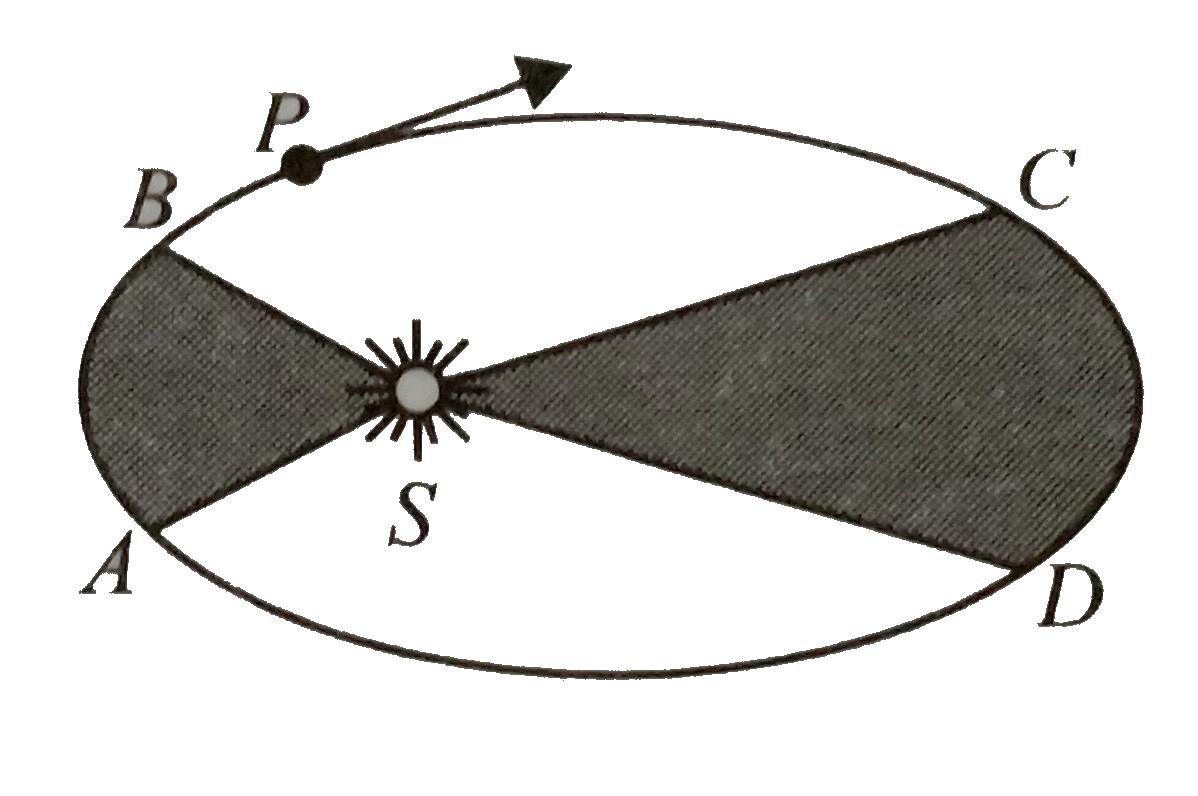
Figure shows elliptical orbit of a plane...

Figure shows elliptical orbit of a planet P about the sun S. The shaded area SCD is twice the shaded area SAB. If `t_(1)` is the time for the planet to move from C to D and `t_(2)` is the time to move from A to B , then

A

`t_(1)=t_(2)`

B

`t_(1)=8t_(2)`

C

`t_(1)=4t_(2)`

D

`t_(1)=2t_(2)`

Text Solution

Verified by Experts

The correct Answer is:

D

From kepler's law areal velocity = constant so `("area "SCD)/(t_(1))=("area "SAB)/(t_(2))impliest_(1)=2t_(2)`
Promotional Banner

Topper's Solved these Questions

  • GRAVITATION

    ALLEN|Exercise Exercise 1 (Check your Grasp)|28 Videos
  • GRAVITATION

    ALLEN|Exercise Exercise 2 (Brain Teasers)|27 Videos
  • GEOMETRICAL OPTICS

    ALLEN|Exercise subjective|14 Videos
  • KINEMATICS-2D

    ALLEN|Exercise Exercise (O-2)|46 Videos

Similar Questions

Explore conceptually related problems

The figure shows elliptical orbit of a planet m about the sun S. the shaded area SCD is twice the shaded area SAB. If t_(1) be the time for the planet to move from C to D and t_(2) is the time to move from A to B, then:

The figure shows elliptical orbit of a planet m about the sun S. the shaded area SCD is twice the shaded area SAB. If t_(1) be the time for the planet to move from C to D and t_(2) is the time to move from A to B, then:

The figure shows elliptical orbit of a plant P about the sun S. The shaded area CSD is twice tha shaded area ASB. If t_(1) is the time taken by the planet to move from C to D and t_(2) is the time to move from A to B, determine the ratio t_(1)//t_(2)

Figure shows the elipticla path of a planet about the sun. The two shaded parts have equal area. If t_1 and t_2 be the tim taken by the planet to go from a to b and from c to d respectively

Figure shows the motion of a planet around the Sun S in an elliptical orbit with the Sun at the focus. The shaded areas A and B are also shown in the figure which can be assumed to be equal. If t_(1) and t_(2) represent the time taken for the planet to move from a to b and c to d , respectively then

Figure shows the motion of a planet around the Sun S in an elliptical orbit with the Sun at the focus. The shaded areas A and B are also shown in the figure which can be assumed to be equal. If t_(1) and t_(2) represent the time taken for the planet to move from a to b and c to d , respectively then

The figure represents an elliptical orbit a planet around sun. The planet takes time T_(1) to travel from A to B and it takes time T_(2) to travel from C to D . If the area CSD is double that of area ASB , them

Figure elliptical path abcd of a planet around the sun S such that the area of Delta csa is (1)/(4) the area of the ellipse, (see figure) with db as the semimajor axis, and ca as the semiminor axis if t_(1) is the time taken for planet to go over path abc and t_(2) for path taken over cda then:

The motion of a planet around sun in an elliptical orbit is shown in the following figure. Sun is situated at one focus. The shaded areas are equal. If the planet takes time t_1 and t_2 in moving from A to B and from C to D respectively, then

A planet of mass m moves in an elliptical orbit around sun with sun at its Focus. (e=eccentricity of ellipse). Then T_(ACB)//T_(BDA) is [T_(ACB) is time taken to travel from A to C B & T_(BDA) is time taken to travel from B to D to A]
