Home
Class 12
PHYSICS
A narrow monochromatic beam of light of ...

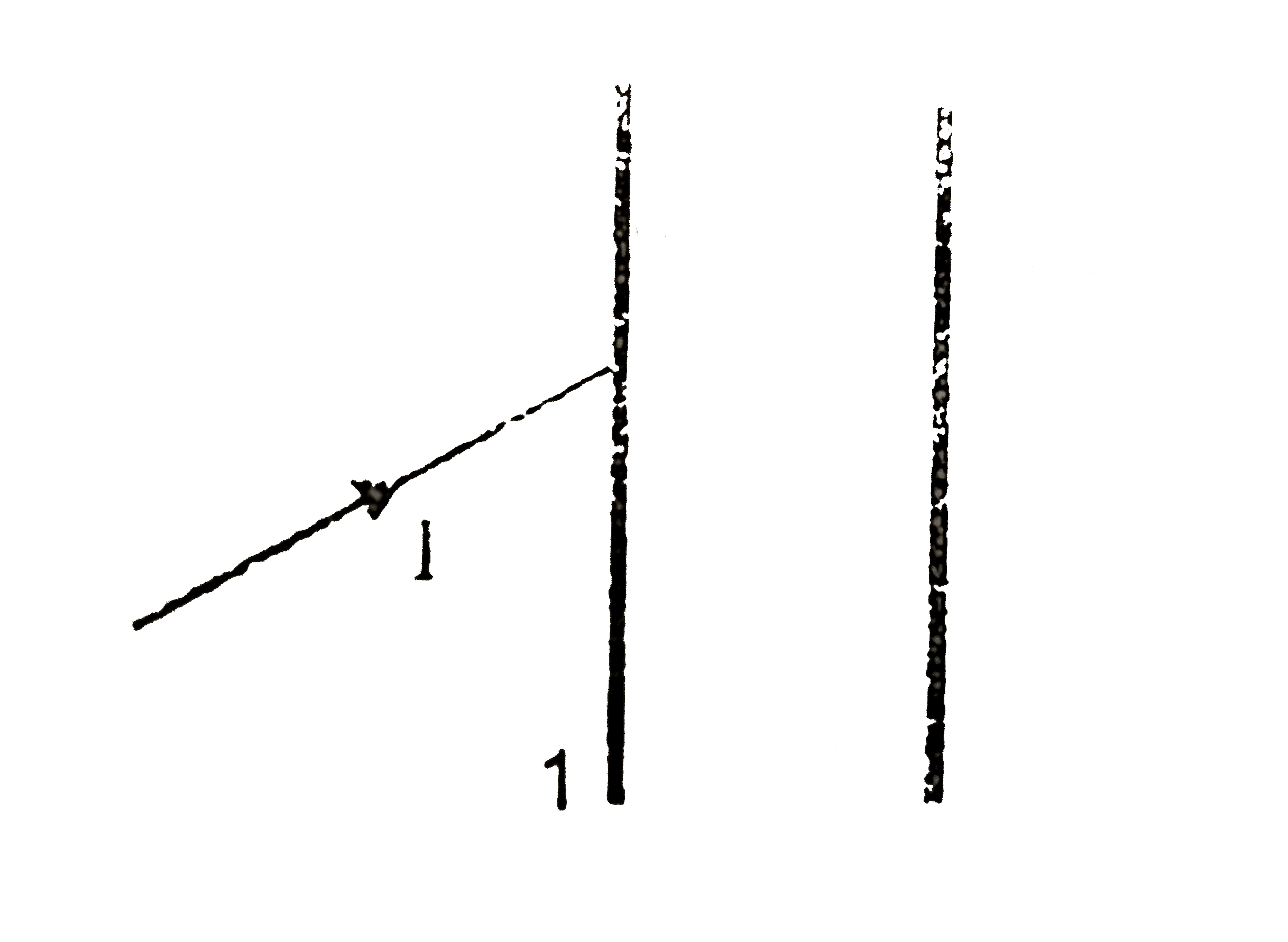
A narrow monochromatic beam of light of intensity `I` is incident on a glass plate as shown in figure. Another identical glass plate is kept close to the first one `&` parallel to it. Each glass plate reflects `25%` of the light incident on it `&` transmits the remaining. The ratio of the minimum `&` the maximum intensities in the interference pattern formed by the two beams obtained after one reflection at each plate is `1:n` find value of `n.`

Text Solution

Verified by Experts

The correct Answer is:
`1:49`


Each plate reflects 25% and transmits `75^(@)` incident beam has an intensity I. this beam undergoes multiple reflections and refractions. The corresponding intensity after each reflection and refraction (transmission) are shown in figure.
Interference pattern is to take place between rays 1 and 2. `I_(1)=I//4` and `I_(2)=9I//64`
`therefore(I_(min))/(I_(max))=((sqrt(I_(1))-sqrt(I_(2)))/(sqrt(I_(1))+sqrt(I_(2))))^(2)=(1)/(49)`
Promotional Banner

Topper's Solved these Questions

  • WAVE OPTICS

    ALLEN|Exercise Exercise 5 A (Previous Years Questions)|17 Videos
  • WAVE OPTICS

    ALLEN|Exercise Exercise 5 B (Previous Years Questions)|19 Videos
  • WAVE OPTICS

    ALLEN|Exercise Exercise 4 A (Conceptual subjective Exercise)|9 Videos
  • UNIT & DIMENSIONS, BASIC MATHS AND VECTOR

    ALLEN|Exercise Exercise (J-A)|7 Videos

Similar Questions

Explore conceptually related problems

A narrow monochromatic beam of light of intensity I is incident on a galss plate as shown in figure. Another identical glass plate is kept close to the first one & parallel to it. Each glass plate reflects 25% of the light incident on it % transmits the remaining find the ratio of the minimum & the maximum intensities in the interference pattern formed by the two beams obtained after one reflection at each plate.

A narrow monochromatic beam of light of intensity 1 is incident on a glass plate as shown in figure Another identical glass plate is kept close to the first one and parallel to it. Each glass plate reflects 25% of the light incident on it and transmits intensities in the interference pattern formed by two beams obtained after one reflection at each plate.

A beam of white light is incident on a hollow prism of glass. Then

A ray of monochromatic light is incident from air on a glass slab. Name the two rays that are parallel to each other.

A ray of light intensity I is incident on a parallel glass-slab at a point A as shown in figure. It undergoes partial reflection and refraction. At each reflection 25% of incident energy is reflected. The rays AB and A^(')B^(') undergo interference. The ratio I_(max)//I_(min) is

A ray of light intensity I is incident on a parallel glass-slab at a point A as shown in figure. It undergoes partial reflection and refraction. At each reflection 25% of incident energy is reflected. The rays AB and A^(')B^(') undergo interference. The ratio I_(max)//I_(min) is

A ray of light in air is incident on a glass plate at polarising angle of incidence. It suffers a deviations of 22^(@) on entering glass. The angle of polarisation is

A certain monochromatic light travelling in air is incident on a glass plate at a polarising angle. Angle of refraction in glass is found to be 32^(@) Calculate : (i) the polarising angle, (ii) refractive index of glass.

Unpolarized light of intensity I_(0) is incident on surface of a block of glass at brewster's angle. In that case, which one of the following statements is true-

If two light waves having same frequency have intensity ratio 4:1 and they interfere, the ratio of maximum to minimum intensity in the pattern will be

