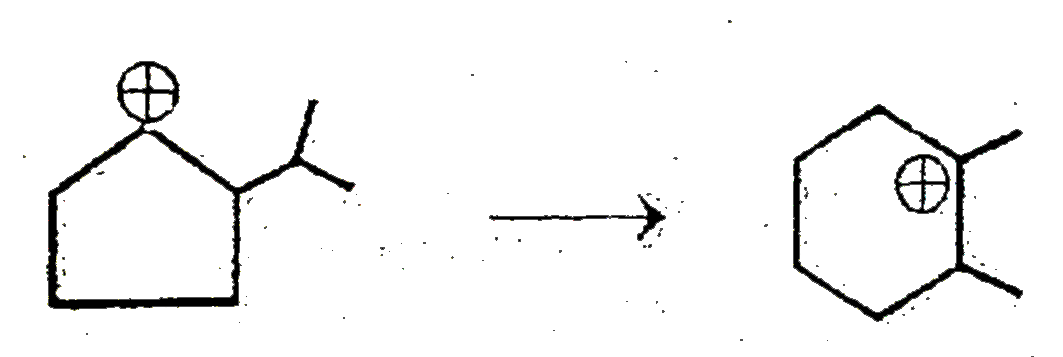
A
B
C
D
Text Solution
Verified by Experts
The correct Answer is:



Topper's Solved these Questions
Similar Questions
Explore conceptually related problems
ALLEN-TEST PAPERS-PAPER 1
- Which of the following represents functional isomerism ?
Text Solution
|
- Identify correct basic strength order of following compounds:-
Text Solution
|
- How many 1,2-shifts are involved in the following rearrangement of car...
Text Solution
|
- Which of the following is not correctly match the final major product?
Text Solution
|
- Which of the following order is correct for the decreasing reactivity ...
Text Solution
|
- Which of following will show tautomerism :-
Text Solution
|
- Correct order of basic strength is :- (I) CH(3)-overset(O)overset(||...
Text Solution
|
- Out of following which will show hyperconjugation:-
Text Solution
|
- Identify the major product?
Text Solution
|
- Rearrangement is not possible in :-
Text Solution
|
- Assertion: If d(x^(2)-y^(2)) and p(y) orbitals come close together al...
Text Solution
|
- Assertion:- CH(3)Cl has more dipole moment than CH(3)F Reason:- The ...
Text Solution
|
- Assertion: - Metaphosphoric acid is highly unstable in monomer form an...
Text Solution
|
- Explain, why does boron not form B^(3+) ions.
Text Solution
|
- In which process Ca(OH)(2) is used to produce NH(3)?
Text Solution
|
- Softening of hard water is done using sodium aluminium silicate (zeoli...
Text Solution
|
- Aqueous ammonia is used as a precipitating reagent for Al^(3+) ions as...
Text Solution
|
- Assertion:- The reaction quotient Q, has the same presentation form as...
Text Solution
|
- Assertion:- H(3)PO(4) is a dibasic compound. Reason:- The two H-ato...
Text Solution
|
- Assertion:- If some PCl(3)(g) containing labelled (radio active) phosp...
Text Solution
|