Home
Class 12
CHEMISTRY
Which of the following is not correctly ...

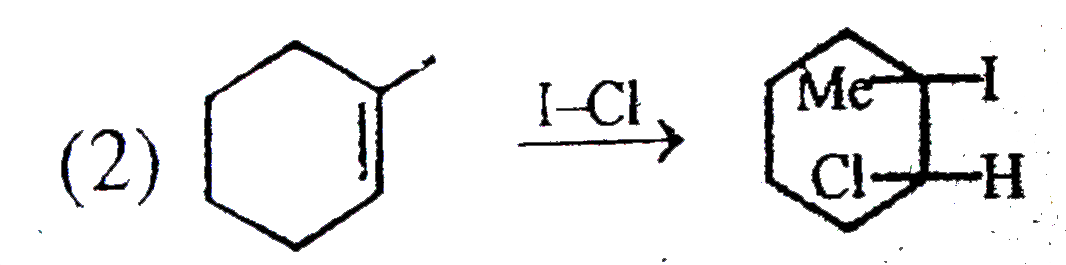
Which of the following is not correctly match the final major product?

A

`CH_(3)CH=CH_(2)overset(HO-Cl)rarrCH_(3)-overset(OH)overset(|)CH-underset(Cl)underset(|)CH_(2)`

B

C

`Cl-CH=CH_(2)underset(H_(2)O_(2))overset(HCl)rarrCl-overset(Cl)overset(|)CH-CH_(3)`

D

All of these

Text Solution

AI Generated Solution

The correct Answer is:

To solve the question "Which of the following is not correctly matched with the final major product?", we will analyze each option provided, focusing on the reactions and their expected products. ### Step-by-Step Solution: 1. **Identify the Reactions:** We need to analyze the reactions given in each option to determine the products formed. The question states that we are looking for the one that does not match the expected product. 2. **First Reaction:** - **Reactants:** Alkene + HOCl - **Mechanism:** This is an electrophilic addition reaction where Cl+ acts as the electrophile and OH- acts as the nucleophile. - **Product Formation:** The electrophile (Cl+) attacks the terminal carbon of the alkene, forming a secondary carbocation. The nucleophile (OH-) then attacks the carbocation. - **Expected Product:** The product formed is CH3CH(OH)CH2Cl, which is correctly matched. 3. **Second Reaction:** - **Reactants:** Alkene + ICl - **Mechanism:** Similar to the first reaction, this is also an electrophilic addition reaction. I+ is the electrophile and Cl- is the nucleophile. - **Product Formation:** The electrophile (I+) attacks the carbon to form a tertiary carbocation. The nucleophile (Cl-) then attacks this carbocation. - **Expected Product:** The correct product should be CH3C(I)ClCH2, where I is attached to the more substituted carbon, not to the methyl group. - **Incorrect Match:** If the product shows I attached to the methyl group, this is incorrect. 4. **Third Reaction:** - **Reactants:** Alkene + HCl - **Mechanism:** This reaction follows the anti-Markovnikov rule, where Cl- will attack the carbon with fewer hydrogen atoms. - **Product Formation:** The Cl- will attach to the less substituted carbon, leading to the formation of a dichloro compound. - **Expected Product:** The product formed is correctly matched. 5. **Conclusion:** Based on the analysis, the second reaction is the one that does not correctly match the final major product. The expected product for the second reaction is not correctly represented in the options provided. ### Final Answer: The second option is the one that is not correctly matched with the final major product. ---
Promotional Banner

Topper's Solved these Questions

Similar Questions

Explore conceptually related problems

Which of the following is not correctly matched

Which of the following is not correctly matched

Which of the following is not correctly matched

Which of the following is not correctly matched

Which of the following is not correctly matched

Which of the following is not correctly matched

Which of the following is not correctly matched ?

Which of the following is not correctly matched?

Which of the following is not correctly matched?

Which of the following is not correctly matched?

ALLEN-TEST PAPERS-PAPER 1
  1. Identify correct basic strength order of following compounds:-

    Text Solution

    |

  2. How many 1,2-shifts are involved in the following rearrangement of car...

    Text Solution

    |

  3. Which of the following is not correctly match the final major product?

    Text Solution

    |

  4. Which of the following order is correct for the decreasing reactivity ...

    Text Solution

    |

  5. Which of following will show tautomerism :-

    Text Solution

    |

  6. Correct order of basic strength is :- (I) CH(3)-overset(O)overset(||...

    Text Solution

    |

  7. Out of following which will show hyperconjugation:-

    Text Solution

    |

  8. Identify the major product?

    Text Solution

    |

  9. Rearrangement is not possible in :-

    Text Solution

    |

  10. Assertion: If d(x^(2)-y^(2)) and p(y) orbitals come close together al...

    Text Solution

    |

  11. Assertion:- CH(3)Cl has more dipole moment than CH(3)F Reason:- The ...

    Text Solution

    |

  12. Assertion: - Metaphosphoric acid is highly unstable in monomer form an...

    Text Solution

    |

  13. Explain, why does boron not form B^(3+) ions.

    Text Solution

    |

  14. In which process Ca(OH)(2) is used to produce NH(3)?

    Text Solution

    |

  15. Softening of hard water is done using sodium aluminium silicate (zeoli...

    Text Solution

    |

  16. Aqueous ammonia is used as a precipitating reagent for Al^(3+) ions as...

    Text Solution

    |

  17. Assertion:- The reaction quotient Q, has the same presentation form as...

    Text Solution

    |

  18. Assertion:- H(3)PO(4) is a dibasic compound. Reason:- The two H-ato...

    Text Solution

    |

  19. Assertion:- If some PCl(3)(g) containing labelled (radio active) phosp...

    Text Solution

    |

  20. Assertion (A): Addtion of NH(4)OH to an aqueous solution of BaCl(2) in...

    Text Solution

    |
