Home
Class 12
CHEMISTRY
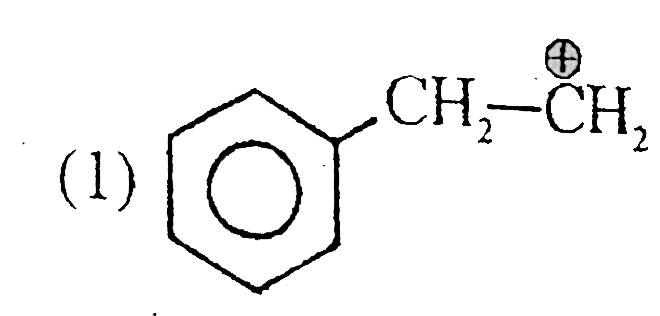
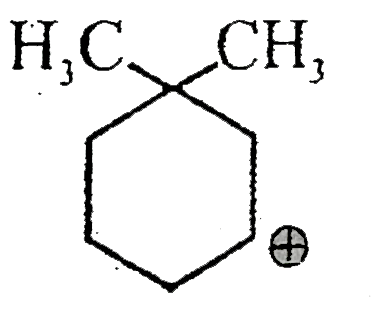
Rearrangement is not possible in :-...

Rearrangement is not possible in :-

A

B

`CH_(3)-underset(OCH_(3))underset(|)CH-overset(o+)CH-CH_(3)`

C

D

`CH_(3)-underset(CH_(3))underset(|)CH-overset(o+)CH-CH_(3)`

Text Solution

AI Generated Solution

The correct Answer is:

To solve the question "Rearrangement is not possible in:", we need to analyze the stability of the carbocations formed in the given options. Rearrangement occurs to form more stable carbocations. Let's go through the options step-by-step. ### Step 1: Understand the concept of carbocation stability Carbocations can rearrange to form more stable species. The stability order of carbocations is: - Tertiary (most stable) - Secondary - Primary (least stable) ### Step 2: Analyze each option #### Option A: Benzyl carbocation (C6H5-CH2^+) - This is a primary carbocation. - It can rearrange to a more stable secondary carbocation due to the presence of the benzene ring, which provides resonance stabilization. - **Conclusion**: Rearrangement is possible. #### Option B: CH3C^+(H)OCH3 - This is a secondary carbocation. - A hydride shift can occur to form a more stable tertiary carbocation. - **Conclusion**: Rearrangement is possible. #### Option C: Cyclic carbocation - This is a secondary carbocation in a cyclic structure. - Any rearrangement (like a hydride shift) will still result in a secondary carbocation. - **Conclusion**: Rearrangement is NOT possible since the stability does not increase. #### Option D: CH3-CH^+(CH3)-CH2-CH3 - This is a secondary carbocation. - A hydride shift can occur to form a tertiary carbocation. - **Conclusion**: Rearrangement is possible. ### Final Answer The compound in which rearrangement is not possible is **Option C** (the cyclic secondary carbocation). ---
Promotional Banner

Topper's Solved these Questions

ALLEN-TEST PAPERS-PAPER 1
  1. Out of following which will show hyperconjugation:-

    Text Solution

    |

  2. Identify the major product?

    Text Solution

    |

  3. Rearrangement is not possible in :-

    Text Solution

    |

  4. Assertion: If d(x^(2)-y^(2)) and p(y) orbitals come close together al...

    Text Solution

    |

  5. Assertion:- CH(3)Cl has more dipole moment than CH(3)F Reason:- The ...

    Text Solution

    |

  6. Assertion: - Metaphosphoric acid is highly unstable in monomer form an...

    Text Solution

    |

  7. Explain, why does boron not form B^(3+) ions.

    Text Solution

    |

  8. In which process Ca(OH)(2) is used to produce NH(3)?

    Text Solution

    |

  9. Softening of hard water is done using sodium aluminium silicate (zeoli...

    Text Solution

    |

  10. Aqueous ammonia is used as a precipitating reagent for Al^(3+) ions as...

    Text Solution

    |

  11. Assertion:- The reaction quotient Q, has the same presentation form as...

    Text Solution

    |

  12. Assertion:- H(3)PO(4) is a dibasic compound. Reason:- The two H-ato...

    Text Solution

    |

  13. Assertion:- If some PCl(3)(g) containing labelled (radio active) phosp...

    Text Solution

    |

  14. Assertion (A): Addtion of NH(4)OH to an aqueous solution of BaCl(2) in...

    Text Solution

    |

  15. When the system does not exchange heat with the surroundings, the proc...

    Text Solution

    |

  16. Assertion:- Reversible process and a cyclic process are the same typ...

    Text Solution

    |

  17. Assertion:- 2nd member of ethyl ketone forms two oximes on reacting wi...

    Text Solution

    |

  18. Assertion:- Boiling point of cis-2-butene is more than trans-2-butene....

    Text Solution

    |

  19. Assertion:- Acrylic acid is unsaturated compound. Reason:- One doub...

    Text Solution

    |

  20. Assertion:- All compounds having C=C bond exhibit geometrical isomeris...

    Text Solution

    |
