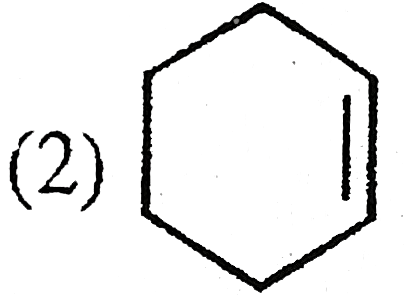
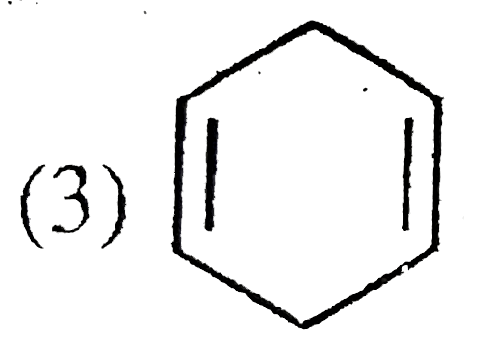
1,2 di-bromo cyclohexane on dehydro halogenation give:-
A
B
C
D
None of these
Text Solution
Verified by Experts
The correct Answer is:
A
Topper's Solved these Questions
TEST PAPERS
ALLEN|Exercise PAPER 1|60 Videos
TEST PAPERS
ALLEN|Exercise PAPER 2|58 Videos
TEST PAPER 4
ALLEN|Exercise CHEMISTRY|45 Videos
THERMODYNAMICS
ALLEN|Exercise EXERCISE -4|18 Videos
Similar Questions
Explore conceptually related problems
1,2 di bromo cyclohexane on dehydrohalogenation gives
Neopentyl bromide undergoes dehydro halogenation to give alkene even though it has no beta- hydrogen. This is due to :
1 - Bromo -2, 2 - dimethylcyclohexane on treatment with methanol gives
How many assymmetric carbon atoms are present in (i)1,2-Dimethyl cyclohexane , (ii)3-Methyl cyclopentene , (iii)3-Methylcyclohexene
The major product in the dehydrohalogenation of 3 - Bromo - 2, 2 - dimethylbutane is
7-bromo-1,3,5-cycloheptatriene exists as ionic species in aqueous solution while 5-bromo-1,3-cyclopentadiene doesn't ionise even in presence of Ag^(+)(aq) , Explain.
Statement-1 : All interhalogens are paramagnetic Statement-2 : AB type of interhalogen undergoes hydrolysis giving a halide ion derived from the smaller halogen and a hypohalite ion derived from the larger halogen.
Assertion : Interhalogen compounds are more reactive than halogens (except fluorine) Reason : They all undergo hydrolysis giving halide ion derived from the smaller halogen and anion derived from larger halogen.