Home
Class 11
PHYSICS
A point charged q placed at (3a, 0) and ...

A point charged q placed at `(3a, 0)` and another charge `-2q` is placed `(-3a, 0)`
At how many points on the x-axis, (at finite distance) electric potential will be zero ?

A

1

B

2

C

3

D

4

Text Solution

Verified by Experts

The correct Answer is:
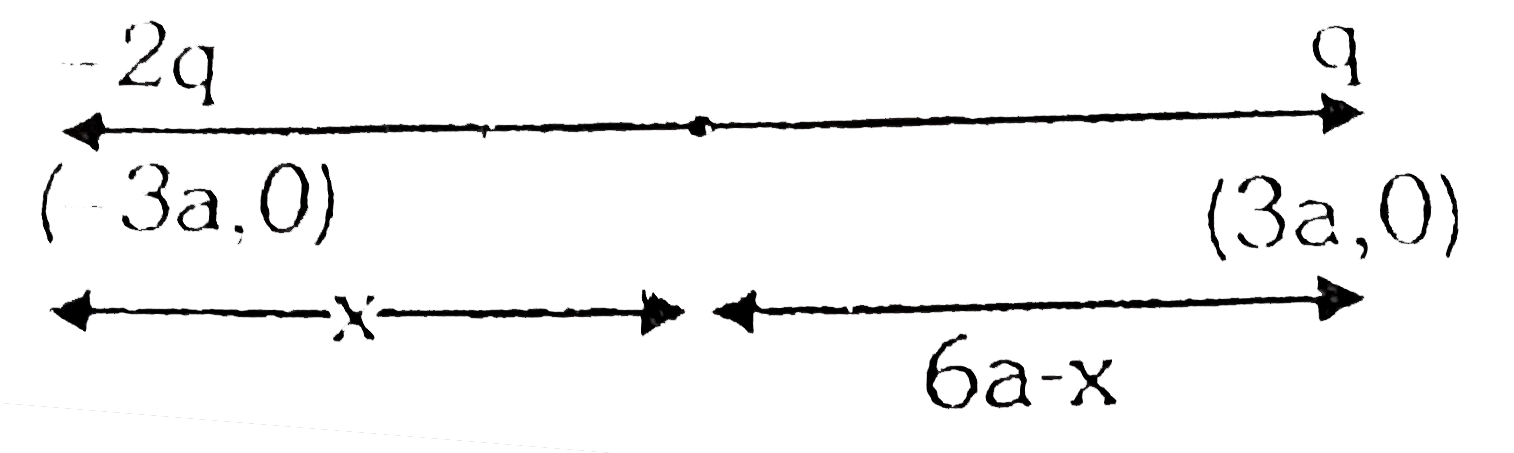
B

Let the poyential will be zero at x distance from `-2q`

`:. (Kx-2q)/x+(Kq)/((6a-x))=0 :. x=4a`
`(Kx-2q)/x+(Kq)/(6a+x)=0rArr x=-12a`
OR
Promotional Banner

Topper's Solved these Questions

  • MISCELLANEOUS

    ALLEN|Exercise Comprehension 4|6 Videos
  • MISCELLANEOUS

    ALLEN|Exercise DATA SUFFICIENCY QUESTIONS|3 Videos
  • MISCELLANEOUS

    ALLEN|Exercise Comprehension 2|8 Videos
  • KINEMATICS (MOTION ALONG A STRAIGHT LINE AND MOTION IN A PLANE)

    ALLEN|Exercise BEGINNER S BOX-7|8 Videos
  • PHYSICAL WORLD, UNITS AND DIMENSIONS & ERRORS IN MEASUREMENT

    ALLEN|Exercise EXERCISE-IV|8 Videos

Similar Questions

Explore conceptually related problems

Electric potential is a scalar quantity. Due to a point charge charge q at distance r, the potential is given by V=(q)/(4pi in_(0)r) . A point charge q is placed at (3a, 0) and another charge -2q is placed at (-3a, 0) . At how many points on the x-axis, (at finite distance) electric potential will be zero?

Electric potential is a scalar quantity. Due to a point charge charge q at distance r, the potential is given by V=(q)/(4pi in_(0)r) . A point charge q is placed at (3a, 0) and another charge -2q is placed at (-3a, 0) . If we plot a graph of potential (V) on x-axis it will be like:

A positive point charge q_(1) is placed at (a,0) and another positive point charge q_(2) is placed at (0,a) . Find the force acting on q_(1) .

Two equal charges q are placed at a distance of 2a and a third charge -2q is placed at the midpoint. The potential energy of the system is

Two point charges q each are fixed at (a,0) and (-a,0). A third charge Q is placed at origin. Electrons potential energy of the system will

A point charge q_1=q is placed at point P. Another point charge q_2=-q is placed at point Q. At some point R(R!=P, R!=Q) , electric potential due to q-1 is V_1 and electric potential due to q_2 is V_2 . Which of the following is correct

Two point charges +4q and +q are placed 30cm apart. At what point on the line joining them is the electric field zero

Two point charges q AND 2q are placed at (a,0) and (0,a) A point charge q^(1) is placed at a P on the quarter circle of radius a as shown in the diagram so that the electric field at the origin becomes zero

Two point charges (Q each are placed at (0,y) and (0-y) A point charge q of the same polarity can move along the x-axis. Then

A point charge q_1 = + 2muC is placed at the origin of coordinates. A second charge, q_2 = - 3muC , is placed on the x-axis at x = 100cm . At what point (or points) on the x-axis will the absolute potential be zero?