Home
Class 11
PHYSICS
Four point charges +8muC-1muC,-1muC and ...

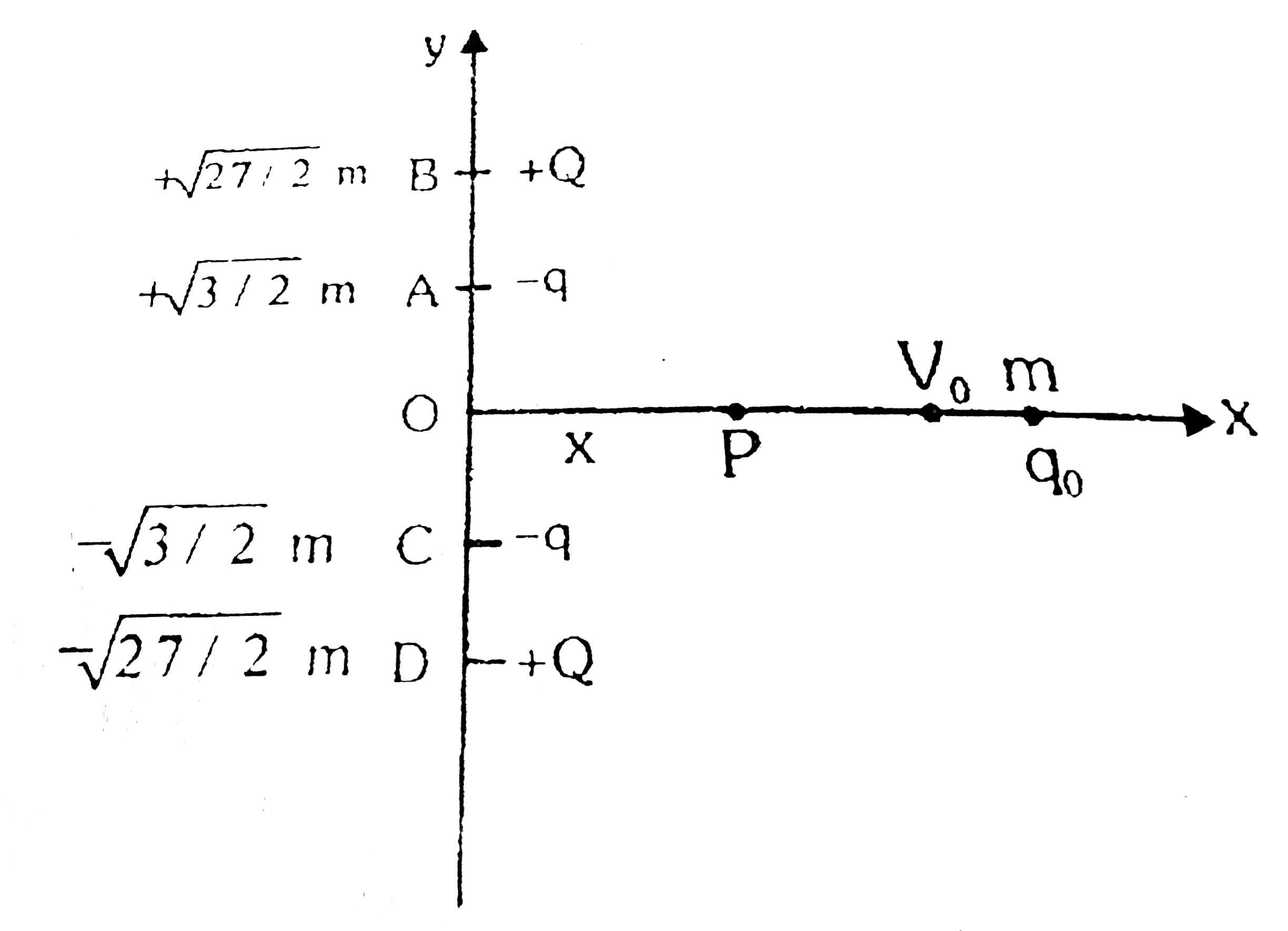
Four point charges `+8muC-1muC,-1muC and +8muC` are fixed at the points `-sqrt(27//2)m, -sqrt(3//2)m+sqrt(3//2)m and + sqrt(27//2)m` respectively on the Y-axis. A particle of mass `6xx10^-4` kg and charge `+0.1muC` moves along the -X direction. It speed at `x=+oo` is `v_0`. Find the least value of `v_0` for which the paticle will cross the origin. Find also the kinetic energy of the particle at the origin. Assume that space is gravity free.

Text Solution

Verified by Experts

The correct Answer is:
`(v_(0))_("min")=3 m//s, K=3xx10^(-4) J`

In the figure

`q=1 muC=10^(-6)C, q_(0)=+0.1 muC=10^(-7) C`
and
`m=6xx10^(-4) kg` and `Q=8 muC=8cc10^(-6) C`
Let P be any point at a distance x from origin O. Then
`AP=CP=sqrt(3/2+x^(2))`
`BP=DP=sqrt(27/2+x^(2))`
Electric potential at point P will be
`V=(2KQ)/(BP)-(2Kq)/(AP)`
where `K=1/(4pi epsilon_(0))=9xx10^(9) N//m^(2)//C^(2)`
`:. V=2xx9xx10^(9)[(8xx10^(-6))/sqrt(27/2+x^(2))-10^(-6)/sqrt(3/2+x^(2))]`
`V=1.8xx10^(4)[8/sqrt(27/2+x^(2))-1/sqrt(3/2+x^(2))]` ...(i)
`:.` Electric field at P is
`E=-(dV)/(dx)=1.8xx10^(4)`
`[(8)((-1)/2)(27/2+x^(2))^(-3/2)-(-1/2)(3/2+x^(2))^(-3/2)](2x)`
`E=0` on x-axis where `-x=0` or
`8/((27/2+x^(2))^(3//2))=(1)/((3/2+x^(2))^(3//2))`
`rArr ((4)^(3//2))/((27/2+x^(2))^(3//2))=1/((3/2+x^(2))^(3//2))`
`rArr (27/2+x^(2))=4(3/2+x^(2))`
This equation gives `x=+-sqrt(5/2)m`
The least value of kinetic energy of the particle at infinity should be enough to take particle upto
`x=+ sqrt(5/2)m` because at `x=+sqrt(5/2)m, E=0`
`rArr` Electrotatic force on charge q is zero or `F_(e)=0`. For at `x gt sqrt(5/2)m`, E is repulsive (towards x-axis) and for `x lt sqrt(5/2) m`, E is attractive (towards negative x-axis).
Now, from Eq. (i) potential at `x=sqrt(5/2) m`
`v=1.8xx10^(4)[8/sqrt(27/2+5/2)-1/sqrt(3/2+5/2)]`
`rArr V=2.7xx10^(4)` volt
Applying energy conservation at `x=oo` and `x=sqrt(5/2)m, 1/2 mv_(0)^(2)=q_(0)V` ...(ii)
`:. v_(0)=sqrt((2q_(0)V)/m)`
Substituting the values
`v_(0)=sqrt((2xx10^(-7)xx2.7xx10^(4))/(6xx10^(-4)))rArr v_(0)=3 m//s`
`:.` Minimum value of `v_(0)` is `3 m//s`
From eq. (i) potential at origin `(x=0)` is
`V_(0)=1.8xx10^(4)[8/sqrt(27/2)-1/sqrt(3/2)]~~2.4xx10^(4) V`
Let K be the kinetic energy of the particle at origin. Applying energy conservation at x=0 and `x=oo`
`K+q_(0)V_(0)=1/2 mv_(0)^(2)` But `1/2 mv_(0)^(2)=q_(0)V` [from Eq. (ii)]
`K=q_(0)(V-V_(0))=(10^(-7))(2.7xx10^(4)-2.4xx10^(4))`
`rArr K=3xx10^(-4) J`
Promotional Banner

Topper's Solved these Questions

  • MISCELLANEOUS

    ALLEN|Exercise PHY|68 Videos
  • MISCELLANEOUS

    ALLEN|Exercise EXERCISE-1|120 Videos
  • MISCELLANEOUS

    ALLEN|Exercise LINKED COMPREHENSION TYPE|3 Videos
  • KINEMATICS (MOTION ALONG A STRAIGHT LINE AND MOTION IN A PLANE)

    ALLEN|Exercise BEGINNER S BOX-7|8 Videos
  • PHYSICAL WORLD, UNITS AND DIMENSIONS & ERRORS IN MEASUREMENT

    ALLEN|Exercise EXERCISE-IV|8 Videos

Similar Questions

Explore conceptually related problems

Four point charges +8muC,-1muC,-1muC and , +8muC are fixed at the points -sqrt(27//2)m,-sqrt(3//2)m,+sqrt(3//2)m and +sqrt(27//2)m respectively on the y-axis. A particle of mass 6xx10^(-4)kg and +0.1muC moves along the x-direction. Its speed at x=+ infty is v_(0) . find the least value of v_(0) for which the particle will cross the origin. find also the kinetic energy of the particle at the origin in tyhis case. Assume that there is no force part from electrostatic force.

two point charges 2 muC and -4 muC are situated at points (-2m, 0m) and (2m, 0m) respectively. Find out potential at point C( 4m, 0m) and D (0 m, sqrt(5) m) .

Electric charges of +10 muC,+5 muC,-3 muC and +8 muC are placed at the corners of a square of side sqrt(2) m, the potential at the centre of the square is

Two point charges 3 muC and 2.5 muC are placed at point A (1, 1, 2)m and B (0, 3, -1)m respectively. Find out electric field intensity at point C(3, 3, 3)m.

A particle of mass 100 gm and charge 2muC is released from a distance of 50 cm from a fixed charge of 5muC . Find the speed of the particle when its distance from the fixed charge becomes 3 m.

A particle of mass 2 g and charge 1 muC is held at rest on a frictionless surface at a distance of 1m from a fixed charge of 1 mC. If the particle is released it will be repelled. The speed of the particle when it is at distance of 10 m from fixed charge is :

Three point charge q_1=1muC, q_2=-2muC and q_3=3muC are placed at (1m, 0,0), (0,2m,0) and (0,0,3m) respectively. Find the electric potential at as origin.

Electric charge of 1 muC, -1 muC and 2 muC are placed in air at the corners A, B and C respectively of an equilateral triangle ABC having length of each side 10 cm. The resultant force on the charge at C is

Four point charges 1muC,3muC, - 2muC and -2muC are arranged on the four vertices of a square of side 1 cm. The dipole moment of this charge assembly is

Two point charges q_1=q_2=2muC are fixed at x_1=+3 m and x_2=-3m as shown in figure. A third particle of mass 1 g and charge q_3=-4muC are released from rest at y=4.0m .Find the speed of the particle as it reaches the origin.

