Home
Class 11
PHYSICS
A small ball of mass 2 xx 10^-3 kg, havi...

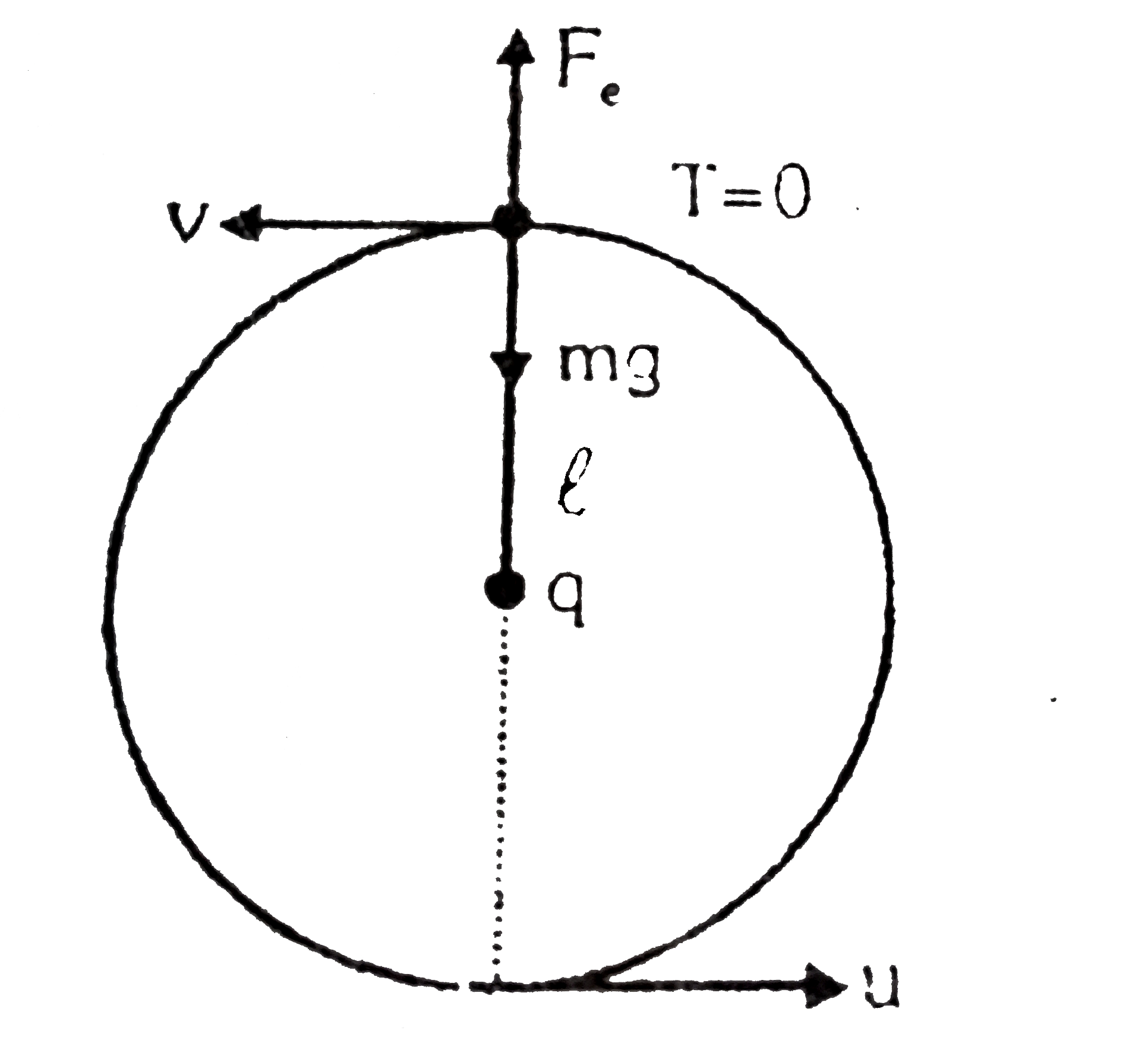
A small ball of mass `2 xx 10^-3 kg`, having a charge `1 mu C`, is suspended by a string of length `0.8 m`. Another identical ball having the same charge is kept at the point of suspension. Determine the minimum horizontal velocity that should be imparted to the lower ball so that it can make a complete revolution.

Text Solution

Verified by Experts

The correct Answer is:
`5.86 m//s`

Given : `q=1 muC=10^(-6)C`

`m=2xx10^(-3)` kg and `l=0.8 m`
Let u be the speed of the particle at its lowest point and v its speed at high point. At highest point three forces are acting on the particle.
(i) Electrostatic repulsion
`F_(e)-1/(4pi epsilon_(0))=q^(2)/l^(2)` (outwards)
(ii) Weight W=mg (inwards)
(iii) Tension T (inwards)
`T=0`, if the particle has just to complate the circle and the necessary centripetal force provided by
`W-F_(e)` i.e., `(mv^(2))/l=W-F_(e)`
`rArr v^(2)=l/m(mg-1/(4pi epsilon_(0))xxq^(2)/l^(2))`
`v^(2)=0.8/(2xx10^(3))(2xx10^(3)xx10-(9.0xx10^(9)xx(10^(-6))^(2))/((0.8)^(2)))`
`rArr v^(2)=2.4 m^(2)//s^(2)` ...(i)
Now, the electrostatic potential energy at the lowest and highest points are equal. Hence, from conservation of mechanical energy.
Increase in gravitational potential energy
`=` Decrease in kinetic energy
`rArr mg(2l)=1/2 m (u^(2)-v^(2))rArr u^(2)-v^(2)=4gl`
Substituting the values of `v^(2)` from Eq (i), we get
`u^(2)=2.4+4(10)(0.8)=34.4 m^(2)//s^(2)`
`:. u=5.86 m//s`
Therefore minimum horizontal velocity imparted to the lower ball, so that it can make complete revolution, is `5.86 m//s`
Promotional Banner

Topper's Solved these Questions

  • MISCELLANEOUS

    ALLEN|Exercise PHY|68 Videos
  • MISCELLANEOUS

    ALLEN|Exercise EXERCISE-1|120 Videos
  • MISCELLANEOUS

    ALLEN|Exercise LINKED COMPREHENSION TYPE|3 Videos
  • KINEMATICS (MOTION ALONG A STRAIGHT LINE AND MOTION IN A PLANE)

    ALLEN|Exercise BEGINNER S BOX-7|8 Videos
  • PHYSICAL WORLD, UNITS AND DIMENSIONS & ERRORS IN MEASUREMENT

    ALLEN|Exercise EXERCISE-IV|8 Videos

Similar Questions

Explore conceptually related problems

A ball of mass m is attached to one end of a light rod of length l , the other end of which is hinged. What minimum velocity v should be imparted to the ball downwards, so that it can complete the circle ?

The both of a pendulum has mass m = 1 kg and charge q = 40mu C . Length of pendulum is = 0.9 m. The point of suspensison also has the same charge 40 muC . What is the minimum speed u (in m/s) should be imparted to the bob so that it can complete vertical circle ?

Two charged particles having charge 2.0 xx 10^(-8)C . Each are joined by an isolating string of length 1m and the system is kept on a smooth horizontal task. The tension in the string.

A ball of mass 10^(-2) kg and having charge + 3 xx 10^(-6)C is tied at one end of a 1m along thread. The other end of the thread is fixed and a charge - 3 xx 10^(-6) C is placed at this end. The ball can move in the circulr orbit of radius 1m in the vertical plane. Initially, the ball is at the bottom. Find the minimum initial horizontal velocity of the ball, so that it will be able to complete the full circle.

Three identical small balls, each of mass 0.1 g, are suspended at one point on silk thread having a length of l = 20cm . What charges should be imparted to the balls for each thread to form an angle of alpha = 30^@ with the vertical?

A ball of mass m with a charge q can rotate in a vertical plane at the end of a string of length l in a uniform electrostatic field whose lines of force are directed upwards. What horizontal velocity must be imparted to the ball in the upper position so that the tension in the string in the lower position of the ball is 1.5 times than the weight of the ball?

Two charged particles having charge 2.0xx 10^(-8)C each are joined by an insulating string of length 1 m and the system is kept on a smooth horizontal table. Find the tension in the string.

A small steel ball A is suspended by an inextensible thread of length l= 1.5 m from O . Another identical ball is thrown vertically downwards such that its surface remains just in contact with thread during downward motion and collides elastically with the suspended ball. If the suspended ball just completes vertical circle after collision, calculate the velocity (in cm//s ) of the falling ball just before collision (g = 10 m s^(-2)) .

Two small spheres, each having a mass of 20 g, are suspended form a common point by two insulating strings of length 40 cm each. The spheres are identically charged and the speration between the balls at equilibrium is found to be 4 cm . Find the charge on each sphere.

A ball of mass 0.25 kg attached to the end of a string of length 1.96 m is moving in a horizontal circle. The string will break if the tension is more than 25 N . What is the maximum speed with which the ball can be moved

