Home
Class 12
PHYSICS
A concave mirror of focal length 20 cm i...

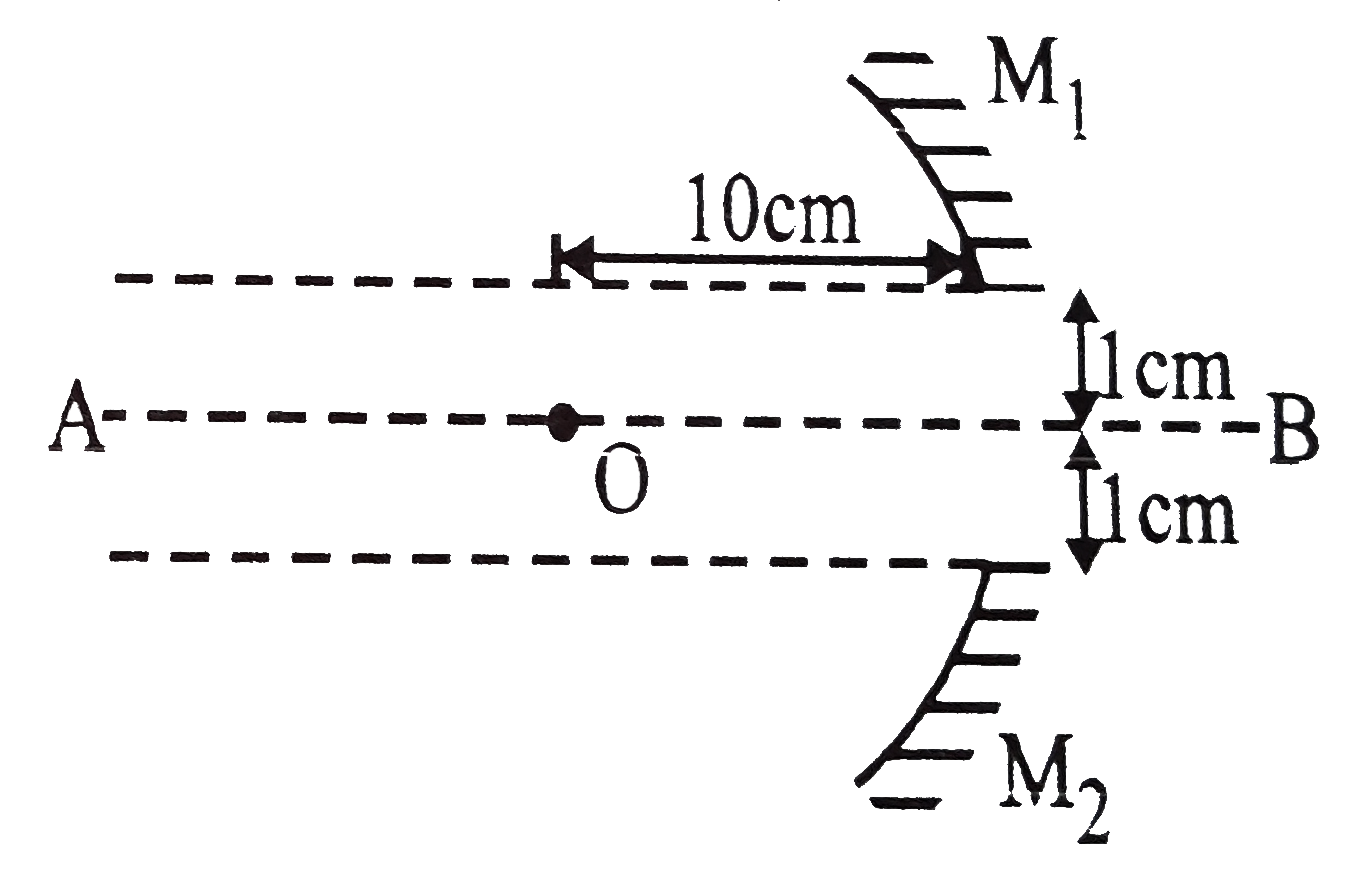
A concave mirror of focal length `20 cm` is cut into two parts from the middle and the two parts are moved perpendicularly by a distance `1 cm` from the previous principal axis `AB` .find the distance between the images formed by the two parts?

A

2 mm

B

6mm

C

3mm

D

4mm

Text Solution

Verified by Experts

The correct Answer is:

A

For `M_(1): u=-10"cm"`
f=-20 cm , `h_(0)= -0.1 "cm"`
`v=(200)/(-10+20) = (200)/(10) implies v=20"cm"`
`m=-(v)/(u) implies (h_(1))/(h_(0)) = (+20)/(+10)`
`implies h_(1) = 2 xx -0.1 = -0.2 , h_(1) = -2` mm
For `m_(2) = (-20)/(-10) = 2 implies h_(1) = 0.2 "cm" = 2"mm"`
Promotional Banner

Topper's Solved these Questions

  • GEOMETRICAL OPTICS

    ALLEN|Exercise EXERCISE-2|44 Videos
  • GEOMETRICAL OPTICS

    ALLEN|Exercise EXERCISE-3|12 Videos
  • GEOMETRICAL OPTICS

    ALLEN|Exercise EXERCISE - 05 (B) (ASSERTION & REASON )|9 Videos
  • CURRENT ELECTRICITY

    ALLEN|Exercise EX.II|66 Videos
  • GRAVITATION

    ALLEN|Exercise EXERCISE 4|9 Videos

Similar Questions

Explore conceptually related problems

A concave mirror forms real image of a point source lying on the optical axis at a distance of 50cm from the mirror. The focal length of the mirror is 25cm. The mirror is cut in two, and its halves are drawn at a distance of 1 cm apart in a direction perpendicular to the optical axis. Q. The distance between the two images formed by the two halves of the mirror is

A particle goes in a circle of radius 2.0 cm. A concave mirror of focal length 20 cm is placed with its principal axis passing through the centre of the circle and perpendicular to its plane. The distance between the pole of the mirror and the centre of the circle is 30 cm. Calculate the radius of the circle formed by the image.

A symmetrical converging convex lens of focal length 10 cm & diverging concave symmetrical lens of focal length -20 cm are cut from the middle and perpendicularly and symmetrically to their principal axis. The parts thus obtained are arrenged as shown in the figure. Find the focal length (in cm ) of this arragement

An object is at 20 cm from a concave mirror of focal length 10 cm, the nature of image is

Concave mirror forms the real image of a point source lying on the optical axis at a distance of 50 cm from the mirror. The focal length of the mirror is 25 cm. The mirror is cut into and its halves are drawn a distance of 1 cm apart in a direction perpendicular to the optical axis. How will the image formed by the halves of the mirror be arranged?

A point object is placed at a distance 20 cm from the focus of a concave mirror of radius of curvature 20 cm. Find the distance (in cm) of the image from the focus.

A concave mirror forms an image of the sun at a distance of 12 cm from it.

A point object is placed 60 cm from the pole of a concave mirror of focal length 10 cm on the principal axis. Find: a. the position of image. b. If the object is shifted 1 mm towards the mirror along principal axis, find the shift in image. Explain the result.

A concave mirror forms real image of a point source lying on the optical axis at a distance of 50cm from the mirror. The focal length of the mirror is 25cm. The mirror is cut in two, and its halves are drawn at a distance of 1 cm apart in a direction perpendicular to the optical axis. Q. In the given situation, if the two halves are each rotated (before being separated) about S by 90^(@) , with reference to original position, then the distance between the two images will be

An equi-convex lens of mu=1.5 and R=20 cm is cut into two equal parts along its axis. Two parts are then separated by a distance of 120 cm (as shown in figure). An object of height 3 mm is placed at a distance of 30 cm to the left of first half lens. The final image will form at

ALLEN-GEOMETRICAL OPTICS-EXERCISE- 01
  1. In the figure shown, how many images of the star will an observer at O...

    Text Solution

    |

  2. The distance of an object from a concave spherical mirror is equal to ...

    Text Solution

    |

  3. A concave mirror of focal length 20 cm is cut into two parts from the ...

    Text Solution

    |

  4. Radius of curvature of each mirror is R. 'O' is object. Consider first...

    Text Solution

    |

  5. A convex mirror of focal length 'f' is placed at the origin with its r...

    Text Solution

    |

  6. The x-z plane separates two media A and B of refractive indices mu(1) ...

    Text Solution

    |

  7. A ray of light travelling in a medium of refractive index mu is incide...

    Text Solution

    |

  8. Consider the situation shown in figure. Water (mu(w) = (4)/(3)) is fil...

    Text Solution

    |

  9. A plane mirror is placed at the bottom of a tank containing a liquid o...

    Text Solution

    |

  10. When a pin is moved along the principal axis of a small concave mirror...

    Text Solution

    |

  11. A ray of light (R(1)) is incident on a glass slab at an angle equal to...

    Text Solution

    |

  12. Refractive index of a glass cube is sqrt(2). A ray of light is inciden...

    Text Solution

    |

  13. A ray of light travels from an optically denser to rarer medium. The c...

    Text Solution

    |

  14. The distance of final image from AB as observed by observer is P is

    Text Solution

    |

  15. What is the least radius through which an optical fiber of core diamet...

    Text Solution

    |

  16. A ray of light from a denser medium strikes a rarer medium at an angle...

    Text Solution

    |

  17. An object is immersed in a fluid.In order that the object becomes invi...

    Text Solution

    |

  18. A ray of light is incident upon an air/water interface ( it passes fro...

    Text Solution

    |

  19. A light ray is incident on a transparent sphere of index = sqrt(2) , a...

    Text Solution

    |

  20. An air bubble inside water. The refractive index of water is 4/3 . At ...

    Text Solution

    |
