Home
Class 12
PHYSICS
Look at the ray diagram shown ,what will...

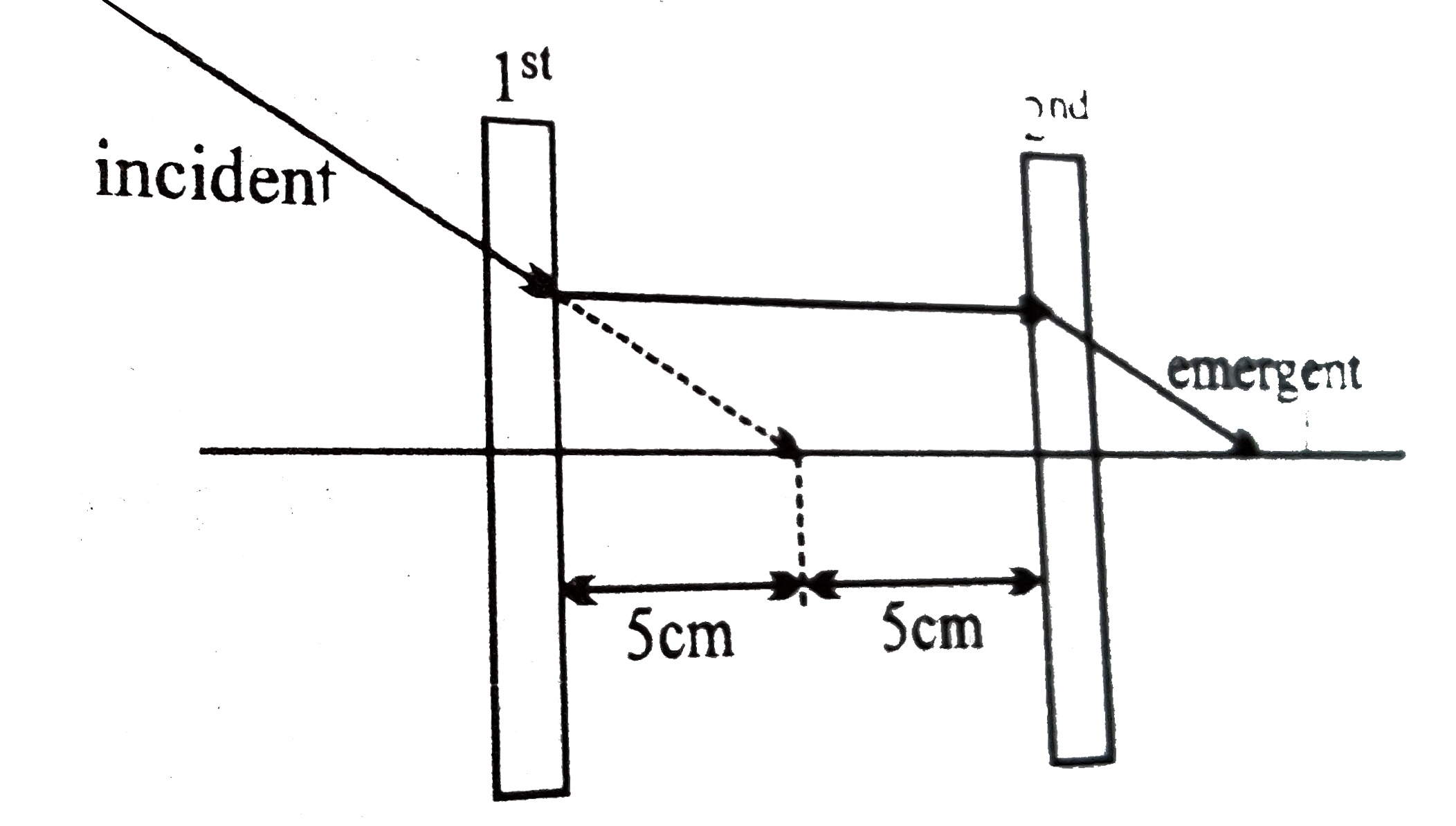
Look at the ray diagram shown ,what will be th focal length of th e`1^(st)`and the `2^(nd)`lens,if the incident light ray passes without any deviation?

Text Solution

Verified by Experts

The correct Answer is:

C

From figure `1^(st)` behave as diverging and `2^(nd)` behave converging
In `1st` incident ray appear to pass at 5 cm distance point and after refraction it becomes parallel to principal axis i.e. the focal length = -5cm and for second f=5 cm
Promotional Banner

Topper's Solved these Questions

  • GEOMETRICAL OPTICS

    ALLEN|Exercise EXERCISE-2|44 Videos
  • GEOMETRICAL OPTICS

    ALLEN|Exercise EXERCISE-3|12 Videos
  • GEOMETRICAL OPTICS

    ALLEN|Exercise EXERCISE - 05 (B) (ASSERTION & REASON )|9 Videos
  • CURRENT ELECTRICITY

    ALLEN|Exercise EX.II|66 Videos
  • GRAVITATION

    ALLEN|Exercise EXERCISE 4|9 Videos

Similar Questions

Explore conceptually related problems

A ray of light is normally incident on one face of an equilateral glass prism. Answer the following : (a) What is the angle of incidence on the first face of the prism? (b) What is the angle of refraction from the first face of the prism ? (c) What will be the angle of incidence at the second face of the prism ? (d) Will the light ray suffer minimum deviation by the prism ?

A light ray travelling parallel to the principal axis of a convex lens of focal length 12 cm strikes the lens at a height of 5 mm from the principal axis. What is the angle of deviation produced?

(a) Draw a ray diagram to show the image formation by a combination of two thin convex lenses in contact . Obtain the expression for the power of this combination in terms of the focal lengths of the lenses. (b) A ray of light passing from air through an equilateral glass prism undergoes minimum deviation when the angle of incidence is (3)/(4)^(th) of the angle of prism . Calculate the speed of ltbRgt light in the prism.

When a ray of light passes from air to glass, for what angle of incidence, the ray will not be deviated?

A ray of light passes through the equilateral prism such that angle of incidence is equal to the angle of emergence if the angle of incidence is 45^(@) . The angle of deviation will be

See below the diagram. Calculate the focal length of cancave lens with the help of above ray diagram: The focal length of convexlens is 20 cm.

A ray of light enters a spherical drop of water of refractive index mu as shown in figure. Q. An expression of the angle between incident ray and emergent ray (angle of deviation) as shown in figure.

A ray of light enters a spherical drop of water of refractive index p as shown in the figure. An expression of the angle between incidence ray and emergent ray (angle of deviation) as shown in the figure is

A source of light is located at double focal length from a convergent lens. The focal length of the lens is f=30cm. At what distance from the lens should a flat mirror be placed, so that the rays reflected from the mirror are parallel after passing through the lens for the second time?

Draw ray diagrams showing the image formation by a convex lens when an object is placed (a) between optical centre and focus of the lens (b) between focus and twice the focal length of the lens ( c) at twice the focal length of the lens (d) at infinity , (e) at the focus of the lens

ALLEN-GEOMETRICAL OPTICS-EXERCISE- 01
  1. A paraxial beam is incident on a glass (n=1.5) hemisphere of radius R=...

    Text Solution

    |

  2. A concave spherical surface of radius of curvature 10 cm separates two...

    Text Solution

    |

  3. A double convex lens, made of a meterial of refractive index mu(1), is...

    Text Solution

    |

  4. Optic axis of a thin equiconvex lens is the x-axis. The co-rodinates o...

    Text Solution

    |

  5. A converging lens of focal length 20 cm and diameter 5 cm is cut along...

    Text Solution

    |

  6. Look at the ray diagram shown ,what will be th focal length of th e1^(...

    Text Solution

    |

  7. A diverging lens of focal length 10cm is placed 10cm in front of a pla...

    Text Solution

    |

  8. A point object O moves from the principal axis of a converging lens in...

    Text Solution

    |

  9. A point object O is placed at a distance of 20 cm from a convex lens o...

    Text Solution

    |

  10. A point source of light is placed on the principal axis between F and ...

    Text Solution

    |

  11. A man wants to photograph a white donkey as a Zwbra after fitting a gl...

    Text Solution

    |

  12. Alens is placed between a source of light and a wall. It forms images ...

    Text Solution

    |

  13. In the displacement method , a convex lens is placed in between an obj...

    Text Solution

    |

  14. A beam of light consisting of red, green and blue colurs is incident o...

    Text Solution

    |

  15. A ray of light is incident normally on the first refracting face of th...

    Text Solution

    |

  16. A horizontal ray of light passes through a prism of index 1.50 and ape...

    Text Solution

    |

  17. The curve of angle of incidence versus angle of deviaton wshown has be...

    Text Solution

    |

  18. A beam of monochromatic light is incident at i= 50^(@) on one face of ...

    Text Solution

    |

  19. A parallel of white light falls on a concave lens , Image of blue , re...

    Text Solution

    |

  20. Which of the following quantities related to a lens depend on the wave...

    Text Solution

    |
