Home
Class 12
PHYSICS
A point source S is placed at the bottom...

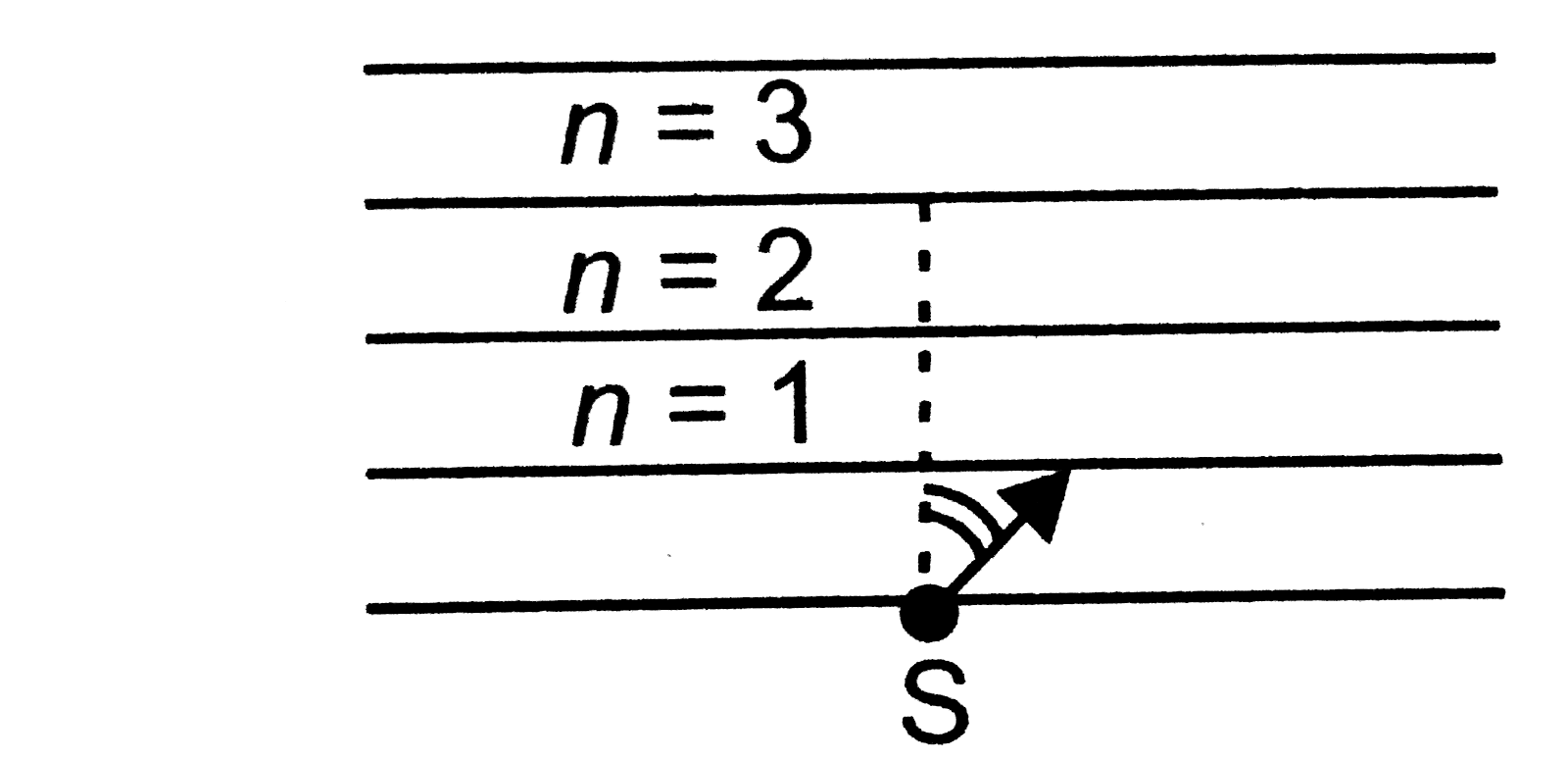
A point source `S` is placed at the bottom of different layers as shown is figure,the refractive index of bottommost layer is `mu_(0)` The refractive index of any other upper layer is
`mu(n)=mu_(0)-(mu_(0))/(4pi-18)` where `n=1,2,.....`
A ray of light starts form the source `S` as shown. Total internal reflection takes place at the upper surface of a layer haing `n` equal to

A

3

B

5

C

4

D

6

Text Solution

Verified by Experts

The correct Answer is:

A

For parallel composite slab `"usin"theta` = constant
`mu_(0) xx "sin"I = mu("n")xx "sin"90^(@)`
`mu_(0) "sin"30^(@) = mu_(0) + (mu_(0))/(mun-18)`
`(1)/(2) = 1 + (1)/(4n-18) implies (1)/(18-4n) = (1)/(2) implies "n"= 4`
`implies` upper layer of n=3
Promotional Banner

Topper's Solved these Questions

Similar Questions

Explore conceptually related problems

A point source S is placed at the bottom of different layers as shown in the figure. The refractive index of bottom most layer is mu_(0) . The refractive index of any other upper layer is mu(n)=mu_(0)-(mu_(0))/(4n-18) where n=1,2………….A ray of light with angle i slightly more than 30^(@) starts from the source S. Total internal reflection takes place at the upper surface of a layer having n equal to

The refractive index of an anisotropic medium varies as mu=mu_(0)sqrt((x+1)) , where 0lexlea . A ray of light is incident at the origin just along y-axis (shown in figure). Find the equation of ray in the medium .

Find the angle of deviation suffered by the light ray shown in figure. The refractive index mu= 2.0 for the prism material.

A prism of glass (mu=1.5) is dipped in to water as shown in the figure. If the refractive index of water is 4/3, then the incident ray will be totally reflected if

A transparent cube of side d, made of a material of refractive index mu_(2) , is immersed in a liquid of refractive index mu_(1)(mu_(1)ltmu_(2)) . . A ray is incident on the face AV at an angle theta (shown in the figure). Total internal refraction takes place at point E on the face BC. Then must satisfy:

A transparent cube of side d, made of a material of refractive index mu_(2) , is immersed in a liquid of refractive index mu_(1)(mu_(1)ltmu_(2)) . . A ray is incident on the face AV at an angle theta (shown in the figure). Total internal refraction takes place at point E on the face BC. Then must satisfy:

A slab of refractive index mu is placed in air and light is incident at maximum angle theta_0 from vertical. Find minimum value of mu for which total internal reflection takes place at the vertical surface.

Light is incident on the thin lens as shown in figure. The refractive index of the material of the lens is mu_(2) . The radii of curvature of both the surfaces are R. The refractive index of the medium of left side is mu_(1) , while that of right side is mu_(3) . What is the focal length of the lens?

A long rectangular slab of transparent medium of thickness d placed on a table with its length parallel to the x-axis and width parallel to the axis. A ray of light travelling inair makes a near normal incidence on the slab as shown. Taking the point of incidence as orign (0,0,0). The refraction index mu of the medium varies as mu=(mu_(0))/(1-(x/r) where mu_(1) and r(gtd) are constants. The refractive index of air is mu_(0) The x-coordinate of the point A where the ray intersects the upper surface of the slab air boundary is

A glass slab consists of thin uniform layers of progressively decreasing refractive indices refractive index such that the refractive index of any layer is mu-mDeltamu . Here mu and Deltamu denotes the refractive index of 0th layer and the difference in refractive index betweeen any two consecutive layers, resepctively. The integer m=0,1,2,3 ... denotes the number of the suscessive layers. A ray of light from the 0th layers enters the 1st layer at an angle of incidence of 30^(@) . After undergoing the mth refraction, the ray emerges paralllel to the interaface. If mu=1.5 and Deltamu=0.015 , then the value of m is

ALLEN-GEOMETRICAL OPTICS-EXERCISE-2
  1. What is the length of the image of the rod in mirror, according to the...

    Text Solution

    |

  2. Two thin slabs of refractive indices mu(1) and mu(2) are placed parall...

    Text Solution

    |

  3. A point source S is placed at the bottom of different layers as shown ...

    Text Solution

    |

  4. A ray of light of refractive index 1.4approaches the boundary surface ...

    Text Solution

    |

  5. A ray of light strikes a cubical slab surrounded by air as shown in th...

    Text Solution

    |

  6. A cubical block of glass of refractive index n1 is in contact with the...

    Text Solution

    |

  7. A beam of diameter 'd' is incident on a glass hemisphere as shown. If ...

    Text Solution

    |

  8. When an object is at distance x and y from a lens, a real image and a ...

    Text Solution

    |

  9. A light ray hits the pole of a thin biconvex lens as shown in fig. The...

    Text Solution

    |

  10. A ray of light passes through a prism in a principle plane the deviati...

    Text Solution

    |

  11. The diagram shows five isosceles right angled prisms.A light ray incid...

    Text Solution

    |

  12. A certain prism is found to produce a minimum of38^(@).It produces a d...

    Text Solution

    |

  13. A ray incident at an angle 53^(@) on a prism emerges at an angle 37^(@...

    Text Solution

    |

  14. A man of height 170cmwants to see his complete image in a plane mirror...

    Text Solution

    |

  15. Two plane mirrors at an angle such that a ray incident on a mirror und...

    Text Solution

    |

  16. If the equation of mirror is given by y= 2//pi "sin"pix (y gt 0 , 0 le...

    Text Solution

    |

  17. In the fig. shown consider the first reflection at the plane mirror an...

    Text Solution

    |

  18. The figure shows a ray incident a angle i=pi//3 of the plot drawn show...

    Text Solution

    |

  19. A ray of light is incident normally on one face of 30^(@) - 60^(@) - 9...

    Text Solution

    |

  20. A curved surface of radius R separates two medium of refractive indice...

    Text Solution

    |
