Home
Class 12
PHYSICS
A fly F is sitting an a glass S 45 cm t...

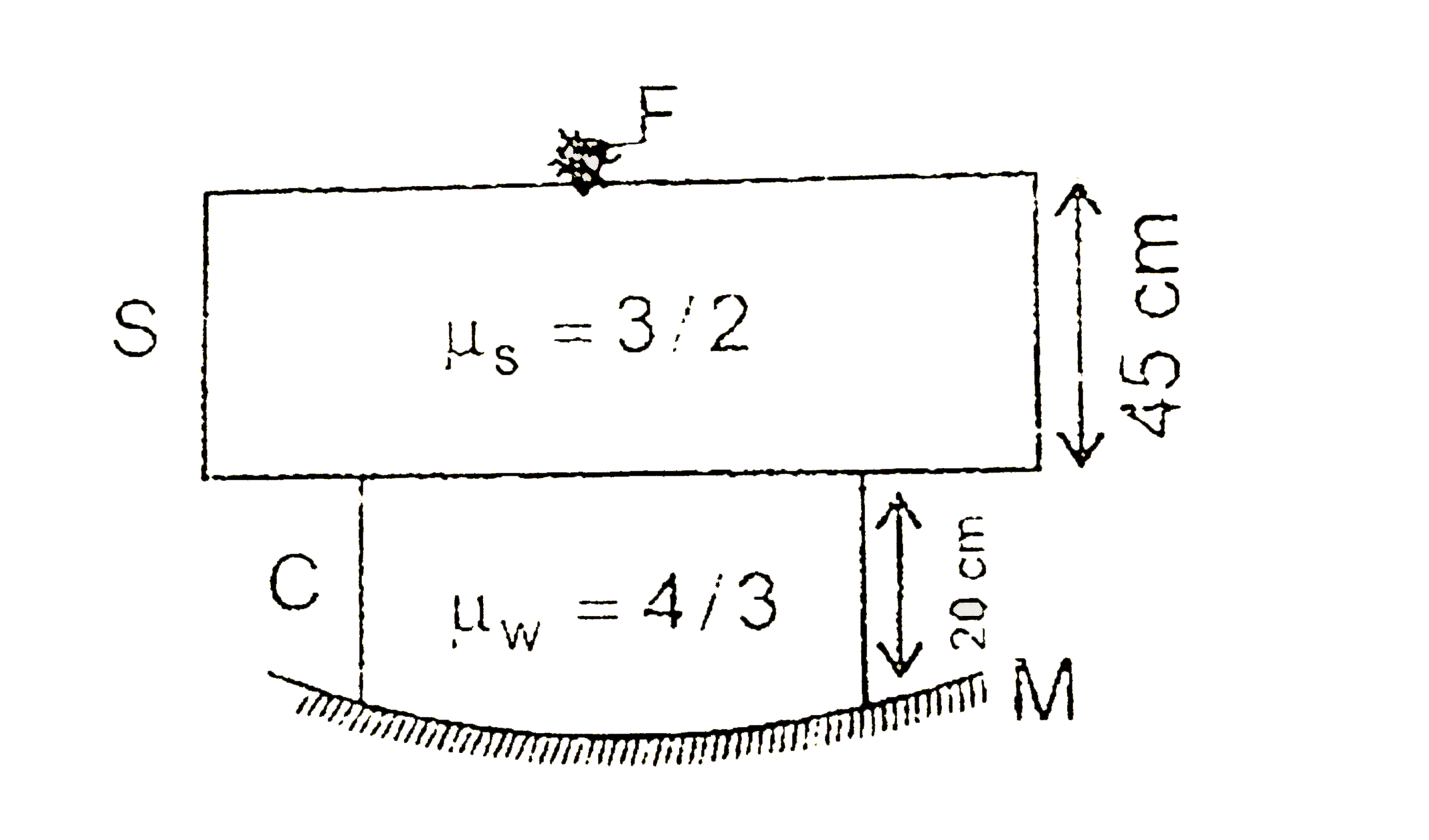
A fly `F` is sitting an a glass `S 45 cm` thick `&` of refractive index `3//2`. The slab covers the top of a container `C` containing water `(R.I.4//3)` upto a height of `20 cm`. Bottom of container is closed by a concave mirror `M` fo radius of curvature `40 cm`. Lacate the final image formed by all refractions `&` reflection assuming paraxial rays.

Text Solution

Verified by Experts

The correct Answer is:
`(45)/(2)` cm below F

`x=45((4)/(3)) xx (2)/(3)= 40 cm`
So total distance = 60 cm

f = -20 cm
`(1)/(v) +(1)/(u) = (1)/(f)`
`implies (1)/(v) + (1)/((-60)) = (1)/(-20)`
`implies (1)/(v) = (1)/(60) - (1)/(20)= (-40)/(60 xx 20) implies v = -30`
So image after reflection from mirror will be at d=30 cm. So 10 cm above 'A'
After refraction at A : It will be at `(10)/((4//3))(3//2) = (90)/(8) = (45)/(4)` cm
so distance from 'B' layer is `(45 - (45)/(4)) = 45 xx (3)/(4)`
So final image after refraction at 'A' will be at :
`45 xx (3)/(4) xx (2)/(3) = (45)/(2)` from 'A' surface
Promotional Banner

Topper's Solved these Questions

  • GEOMETRICAL OPTICS

    ALLEN|Exercise EXERCISE-04[B]|18 Videos
  • GEOMETRICAL OPTICS

    ALLEN|Exercise EXERCISE-05 (A)|35 Videos
  • GEOMETRICAL OPTICS

    ALLEN|Exercise EXERCISE-3|12 Videos
  • CURRENT ELECTRICITY

    ALLEN|Exercise EX.II|66 Videos
  • GRAVITATION

    ALLEN|Exercise EXERCISE 4|9 Videos

Similar Questions

Explore conceptually related problems

Water is filled in a container upto a height of 5cm . There is a concave mirror of radius of curvature 40cm . A person just above the surface observes image of 'A' . The distance of image from water surface is (mu_("water")=1.33) :

An object is seen through a glass slab of thickness 36 cm and refractive index 3//2. The observer, and the slab are dipped in water (mu=4//3). The shift produced in the position of the object is

A coin is placed at the bottom of a beaker containing water (refractive index=4/3) at a depth of 12cm. By what height the coin appears to be raised when seen from vertical above ?

A container is filled with water (mu=1.33) upto a height of 33.25cm. A convex mirror I s placed 15cm above the water level and image of an object placed at the bottom is formed 25cm below the water level. Focal length of the mirror is

A glass slab of thickness 3cm and refractive index 1.5 is placed in front of a concave mirror of focal length 20cm. Where should a point object be placed if it is to image on to itself?

A particle lies on the bottom of a tank T filled with water upto s height of 90 cm . The medium above the surface of water is of R.I = 1.2 above which there is mirror M . Beyond the mirror M the region contains air ( mu =1 ). The distance of the image formed by the mirrro after reflection of the rays coming from P is ____ cm (w.r.t mirror). .

A coin is placed at the bottom of a glass trough containing water (refractive index = 4/3 ) up to a height 20 cm. At what depth it will appear when it is viewed from air, vertically above the coin. Draw a suitable ray diagram in support of your answer.

An object O is kept in air and a lens of focal length 10 cm (in air) is kept at the botton of a container which is filled upto a height 44 cm by water. The refractive index of water is 4//3 and that of glass is 3//2 . The botton of the container is closed by a thin glass slab of refractive index 3//2 . Find the distance (in cm ) of the final image formed by the system from botton of container (refer to figure shown below).

A slab of glass of refractive index 1.5 and thickness 3cm is placed with the faces perpendicular to the principle axis of a concave mirror. If the radius of curvature of the mirror is 10cm , the distance at which an object must be placed from the mirror so that the image coincides with the object is

A small bulb (assumed to be a point source) is placed at the bottom of a tank containing water to a depth of 80 cm . Find out the area of the surface of water through which light from the bulb can emerge. Take the value of refractive index of water to be 4//3 .

ALLEN-GEOMETRICAL OPTICS-EXERCISE-04[A]
  1. Two concave mirrors each of radius of curvature 40cm are placed such t...

    Text Solution

    |

  2. A balloon is rising up along the axis of a concave mirror of radius of...

    Text Solution

    |

  3. A fly F is sitting an a glass S 45 cm thick & of refractive index 3//...

    Text Solution

    |

  4. An air bubble inside a glass slab (µ=1.5) appears 6 cm when viewed fro...

    Text Solution

    |

  5. A slab of glass, of thickness 6 cm and refractive index mu=1.5 is plac...

    Text Solution

    |

  6. A point object is placed 33cm from a convex mirror of curvature radiu...

    Text Solution

    |

  7. A long solid cylindrical glass rod of refractive index 3/2 is immersed...

    Text Solution

    |

  8. Light from a luminious point on the lower face of a rectangular glass ...

    Text Solution

    |

  9. A rod made of glass, (mu = 1.5) and of square cross-section is bent in...

    Text Solution

    |

  10. A fish is rising up veritcally inside a pond with velocity 4 m//s, and...

    Text Solution

    |

  11. A ray of light falls on a transparent sphere with centre at C as shown...

    Text Solution

    |

  12. A narrow parallel beam of llight is incident on a transparent sphere o...

    Text Solution

    |

  13. A thin equiconvex lens made of glass of refractive index 3//2 and of ...

    Text Solution

    |

  14. In Figure ., L is a converging lens of focal length 10cm and M Iis a c...

    Text Solution

    |

  15. An object is kept at a distance of 16 cm from a thin lens and the imag...

    Text Solution

    |

  16. A point source of light is kept at a distance of 15 cm from a convergi...

    Text Solution

    |

  17. A lens placed between a candle and a fixed screen forms a real tr...

    Text Solution

    |

  18. Consider a 'beam expander' which consists of two converging lenses of ...

    Text Solution

    |

  19. A prism of refractive index sqrt2 has refractive angle 60^@. In the or...

    Text Solution

    |

  20. An equilateral prism deviates a ray through23^(@)for two angles of inc...

    Text Solution

    |

