Home
Class 12
PHYSICS
A rod made of glass, (mu = 1.5) and of s...

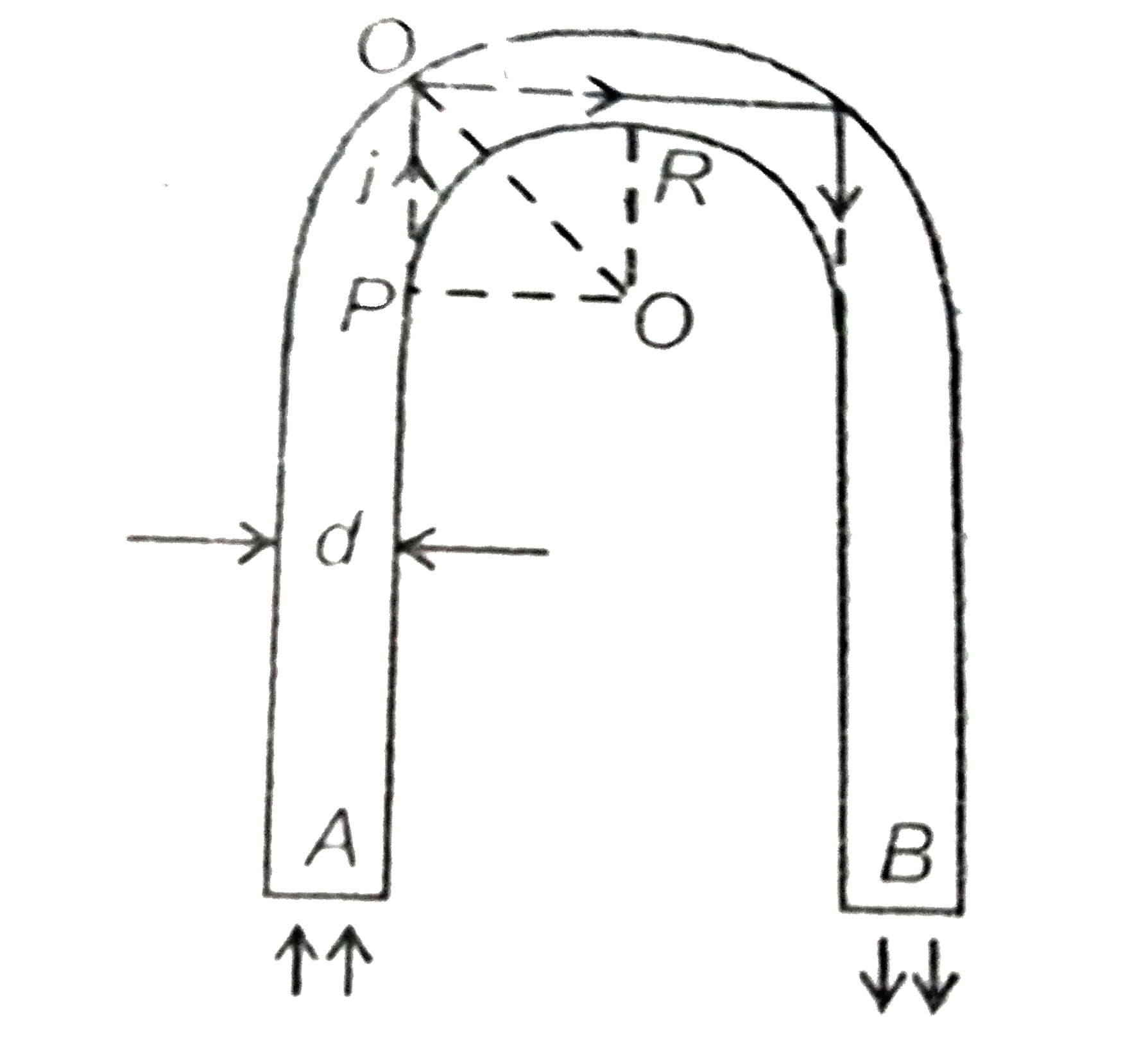
A rod made of glass, `(mu = 1.5)` and of square cross-section is bent into the shape shown in figure. A parallel beam of light falls perpendicularly on the plane flat surface A. Referring to the diagram, d is the width of a side and R the radius of inner semi-circle. Find the maximum value of ratio `((d)/(R))` so that all light entering the glass through surface A emerge from the glass through B.

Text Solution

Verified by Experts

The correct Answer is:
43467

sin c = `(R)/(R+d) = (1)/(1.5) implies (R)/(R+d) gt (1)/(1.5)`
`implies (1)/(1 +d//R) gt (1)/(1.5) implies 1.5 gt 1 + (d)/(R) implies (d)/(R) lt (1)/(2)`
Promotional Banner

Topper's Solved these Questions

  • GEOMETRICAL OPTICS

    ALLEN|Exercise EXERCISE-04[B]|18 Videos
  • GEOMETRICAL OPTICS

    ALLEN|Exercise EXERCISE-05 (A)|35 Videos
  • GEOMETRICAL OPTICS

    ALLEN|Exercise EXERCISE-3|12 Videos
  • CURRENT ELECTRICITY

    ALLEN|Exercise EX.II|66 Videos
  • GRAVITATION

    ALLEN|Exercise EXERCISE 4|9 Videos

Similar Questions

Explore conceptually related problems

A rod made of glass (mu = 1.5) and of square cross-section is equal is bent into the shape shown in figure. A parallel beam of light falls perpendicurly on the plane flat surface . A . Referring to the diagram, d is the width of a side & R is radius of inner semicircle. find the maximum value of ratio (d)/(R) so that all light entering the glass through surface A emerge from the glass through surface B.

A rod of glass ( mu = 1.5) and of square cross section is bent into the shape shown in the figure. A parallel beam of light falls on the plane flat surface A as shown in the figure. If d is the width of a side and R is the radius of circular arc then for what maximum value of (d)/(R) light entering the glass slab through surface A emerges from the glass through B

A parallel beam of light is incident normally on the flat surface of a hemisphere of radius 6 cm and refractive index 1.5 , placed in air as shown in figure (i). Assume paraxial ray approxiamtion. .

A glass rod having square cross-section is bent into the shape as shown in the figure. The radius of the inner semi-circle is R and width of the rod is d. Find the minimum value of d//R so that the light that enters at A will emerge at B. Refractive index of glass is mu=1.5

Find the maximum angle of refraction when a light ray is refracted from glass (mu= 1.50) to air.

A parallel beam of light emerges from the opposite surface of the sphere when a point source of light lies at the surface of the sphere. The refractive index of the sphere is

What should be the value of refractive index n of a glass rod placed in air, so that the light entering through the flat surface of the rod does not cross the curved surface of the rod?

A transparent sphere of radius R ahs a cavity of radius R//2 as shown in figure,. Find the refractive index of the sphere if a parallel beam of light falling on left sureface focuses at point P.

A portion of a straight glass rod of diameter 2 cm and refractive index 1.5 is bent into an arc of a circle of radius R cm and a parallel beam of light is incident on it as shown in figure. Find the smallest R which permits all the light to pass around the arc.

Light is incident at an angle i on one planer end of a transparent cylinderical rod of refractive index mu. Find the least value of mu so that the light entering the rod does not emerge from the curved surface of the rod irrespective of the value of i.

ALLEN-GEOMETRICAL OPTICS-EXERCISE-04[A]
  1. A balloon is rising up along the axis of a concave mirror of radius of...

    Text Solution

    |

  2. A fly F is sitting an a glass S 45 cm thick & of refractive index 3//...

    Text Solution

    |

  3. An air bubble inside a glass slab (µ=1.5) appears 6 cm when viewed fro...

    Text Solution

    |

  4. A slab of glass, of thickness 6 cm and refractive index mu=1.5 is plac...

    Text Solution

    |

  5. A point object is placed 33cm from a convex mirror of curvature radiu...

    Text Solution

    |

  6. A long solid cylindrical glass rod of refractive index 3/2 is immersed...

    Text Solution

    |

  7. Light from a luminious point on the lower face of a rectangular glass ...

    Text Solution

    |

  8. A rod made of glass, (mu = 1.5) and of square cross-section is bent in...

    Text Solution

    |

  9. A fish is rising up veritcally inside a pond with velocity 4 m//s, and...

    Text Solution

    |

  10. A ray of light falls on a transparent sphere with centre at C as shown...

    Text Solution

    |

  11. A narrow parallel beam of llight is incident on a transparent sphere o...

    Text Solution

    |

  12. A thin equiconvex lens made of glass of refractive index 3//2 and of ...

    Text Solution

    |

  13. In Figure ., L is a converging lens of focal length 10cm and M Iis a c...

    Text Solution

    |

  14. An object is kept at a distance of 16 cm from a thin lens and the imag...

    Text Solution

    |

  15. A point source of light is kept at a distance of 15 cm from a convergi...

    Text Solution

    |

  16. A lens placed between a candle and a fixed screen forms a real tr...

    Text Solution

    |

  17. Consider a 'beam expander' which consists of two converging lenses of ...

    Text Solution

    |

  18. A prism of refractive index sqrt2 has refractive angle 60^@. In the or...

    Text Solution

    |

  19. An equilateral prism deviates a ray through23^(@)for two angles of inc...

    Text Solution

    |

  20. The figure shows the path of a ray passing through an equiangular pris...

    Text Solution

    |

