Home
Class 12
PHYSICS
A rectangular slab ABCD, of refractive i...

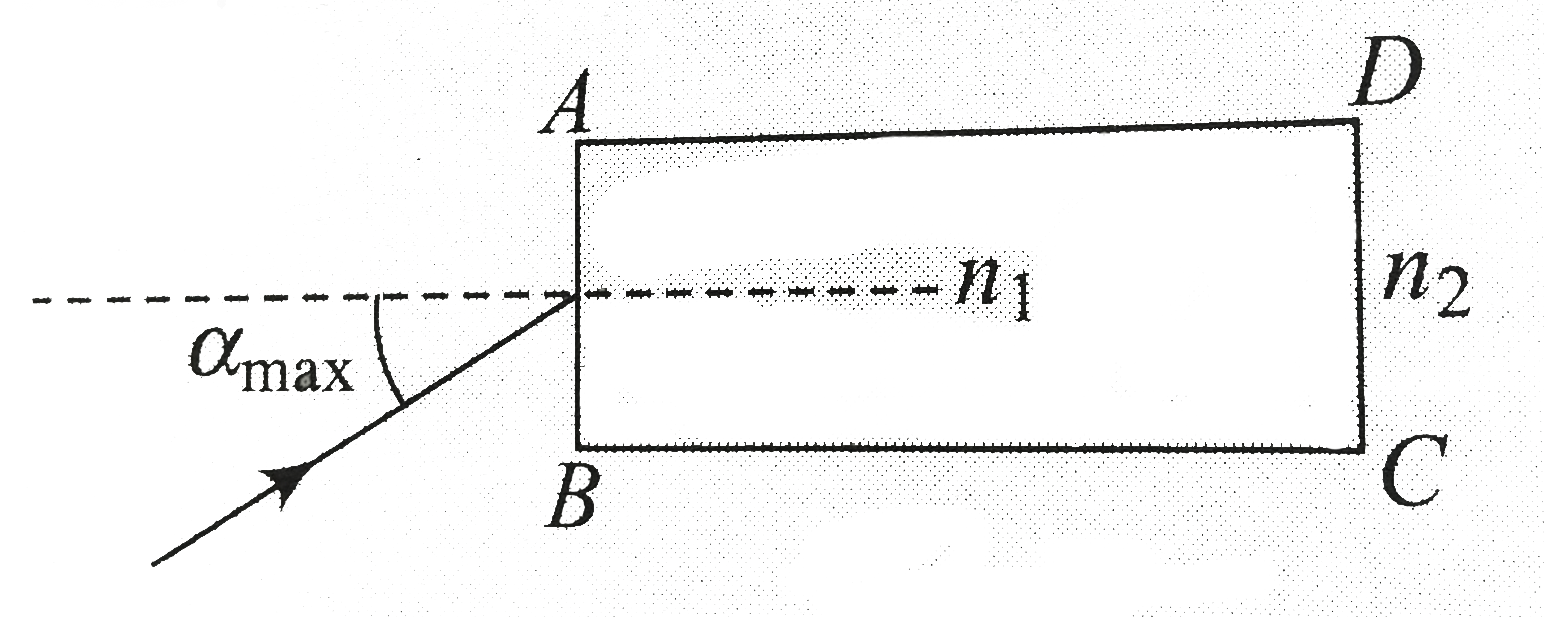
A rectangular slab ABCD, of refractive index `n_1` , is immersed in water of refractive index `n_2(n_1 lt n_2)`. A ray of light is incident at the surface AB of the slab as shown in Fig. Find the maximum value of angle of incidence `alpha_(max)`, such that the ray comes out only from the other surface CD.

A

`sin^(-1)[(n_(1))/(n_(2)) "cos"(sin^(-1).(n_(2))/(n_(1)))]`

B

`sin^(-1)[n_(1) "cos"(sin^(-1).(1)/(n_(2)))]`

C

`sin^(-1)((n_(1))/(n_(2)))`

D

`sin^(-1)((n_(2))/(n_(1)))`

Text Solution

Verified by Experts

The correct Answer is:
A

Rays come out only form CD , means rays after refraction from AB get total internally reflected at AD .

From the figure :
`r_(1) + r_(2) = 90^(@)`
`r_(1) = 90^(@) - r_(2)`
`(r_(1))_("max") = theta_(C)`
[for total internal reflection at AD]
where `"sin"theta_(C) = (n_(2))/(n_(1)) "or" theta_(C) = sin^(-1)((n_(2))/(n_(1)))`
`therefore (r_(1))_("max") = 90^(@) - theta_(C)`
Now applying Snell's law at face AB:
`(n_(1))/(n_(2)) = ("sin"alpha_("max"))/("sin"(r_(1))_("max")) = ("sin"alpha_("max"))/("sin"(90^(@) - theta_(C))) = ("sin"alpha_("max"))/("cos"theta_(C))`
or `"sin" alpha_("max") = (n_(1))/(n_(2))"cos"theta_(C)`
`therefore alpha_("max") = sin^(-1)[(n_(1))/(n_(2)) "cos"theta_(C)] = sin^(-1)[(n_(1))/(n_(2)) "cos"sin^(-1)((n_(2))/(n_(1)))]`
Promotional Banner

Topper's Solved these Questions

Similar Questions

Explore conceptually related problems

A glass prism of refractive index 1.5 is immersed in water of refractive index 4/3. A light ray incident normally on face AB is totally reflected at face AC if

A ray of light is incident on the surface of a glass plate of refractive index sqrt(3) at the polarising angle . The angle of incidence and angle of refraction of the ray is

A ray of light is incident on a glass sphere of refractive index 3/2. What should be the angle of incidence so that the ray which enters the sphere does not come out of the sphere ?

A ray of light is incident on a parallel slab of thickness t and refractive index n. If the angle of incidence theta is small, than the lateral displacement in the incident and emergent ray will be

AB and CD are two slabs. The medium between the slabs has refractive index 2 . Find the minium angle of incidence of Q , so that the ray is totally reflected by both the slabs .

A prism having refractive index sqrt2 and refractive angle 30^@ has one of the refractive surfaces polished. A beam of light incident on the other surfaces will trace its path if the angle of incidence is

A cubical block of glass of refractive index n_1 is in contact with the surface of water of refractive index n_2. A beam of light is incident on vertical face of the block. After refraction a total internal reflection at the base and refraction at the opposite face take place. The ray emerges at angle theta as shown. The value of theta is given by

Refractive index of a glass cube is sqrt(2) . A ray of light is incident on left face of the cube as shown. Right face of a glass cube is silvered. If the total deviation suffered by the ray when it comes out of the glass cube is 45n (in degree) then find n :

A right angles prism (45^(@),90^(@), 45^(@)) of refractive index n has a plate of refractive index (n_(1)ltn) cemented to its diagonal face. The assembley is in air. A ray is incident on AB. a. Calculate the angle of incidence at AB for which the ray strikes the diagonal face at the critical angle. b. Assuming n=1.351 , calculate the angle of incidence at AB for which the refracted rey passes through the diagonal face undeviated.

A ray of light is incident on a surface of glass slab at an angle 45^@ . If the lateral shift produced per unit thickness is 1//sqrt3 , the angle of refraction produced is

ALLEN-GEOMETRICAL OPTICS-EXERCISE-05 (B)
  1. A diverging beam of light from a point source S having divergence angl...

    Text Solution

    |

  2. A point source of light ,S is placed at a distance L in front of th...

    Text Solution

    |

  3. A rectangular slab ABCD, of refractive index n1 , is immersed in water...

    Text Solution

    |

  4. A ray of light passes through four transparent media with refractive i...

    Text Solution

    |

  5. A given ray of light suffers minimum deviation in an equilateral prism...

    Text Solution

    |

  6. An observer can see through a pin-hole the top end of a thin rod of...

    Text Solution

    |

  7. Which one of the following sperical lenses does not exhibit dispersion...

    Text Solution

    |

  8. Two plane mirrors A and B are aligned parallel to each other as shown ...

    Text Solution

    |

  9. The size of the image of an object, which is at infinity, as formed by...

    Text Solution

    |

  10. A ray of light is incident at the glass - water interface at an angle ...

    Text Solution

    |

  11. White light is incident on the interface of glass and air as shown in ...

    Text Solution

    |

  12. An equilateral prism is placed on a horizontal surface. A ray PQ is in...

    Text Solution

    |

  13. A point object is placed at the center of a glass sphere of radius 6cm...

    Text Solution

    |

  14. A container is filled with water (mu=1.33) upto a height of 33.25cm. A...

    Text Solution

    |

  15. A convex lens is in contact with a concave lens. The magnitude of the...

    Text Solution

    |

  16. A point object is placed at a distance of 20 cm from a thin plano-conc...

    Text Solution

    |

  17. A biconvex lens of focal length f forms a circular image of radius r o...

    Text Solution

    |

  18. A ray of light travelling in water is incident on its surface open to ...

    Text Solution

    |

  19. In an experiment to determine the focal length (f) fo a concave mirror...

    Text Solution

    |

  20. Two beam of red and violet color are made to pass separately through a...

    Text Solution

    |

