Home
Class 12
PHYSICS
A transparent slab of thickness d has a ...

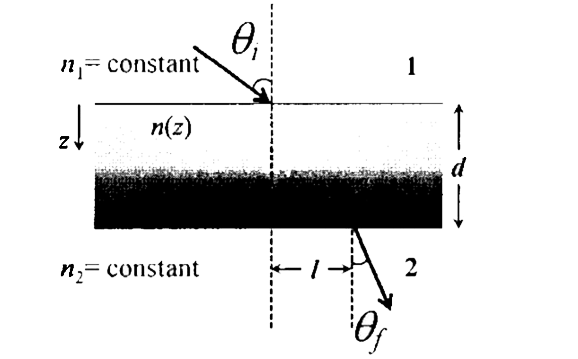
A transparent slab of thickness d has a refractive index n(z) that increases with z. Here z is the vertical distance inside the slab, measured from the top. The slab is placed between two media with uniform refractive indices `n_(1)` and `n_(2)(gtn_(1))`, `theta_(0)`, from medium 1 and emerges in medium 2 with refraction angle `theta_(t)`with a lateral displacement l.
Which of the following statement(s) is (are) true?

Text Solution

Verified by Experts

The correct Answer is:

ABD

For parallel slab
`n_(1) "sin"theta_(t) = n_(2) "sin"theta_(f)`
And l depends on refractive angle in slab
`therefore ` l depends on refractive index of slab and independent of `n_(2)`
Promotional Banner

Topper's Solved these Questions

Similar Questions

Explore conceptually related problems

A ray of light is incident on a parallel slab of thickness t and refractive index n. If the angle of incidence theta is small, than the lateral displacement in the incident and emergent ray will be

If a ray of light is incident from rarer medium at an angle 45° on the surface which separates two medium having refractive indices 1 and sqrt(2) for rarer and denser medium, then angle of deviation of refractive ray with incident ray is

Two optical media of refractive indices n_1 and n_2 contain x and y waves of the same colour in the same thickness. Then their relative refractive index n_1//n_2

A slab of refractive index mu is placed in air and light is incident at maximum angle theta_0 from vertical. Find minimum value of mu for which total internal reflection takes place at the vertical surface.

Consider a ray of light incident from air onto a slab of glass (refractive index n) of width d, at an angle theta . The phase difference between the ray reflected by the top surface of the glass and the bottom surface is

Consider a ray of light incident from air onto a slab of glass (refractive index n) of width d, at an angle theta . The phase difference between the ray reflected by the top surface of the glass and the bottom surface is

Consider a ray of light incident from air onto a slab of glass (refractive index n) of width d, at an angle theta . The phase difference between the ray reflected by the top surface of the glass and the bottom surface is

A spot is placed on the bottom of a slab made of transperent material of refractive index 1.5. The spot is viewed vertically from the top when it seems to be raised by 2 cm. Then, the height of the slab is

A light wave travels through three transparent materials of equal thickness rank in order from the highest to lowest the indices of refraction n_(1),n_(2) and n_(3) .

A transparent thin film of uniform thickness and refractive index n_(1) =1.4 is coated on the convex spherical surface of radius R at one end of a long solid glass cylinder of refractive index n_(2) =1.5 , as shown in the figure. Rays of light parallel to the axis of the cylinder traversing through the film from air to glass get focused at distance f_(1) from the film, while rays of light traversing from glass to air get focused at distance f_(2) from the film, Then
