Home
Class 12
PHYSICS
A convex lens of focal length 15cm and a...

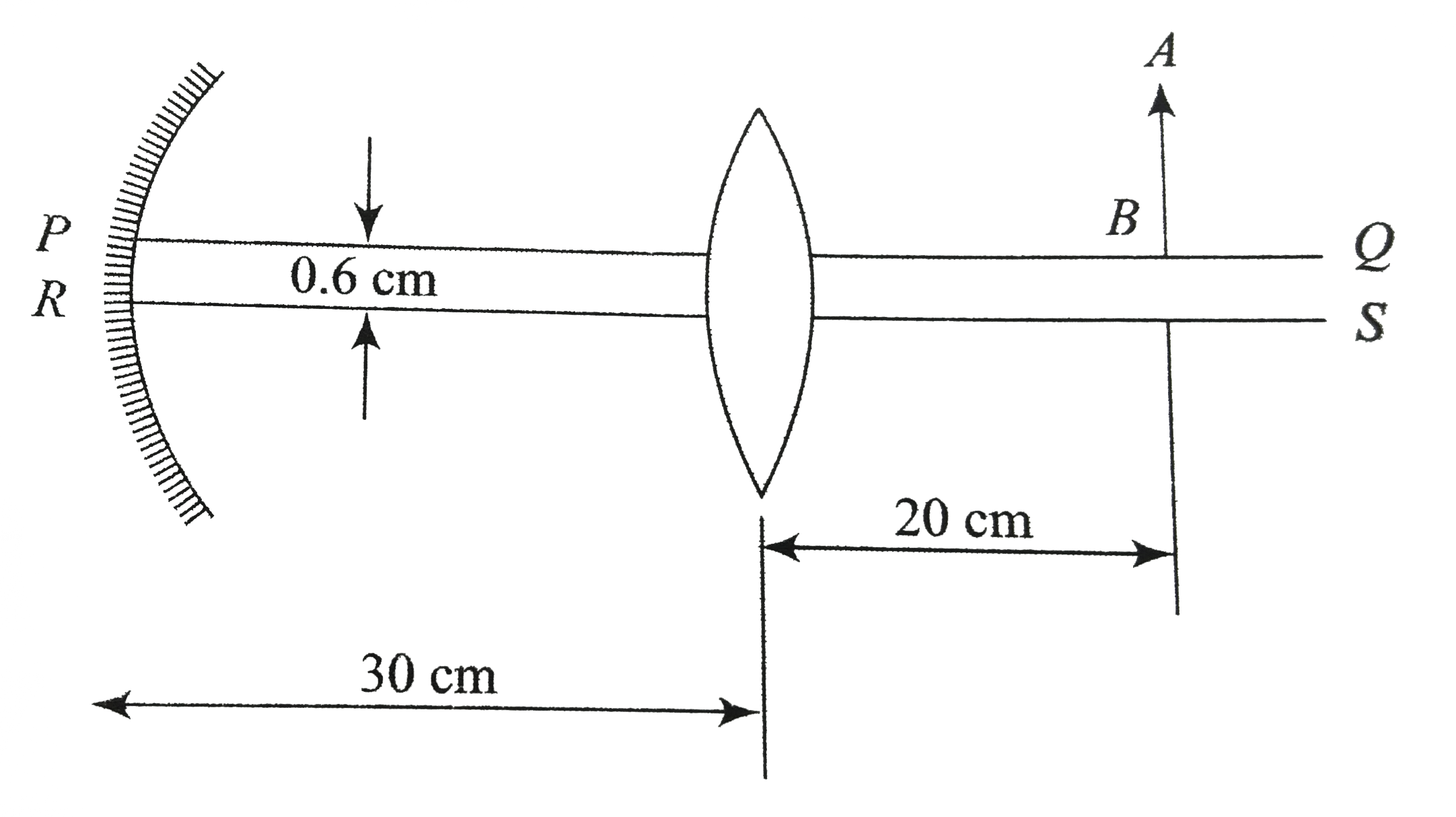
A convex lens of focal length 15cm and a concave mirror of focal length 30cm are kept with their optic axes PQ and RS paralledl but separated in vertical direction by 0.6 cm as shown in Figure. The distance between the lens and mirror is 30cm. An upright object Ab of height 1.2 cm is placed on the optics axis PQ of the lens at a distance of 20 cm from the lens. If `A^(')B^(')` is the image after refraction from the lens and reflection from the mirror, find the distance of `A^(')B^(')` from the pole of the mirror and obtain its magnification. Also, locate positions of `A^(') ` and `B^(')` with respect to the optic axis RS.

Text Solution

Verified by Experts

The correct Answer is:
15 cm ,`(3)/(2)`

(a) Rays coming from object AB first refract from the lens and then reflect from the mirror .
Refraction from the lens :
` u =-20 cm , f = +15 cm `
Using lens formula `(1)/(v) - (1)/(u) = (1)/(f) , (1)/(v) - (1)/(-20) = (1)/(15)`
`therefore v = +60` cm and linear magnification ,
`m_(1) = (v)/(u) = (+60)/(-20) = -3 ` i.e, , first image formed by the lens will be 60 cm from it (or 30 cm from mirror) towards left and 3 times magnified but inverted
Length of first image `A_(1) , B_(1)` would be `1.2 xx 3 = 3.6` cm (inverted).

Reflection from mirror : Image formed by lens `(A_(1) , B_(1))` will behave like a virtual object for mirror at a distance of 30 cm from it as shown . Therefore Using mirror formula ,
`(1)/(v) + (1)/(u) = (1)/(f) "or" (1)/(v) + (1)/(30) = - (1)/(30) therefore v = -15 cm`
& linear magnification , `m_(2) = -(v)/(u) = (-15)/(+30) = +(1)/(2)`
i.e. final image A'B' will be located at a distance of 15 cm from the mirror (towards right) and since magnification is `+^((1)/(2))` length of final image would be `3.6 xx (1)/(2) = 1.8 "cm "`
`therefore A'B' = 1.8` cm
Point `B_(1)` is 0.6 cm above the optic axis of mirror , therefore , its image B' would be `(0.6)(1)/(2) = 0.3` cm
above optic axis . Similarly , point `A_(1)` is 3 cm below the optic axis , therefore , its image A' will be `3 xx (1)/(2) = 1.5 ` cm below the optic axis as shown below :

Total magnification of the image .
`m = m_(1) xx m_(2) = (-3) (+(1)/(2)) = -(3)/(2)`
`therefore A'B' = (m)(AB) = (-(3)/(2))(1.2) = -1.8` cm
Note that , there is no need of drawing the ray diagram if not asked in the questions .
Promotional Banner

Topper's Solved these Questions

Similar Questions

Explore conceptually related problems

A convex lens of focal length 15 cm and concave mirror of focal length 30 cm are kept their optical axes PQ and RS parallel but separated in vertical direction by 0.6 m, as shown. The distance between the lens and mirror is 30 cm. An upright object AB of height 1.2 m is placed on the optic axic PQ of the lens at a distance of 20 cm from the lens. Find the linear magnification of the first image after refraction from the lens.

A convex lens of focal length 15 cm and concave mirror of focal length 30 cm are kept their optical axes PQ and RS parallel but separated in vertical direction by 0.6 m, as shown. The distance between the lens and mirror is 30 cm. An upright object AB of height 1.2 m is placed on the optic axic PQ of the lens at a distance of 20 cm from the lens. Find the linear magnification of the second image after reflection from the mirror.

A convex lens of focal length 15 cm and concave mirror of focal length 30 cm are kept their optical axes PQ and RS parallel but separated in vertical direction by 0.6 m, as shown. The distance between the lens and mirror is 30 cm. An upright object AB of height 1.2 m is placed on the optic axic PQ of the lens at a distance of 20 cm from the lens. As in the lat problem, find the distance of A' below the optic axis of lens.

A convex lens of focal length 15 cm and concave mirror of focal length 30 cm are kept their optical axes PQ and RS parallel but separated in vertical direction by 0.6 m, as shown. The distance between the lens and mirror is 30 cm. An upright object AB of height 1.2 m is placed on the optic axic PQ of the lens at a distance of 20 cm from the lens. If A'B' is the final image formed, A' corresponding to A and B' corresponding to B, find the distance of B' below optics axis of lens.

A concave mirror of focal length 20 cm and a convex lens of focal length 10 cm are kept with their optic axes parallel but separated by 0.5 mm as shown in the figure. The distance between the the lens and mirror in 10 cm. An object of height 3 mm is placedon the optic axis of lens at a distnace between the lens and mirror is 10 cm. An object of height 3 mm is placed on the optic axis of lens at a distance 15 cm from the lens. Find the length of the image formed the mirror in mm.

A convex lens A of focal length 20cm and a concave lens B of focal length 10 cm are kept along the same axis with a distance d between them. If a parallel beam, then d is

A convex lens A of focal length 20cm and a concave lens B of focal length 10 cm are kept along the same axis with a distance d between them. If a parallel beam, then d is

A convex lens of focal length 40 cm is in contact with a concave lens of focal length 25 cm. The power of the combination is

A convex lens of focal length 15 cm is placed on a plane mirror. An object is placed at 30 cm from the lens. The image is

A converging lens of focal length 15 cm and a converging mirror of focal length 10 cm are placed 50 cm apart with common principal axis. A point source is placed in between the lens and the mirror at a distance of 40 cm from the lens. Find the locations of the two images formed.

