Home
Class 12
PHYSICS
Two moving particles P and Q are 10 ...

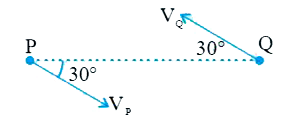
Two moving particles P and Q are 10 m apart at any instant. Velocity of P is 8 m/s at `30^(@)`, from line joining the P and Q. Velocity of Q is 6 m/s at `30^(@)`.Calculate the angular velocity of P with respect to Q.

Text Solution

Verified by Experts

`omega_(PQ)=(8sin30^(@)-(-6sin30^(@)))/(10)=0.7rad//s`
Promotional Banner

Topper's Solved these Questions

  • CIRCULAR MOTION

    ALLEN|Exercise EXERCISE (S-1)|8 Videos
  • CIRCULAR MOTION

    ALLEN|Exercise Dynamics of circular motion|6 Videos
  • BASIC MATHS

    ALLEN|Exercise Question|1 Videos
  • CURRENT ELECTRICITY

    ALLEN|Exercise EX.II|66 Videos

Similar Questions

Explore conceptually related problems

Two moving particles P and Q are 10cm apart at any instant. Velocity of P is 8 m//s at 30^(@) , from line joining the P and Q and velocity of Q is 6m//s at 30^(@) . Calculate the angular velocity of P w.r.t. Q

Q. Species P and S are respectively:

Two particles P and Q are projected simultaneously away from each other from a point A as shown in figure. The velocity of P relative to Q in ms^(-1) at the instant when the motion of P is horizontal is

Two particles P and Q are moving as shown in the figure. At this moment of time the angular speed of P w.r.t. Q is

Two particles P and Q are moving on circle. At a certain instant of time both the particles and diametrically opposite and P has tangential acceleration 8 m//s^(2) and centripetal acceleration 5 m//s^(2) whereas Q has only e centripetal acceleration of 1 m//s^(2) . At that instant acceleration ("in" m//s^2) of P with respect to Q is

The displacement-time graphs of two particles P and Q are as shown in the figure. The ratio of their velocities V_P and V_Q will be

A two particles P and Q are separated by distance d apart. P and Q move with velocity v and u making an angle 60^@ and theta with line PQ the graph between their relative separation (8) when time t is shown in figure (2). The velocity v in terms of u

A force P acts on a particle so as to accelerate it from rest to certain velocity. If P is replaced then by Q which decelerates it to rest.

A sphere P of mass m moving with velocity u collides head on with another sphere Q of mass m which is at rest . The ratio of final velocity of Q to initial velocity of P is ( e = coefficient of restitution )

Two particles p and q located at distances r_p and r_q respectively from the centre of a rotating disc such that r_p gt r_q .
