Home
Class 12
PHYSICS
A car is moving along a banked road laid...

A car is moving along a banked road laid out as a circle of radius r . (a) What should be the banking angle `theta` so that the car travelling at speed v needs no frictional force from tyres to negotiate the turn ? (b) The coefficient of friction between tyres and road are `mu_(s) = 0.9` and `mu_(k) = 0.8` . At what maximum speed can a car enter the curve without sliding toward the top edge of the banked turn ?

Text Solution

Verified by Experts
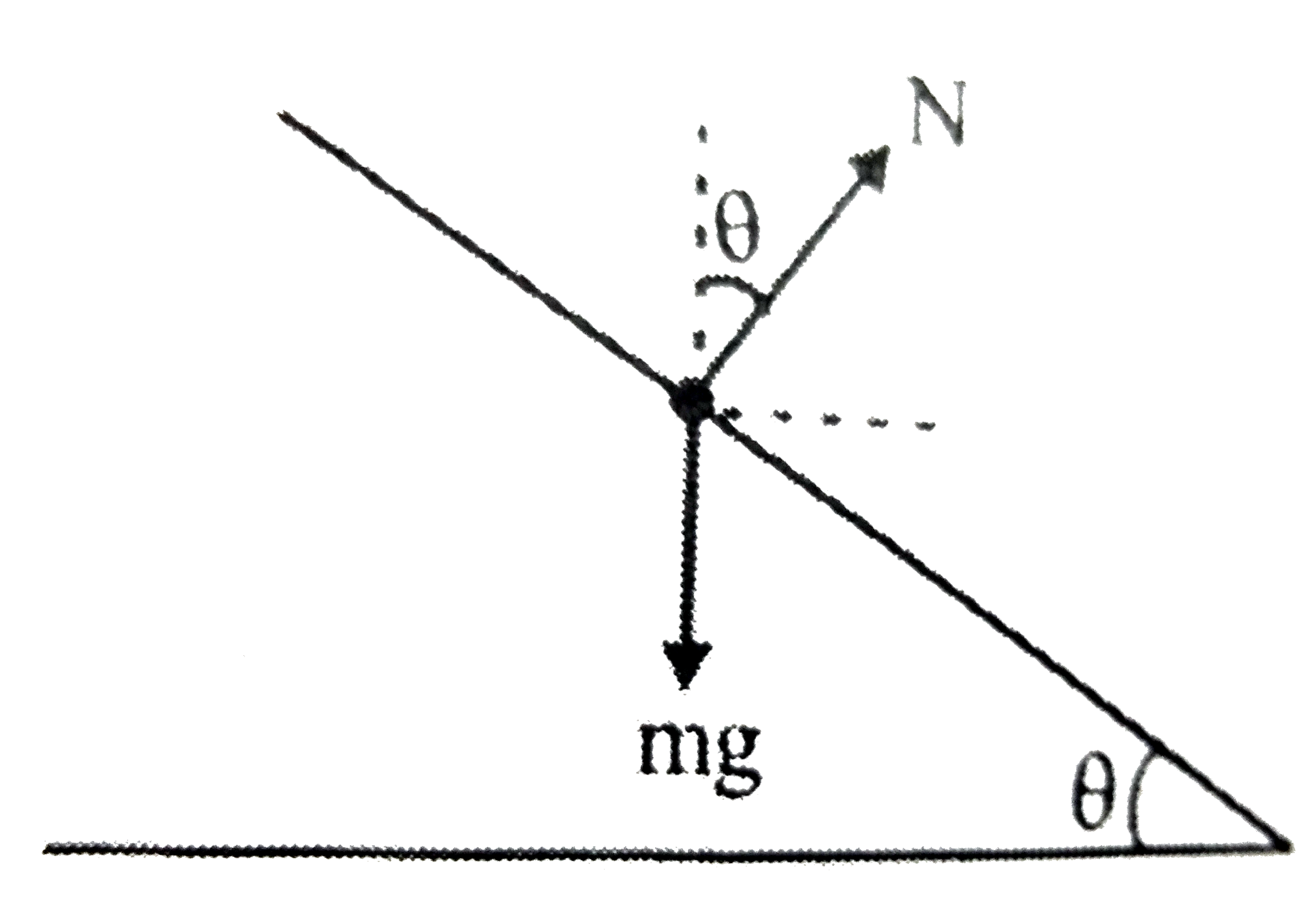
`N sin theta=(mv^(2))/(r)and N cos theta=mg Rightarrow tan theta=(v^(2))/(rg)`
NOTE: In above case friction does not play any role in negotiating the turn.
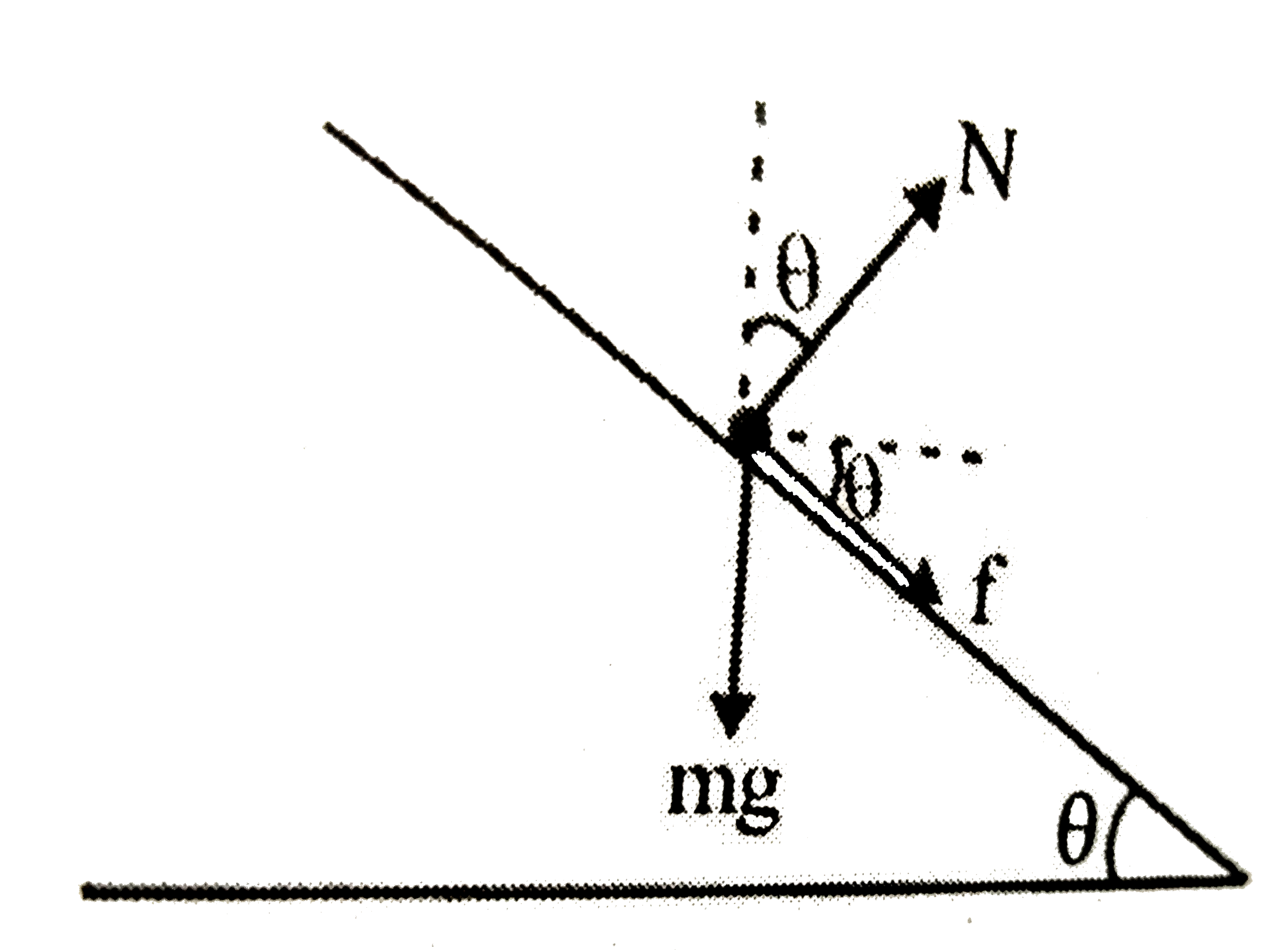
(b) If the driver moves faster than the speed mentioned above, a friction force myst act parallel to the road, inward towards center of the turn.
`Rightarrow Fcostheta+Nsintheta=(mv^(2))/(r)and N cos theta=mg+f sin theta`
For maximum speed of f=`mu N`
`N (mucos theta+sin theta)=(mv^(2))/(r)and N (cos theta-musin theta)=mg`
`=(v^(2))/(rg)=(sin theta+mucostheta)/(cos theta-mu sin theta)Rightarrow v=sqrt(((sin theta+mu cos theta)/(cos theta-mu sin thea)))rg`

Promotional Banner

Topper's Solved these Questions

  • CIRCULAR MOTION

    ALLEN|Exercise EXERCISE (S-1)|8 Videos
  • CIRCULAR MOTION

    ALLEN|Exercise Dynamics of circular motion|6 Videos
  • BASIC MATHS

    ALLEN|Exercise Question|1 Videos
  • CURRENT ELECTRICITY

    ALLEN|Exercise EX.II|66 Videos

Similar Questions

Explore conceptually related problems

A car has to move on a level turn of radius 45 m. If the coefficient of static friction between the tyre and the road is mu_s=2.0, find the maximum speed the car can take without skidding.

If the coefficient of friction between the tyres of a car and the road is mu_(k) , show that the maximum stopping distance of the car when moving with a velocity v is v^(2)//2mu_(k)g

The coefficient of friction between the tyres and the road is 0.1. The maximum speed with which a cyclist can take a circular turn of radius 3 m without skidding is ("Take g"=10ms^(-2))

A car is taking turn on a circular path of radius R. If the coefficient of friction between the tyres and road is mu , the maximum velocity for no slipping is

What will be the maximum speed of a car on a road turn of radius 30 m, if the coefficient of friction between the tyres and the road is 0.4? (Take g=9.8m//s^(2) )

What will be maximum speed of a car on a curved road of radius 30 m , If the coefficient of friction between the tyres and the road is 0.4? (g=9.8 m//s^(2))

What is the minimum stopping distance for a vehicle of mass m moving with speed v along a level road. If the coefficient of friction between the tyres and the road is mu .

Find the maximum speed at which a car can take turn round a curve of 30 cm radius on a level road if the coefficient of friction between the tyres and the road is 0.4. Take g = 10 ms^(-2) .

A car is taking a turn of radius 400 m on a horizontal circle . Coefficient of friction between the ground and tyres of car is 0.2 . Find the maximum speed with a safe turn can be taken

A car of mass 1000kg negotiates a banked curve of radius 90m on a fictionless road. If the banking angle is 45^(@) the speed of the car is: