A passenger on a large ship sailing in a quiet sea hangs a ball from the celling of her cabin by means of a long thread. Whenever the ship acceleration when the pendulum stands at an angle of `5^(@)` to the vertical ?
A passenger on a large ship sailing in a quiet sea hangs a ball from the celling of her cabin by means of a long thread. Whenever the ship acceleration when the pendulum stands at an angle of `5^(@)` to the vertical ?
Text Solution
Verified by Experts
The ball is accelerated by the force T sin `5^(@).` Therefore T `sin5^(@)` = ma.
Vertical component `sumF=0,soT co5^(@)=mg.` By solving a = g `tan 5^(@)` = 0.0875 g = 0.86 `ms^(-2).`
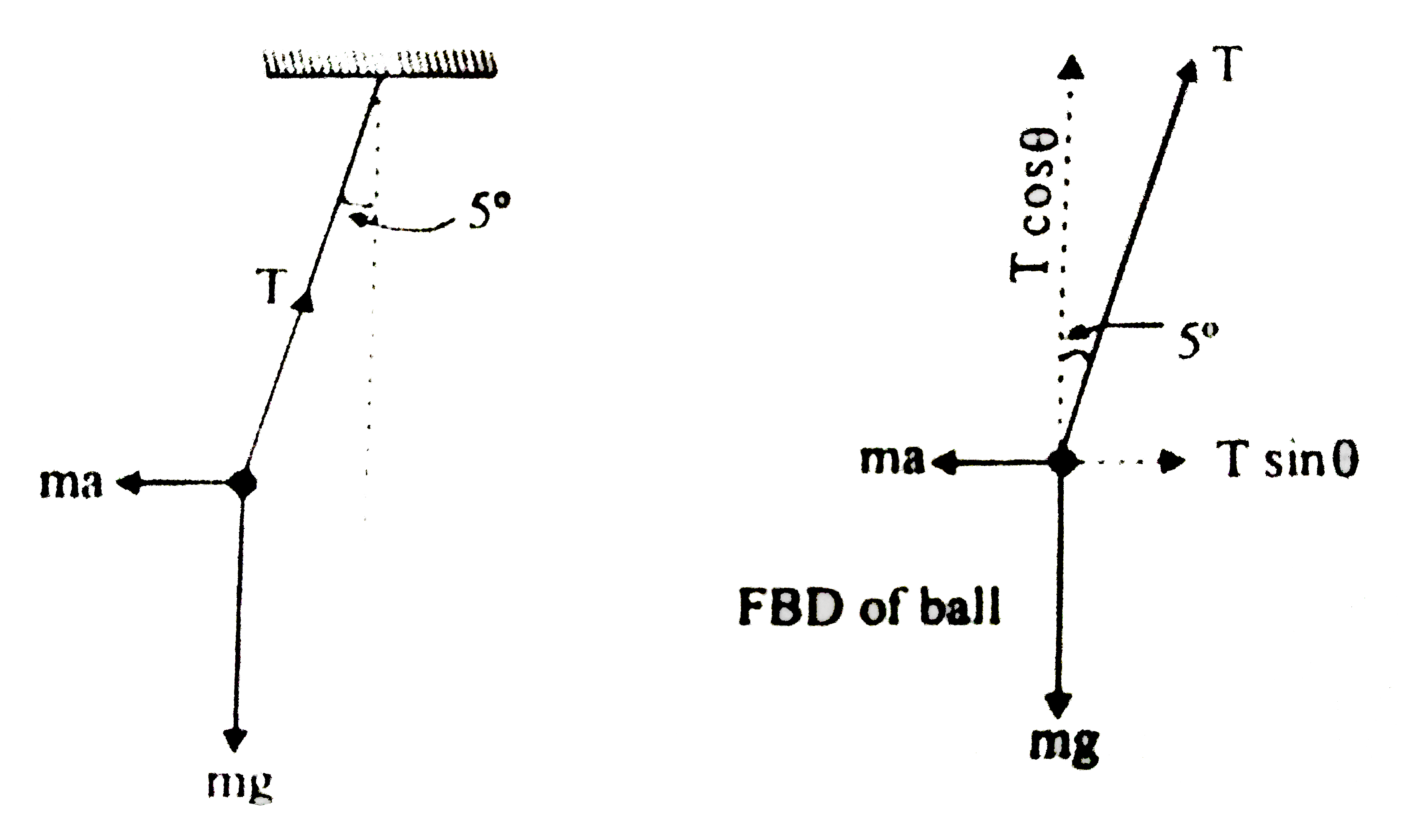
Vertical component `sumF=0,soT co5^(@)=mg.` By solving a = g `tan 5^(@)` = 0.0875 g = 0.86 `ms^(-2).`



Topper's Solved these Questions
Similar Questions
Explore conceptually related problems
A pendulum having a bob of mas m is hanging in a ship sailing along the equator from east to west. When the ship is stationary with respect to water the tension in the string is T_0 . a. Find the speed of the ship due to rotation of the earth about its axis. b. find the difference between T_0 and the earth's attraction on the bob. c. If the ship sails at speed v, what is the tension in the string ? Angular speed of earth's rotation is omega and radius of the earth is R.
One end of a 10 cm long silk thread is fixed to a large vertical surface of a charged non-conducting plate and the other end is fastened to a small ball of mass 10 g and charge of 4 xx 10^(-6) C . In equilibrium, thread makes an angle of 60^(o) with the vertical. (a) Find the tension in the string in equilibrium. (b) Suppose the ball is slightly pushed aside and released. Find the time period of the small oscillations. (Use sigma=7.5xx10^(-7) C/m^2 )
A circus wishes to develop a new clown act. Fig. (1) shows a diagram of the proposed setup. A clown will be shot out of a cannot with velocity v_(0) at a trajectory that makes an angle theta=45^(@) with the ground. At this angile, the clown will travell a maximum horizontal distance. The cannot will accelerate the clown by applying a constant force of 10, 000N over a very short time of 0.24s . The height above the ground at which the clown begins his trajectory is 10m . A large hoop is to be suspended from the celling by a massless cable at just the right place so that the clown will be able to dive through it when he reaches a maximum height above the ground. After passing through the hoop he will then continue on his trajectory until arriving at the safety net. Fig (2) shows a graph of the vertical component of the clown's velocity as a function of time between the cannon and the hoop. Since the velocity depends on the mass of the particular clown performing the act, the graph shows data for serveral different masses. If the angle the cannot makes with the horiaontal is increased from 45^(@) , the hoop will have to be
A circus wishes to develop a new clown act. Fig. (1) shows a diagram of the proposed setup. A clown will be shot out of a cannot with velocity v_(0) at a trajectory that makes an angle theta=45^(@) with the ground. At this angile, the clown will travell a maximum horizontal distance. The cannot will accelerate the clown by applying a constant force of 10, 000N over a very short time of 0.24s . The height above the ground at which the clown begins his trajectory is 10m . A large hoop is to be suspended from the celling by a massless cable at just the right place so that the clown will be able to dive through it when he reaches a maximum height above the ground. After passing through the hoop he will then continue on his trajectory until arriving at the safety net. Fig (2) shows a graph of the vertical component of the clown's velocity as a function of time between the cannon and the hoop. Since the velocity depends on the mass of the particular clown performing the act, the graph shows data for serveral different masses. From figure 2, approximately how much time will it take for clown with a mass of 60 kg to reach the safety net located 10 m below the height of the cannot?
A circus wishes to develop a new clown act. Fig. (1) shows a diagram of the proposed setup. A clown will be shot out of a cannot with velocity v_(0) at a trajectory that makes an angle theta=45^(@) with the ground. At this angile, the clown will travell a maximum horizontal distance. The cannot will accelerate the clown by applying a constant force of 10, 000N over a very short time of 0.24s . The height above the ground at which the clown begins his trajectory is 10m . A large hoop is to be suspended from the celling by a massless cable at just the right place so that the clown will be able to dive through it when he reaches a maximum height above the ground. After passing through the hoop he will then continue on his trajectory until arriving at the safety net. Fig (2) shows a graph of the vertical component of the clown's velocity as a function of time between the cannon and the hoop. Since the velocity depends on the mass of the particular clown performing the act, the graph shows data for serveral different masses. The slope of the line segments plotted in figure 2 is a figure constant. Which one of the following physical quantities does this slope represent?
A circus wishes to develop a new clown act. Fig. (1) shows a diagram of the proposed setup. A clown will be shot out of a cannot with velocity v_(0) at a trajectory that makes an angle theta=45^(@) with the ground. At this angile, the clown will travell a maximum horizontal distance. The cannot will accelerate the clown by applying a constant force of 10, 000N over a very short time of 0.24s . The height above the ground at which the clown begins his trajectory is 10m . A large hoop is to be suspended from the celling by a massless cable at just the right place so that the clown will be able to dive through it when he reaches a maximum height above the ground. After passing through the hoop he will then continue on his trajectory until arriving at the safety net. Fig (2) shows a graph of the vertical component of the clown's velocity as a function of time between the cannon and the hoop. Since the velocity depends on the mass of the particular clown performing the act, the graph shows data for serveral different masses. If a clown holds on to hoop instead of passing through it, what is the position of the cable so that he doesn't hit his head on the ceiling as he swings upward?
A circus wishes to develop a new clown act. Fig. (1) shows a diagram of the proposed setup. A clown will be shot out of a cannot with velocity v_(0) at a trajectory that makes an angle theta=45^(@) with the ground. At this angile, the clown will travell a maximum horizontal distance. The cannot will accelerate the clown by applying a constant force of 10, 000N over a very short time of 0.24s . The height above the ground at which the clown begins his trajectory is 10m . A large hoop is to be suspended from the celling by a massless cable at just the right place so that the clown will be able to dive through it when he reaches a maximum height above the ground. After passing through the hoop he will then continue on his trajectory until arriving at the safety net. Fig (2) shows a graph of the vertical component of the clown's velocity as a function of time between the cannon and the hoop. Since the velocity depends on the mass of the particular clown performing the act, the graph shows data for serveral different masses. If the clown's mass is 80 kg , what initial velocity v_(0) will have as he leaves the cannot?
A circus wishes to develop a new clown act. Fig. (1) shows a diagram of the proposed setup. A clown will be shot out of a cannot with velocity v_(0) at a trajectory that makes an angle theta=45^(@) with the ground. At this angile, the clown will travell a maximum horizontal distance. The cannot will accelerate the clown by applying a constant force of 10, 000N over a very short time of 0.24s . The height above the ground at which the clown begins his trajectory is 10m . A large hoop is to be suspended from the celling by a massless cable at just the right place so that the clown will be able to dive through it when he reaches a maximum height above the ground. After passing through the hoop he will then continue on his trajectory until arriving at the safety net. Fig (2) shows a graph of the vertical component of the clown's velocity as a function of time between the cannon and the hoop. Since the velocity depends on the mass of the particular clown performing the act, the graph shows data for serveral different masses. If the mass of a clown doubles, his initial kinetic energy, mv_(0)^(2)//2 , will :-
A ballistic pendulum is a device that was used to measure the speeds of bullets before the development of electronic tiring, devices. The device consists of a large block of wood of mass M , hanging from two long cords. A bullet of mass m is fired into the block. the bullet comes quickly into rest and the block + bullet rises to a vertical distance h before the pendulum comes momentarily to rest as the ends of the arc. ltbr. In the process. the linear momentum is conserved. In such a collision. some kinetic energy is dissipated as heat: so mechanical energy is not conserved. When there is a loss in mechanical energy, the collision is said to be inelastic. Further when two bodies coalesce, the collision is said to be perfectly inelastic. The collision of block-bullet system is
A ballistic pendulum is a device that was used to measure the speeds of bullets before the development of electronic tiring, devices. The device consists of a large block of wood of mass M , hanging from two long cords. A bullet of mass m is fired into the block. the bullet comes quickly into rest and the block + bullet rises to a vertical distance h before the pendulum comes momentarily to rest as the ends of the arc. ltbr. In the process. the linear momentum is conserved. In such a collision. some kinetic energy is dissipated as heat: so mechanical energy is not conserved. When there is a loss in mechanical energy, the collision is said to be inelastic. Further when two bodies coalesce, the collision is said to be perfectly inelastic. The energy dissipated as heat in the collision is
ALLEN-NEWTON'S LAWS OF MOTION & FRICTION-EXERCISE (JA)
- A passenger on a large ship sailing in a quiet sea hangs a ball from t...
Text Solution
|
- A piece of wire is bent in the shape of a parabola y=kx^(2) (y-axis ve...
Text Solution
|
- A block of mass m is on an inclined L plane of angle 0. The coefficien...
Text Solution
|
- A block is moving on an inclined plane making an angle 45^(@) with the...
Text Solution
|
- A Block of mass m(1) = 1 kg and another mass m(2) = 2kg are placed t...
Text Solution
|