Home
Class 12
PHYSICS
In the adjacent figure, mass of A, B and...

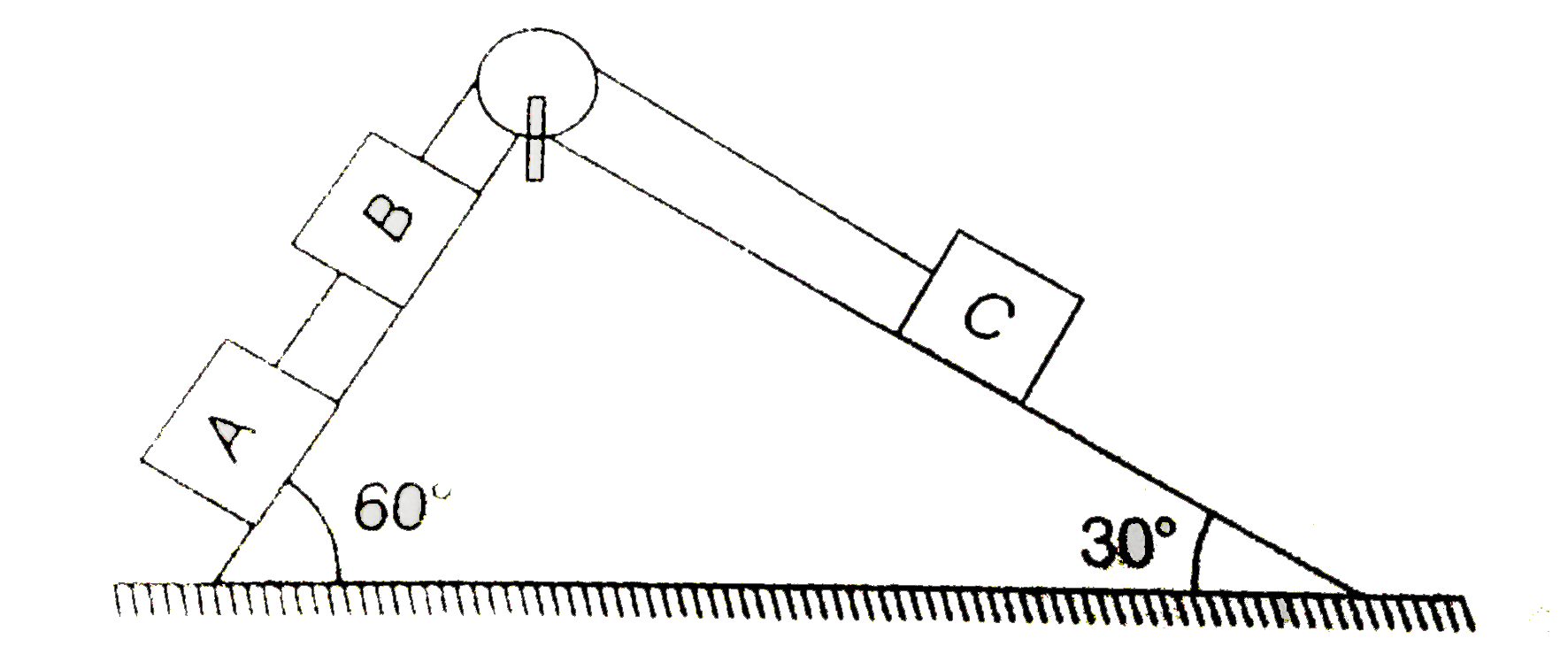
In the adjacent figure, mass of A, B and C are 1 kg , 3 kg and 2 kg, respectively. Find

(a) the acceleration of the system, and
(b) tensions in the string .
Neglect friction. (g`=10ms^(-2)`)

Text Solution

Verified by Experts
(a) IN this case net pulling force
= `m_(A)g sin 60^(@)+m_(B)g sin60^(@)-m_(C)g sin 30^(@)`
`=(M_(A)+m_(B))g sin 60^(@)-m_(C)g sin30^(@)`
`=(1+3)xx10xx(sqrt3)/(2)-2xx10xx1/2`
`=20sqrt3-10=20xx1.732-10=24.64N`
Total mass being pulled = 1+ 3+2= 6 kg

`therefore` Acceleration of the system a `=(24.64)/(6)=4.1m//s^(2)`
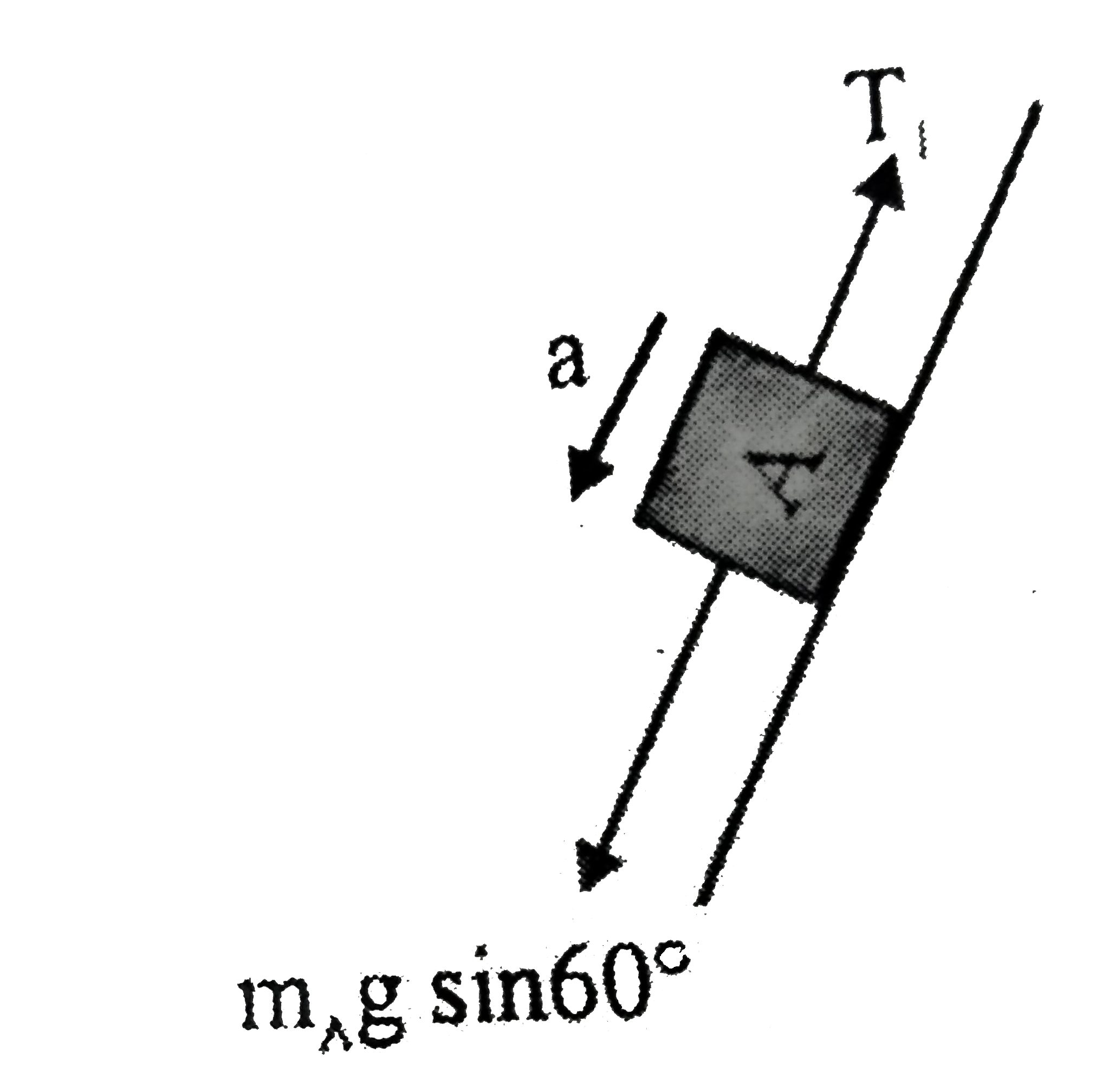
(b) For the tension `T_(1)` in the string between A and B, `m_(A)g sin 60^(@)-T_(1)=(m_(A))(a) therefore T_(1)=m_(A)g sin60^(@)-m_(A)a=m_(A)(g sin60^(@)-a)`
`impliesT_(1)=(1)(10xx(sqrt3)/(2)-4.1)=4.56N`
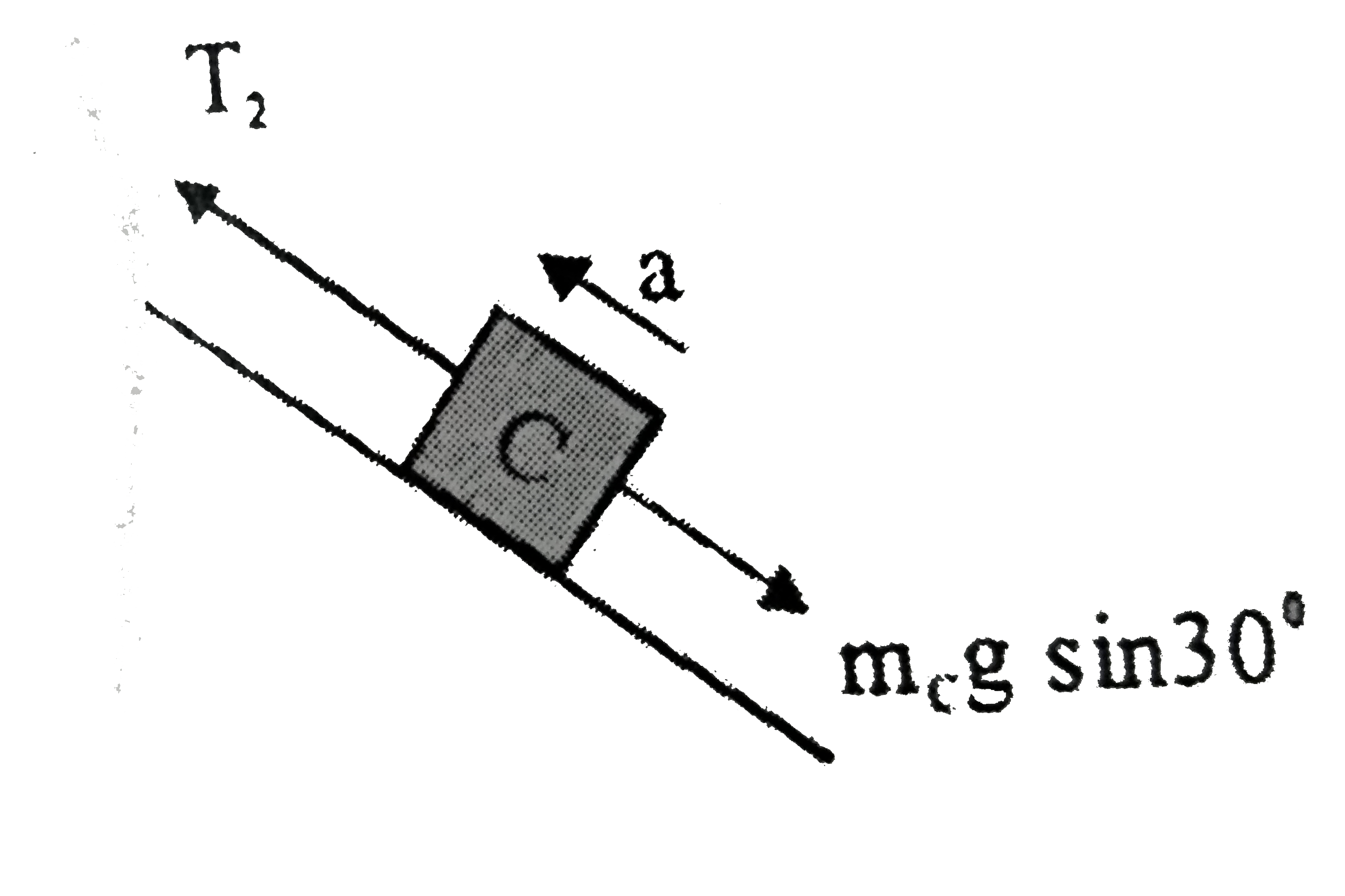
For the tension `T_(2)` in the string between B and C.
`T_(2)-m_(C)g sin30^(@)=m_(C)a`
`impliesT_(2)=m_(C)(a+g sin30^(@))=2[4.1+10((1)/(2))]=18.2N`
Promotional Banner

Topper's Solved these Questions

  • NEWTON'S LAWS OF MOTION & FRICTION

    ALLEN|Exercise EXERCISE (S-1)|23 Videos
  • NEWTON'S LAWS OF MOTION & FRICTION

    ALLEN|Exercise EXERCISE (S-2)|9 Videos
  • MOTION IN A PALNE

    ALLEN|Exercise SOLVED EXAMPLE|28 Videos
  • NEWTONS LAWS OF MOTION

    ALLEN|Exercise EXERCISE-III|28 Videos

Similar Questions

Explore conceptually related problems

In the adjacent figure, masses of A,B and C are 1kg ,3kg and 2kg respectively. Find (a) the acceleration of the system and (b) tension in the strings. Neglect friction. (g=10m//s^(2))

If coeffiecient of friction between the block of mass 2kg and table is 0.4 then out acceleration of the system and tension in the string. (g=10m//s^(2))

In the above example, if two blocks have masses 1kg and 2kg respectively then find their acceleration and tension in different string.

A block A of mass 6kg is applied on a frictionless table. A thread tied to it passes over a frictionless pulley and carries a body B of mass 4kg at the other end. Find the acceleration of the system and tension in the thread (given g=10ms^(-2) )

In the arrangement shown in Figure, m_A=2kg and m_B=1kg . String is light and inextensible. Find the acceleration of centre of mass of both the blocks. Neglect friction everywhere.

In the arrangement shown in Figure, m_A=2kg and m_B=1kg . String is light and inextensible. Find the acceleration of centre of mass of both the blocks. Neglect friction everywhere.

Two block of mass 4 kg and 2 kg are attached by an inextensible light string as shown in figure. Both the blocks are pulled vertically upwards by a force F=120N Find (a) the acceleration of the blocks, (b) tension in the string. (Take g= 10 ms^(-2) )

Two block of mass 4 kg and 2 kg are attached by an inextensible light string as shown in figure. Both the blocks are pulled vertically upwards by a force F=120N Find (a) the acceleration of the blocks (b) tension in the string. (Take g= 10 ms^(-2) )

Consider the situation shown in figure .Both the pulleys and the string and light and all the surfaces are smooth. (a) Find the acceleration of 1kg block. (b) Find the tension in the string. (g = 10 m//s^(2)) .

In the arrangement shown in figure pulleys are mass of block A,b and C is m_(1) = 5 kg m_(2) = 4 kg and m_(3) = 2.5 kg respectively .Co-efficient acceleration of friction for both the plane is mu = 0.50 Calculate acceleration of which block when system is released from rest