Home
Class 12
PHYSICS
When force F applied on m(1) and there i...

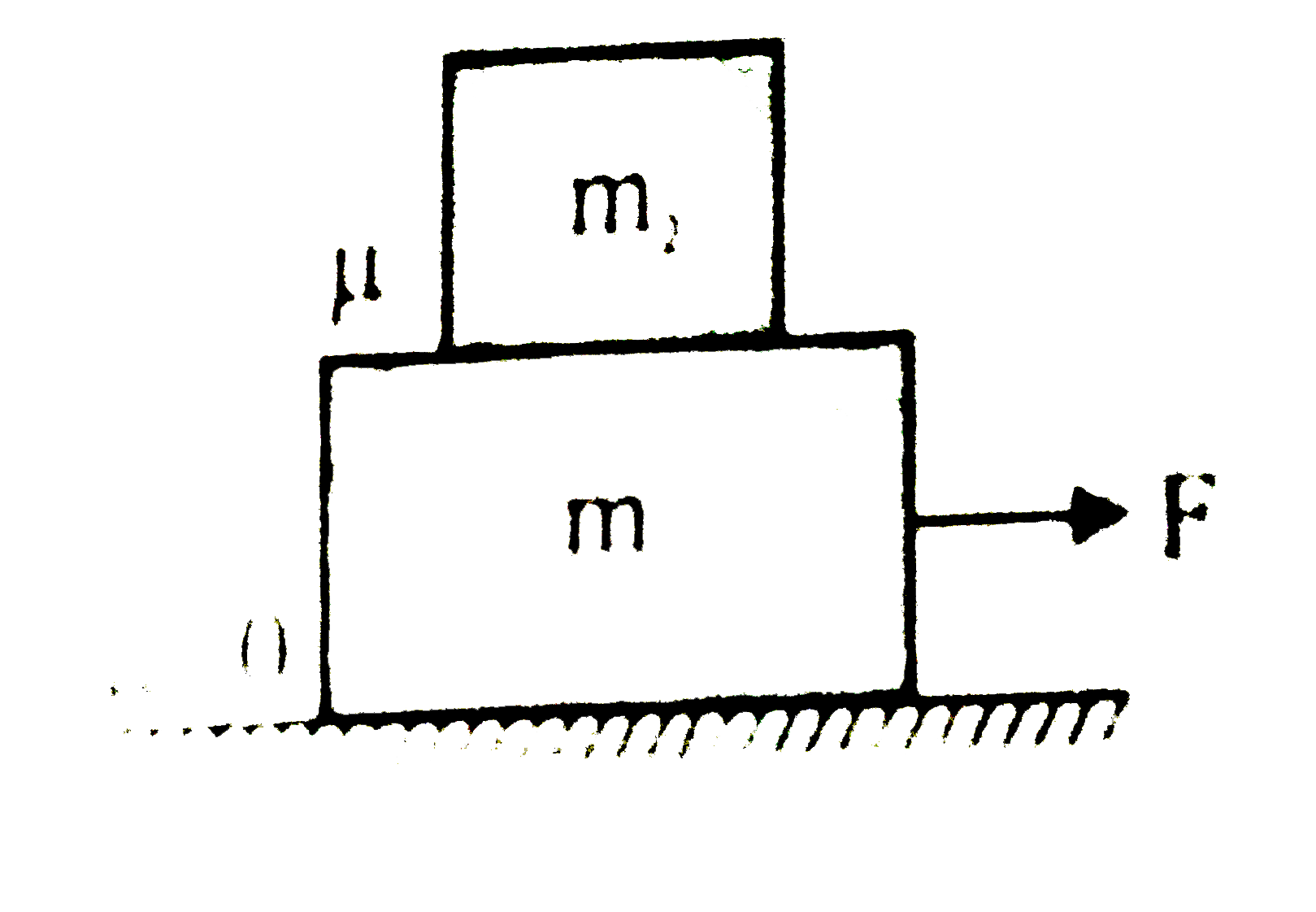
When force F applied on `m_(1)` and there is no friction between `m_(1)` and surface and the coefficient of friction between `m_(1)and m_(2)` is `mu.` What should be the minimum value of F so that there is on relative motion between `m_(1) and m_(2)`

Text Solution

Verified by Experts
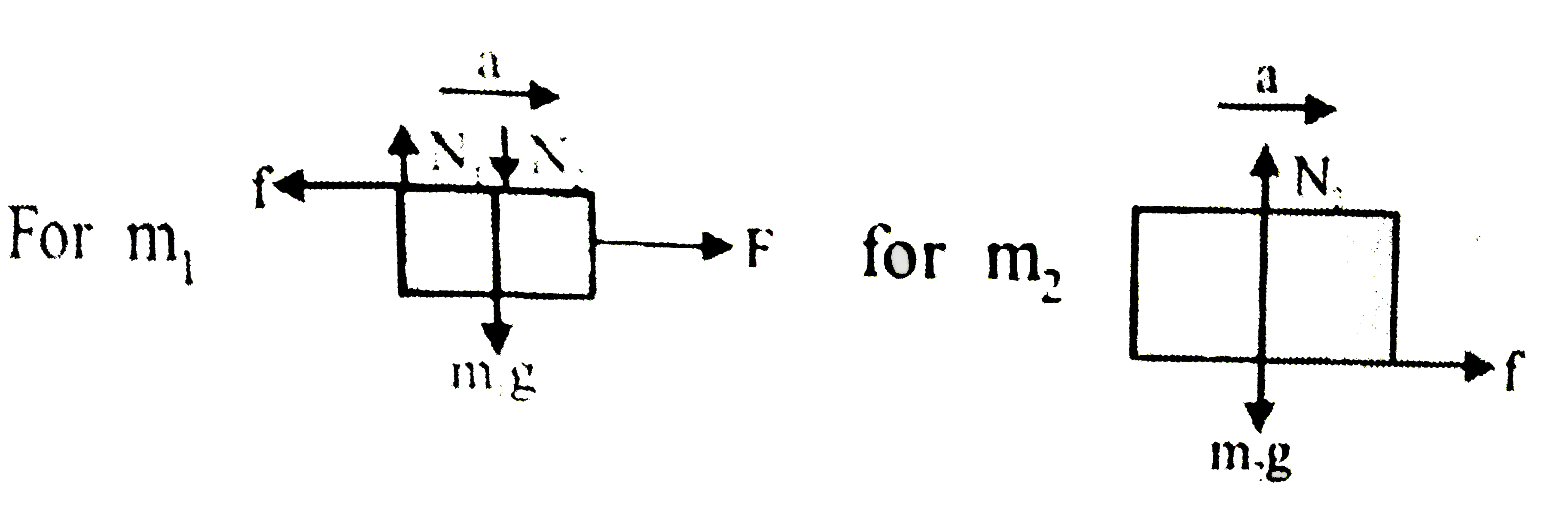

For system acceleration `a=(F)/(m_(1)+m_(2))`
For `m_(2)f=m_(2)aimpliesmum_(2)g=m_(2)((F)/(m_(1)+m_(2)))impliesF_(sin)=mu(m_(1)+m_(2))g`
Promotional Banner

Topper's Solved these Questions

  • NEWTON'S LAWS OF MOTION & FRICTION

    ALLEN|Exercise EXERCISE (S-1)|23 Videos
  • NEWTON'S LAWS OF MOTION & FRICTION

    ALLEN|Exercise EXERCISE (S-2)|9 Videos
  • MOTION IN A PALNE

    ALLEN|Exercise SOLVED EXAMPLE|28 Videos
  • NEWTONS LAWS OF MOTION

    ALLEN|Exercise EXERCISE-III|28 Videos

Similar Questions

Explore conceptually related problems

In the pulley arrangement shown in Fig the pulley p_(2) is movable .Assuming the coefficient of friction between m and surface to be mu the minimum value of M for which m is at rest is

The block each of mass 1 kg are placed as shown .They are connected by a string which passes over a smooth (massless) pulley. There is no friction between m_(1) and the ground.The coefficient of friction between m_(1) and m_(2) is 0.2 A force F is applied to m_(2) . Which of the fpllowing statement is/are correct?

In the figure masses m_(1),m_(2) and M are kg. 20 Kg, 5 kg and 50 kg respectively. The co-efficient of friction between M and ground is zero. The co-efficient of friction between m_(1) and M and that between m_(2) and ground is 0.3. The pulleys and the string are massless. The string is perfectly horizontal between P_(1) and m_(1) and also between P_(2) and m_(2). The string is perfectly verticle between P_(1) and P_(2). An externam horizontal force F is applied to the mass M. Take g=10m//s^(2). (i) Drew a free-body diagram for mass M, clearly showing all the forces. (ii) Let the magnitude of the force of friction between m_(1) and M be f_(1) and that between m,_(2) and ground be f_(2). For a particular F it is found that f_(1)=2f_(2). Find f_(1) and f_(2). Write down equations of motion of all the masses. Find F, tension in the string and accelerations of the masses.

The arrangement shown in the figure, the systme of masses m_(1), m_(2) and m_(3) is being pushed by a force F applied on m_(1) horizontally. In order to prevent the downwards slipping of m_(2) between m_(1) and m_(3) if coefficient of friction between m_(2) and m_(3) is mu and all the other surface are smooth, the minimum value of F :

In the figure masses m_1 , m_2 and M are 20 kg, 5kg and 50kg respectively. The coefficient of friction between M and ground is zero. The coefficient of friction between m_1 and M and that between m_2 and ground is 0.3. The pulleys and the strings are massless. The string is perfectly horizontal between P_1 and m_1 and also between P_2 and m_2 . The string is perfectly vertical between P_1 and P_2 . An external horizontal force F is applied to the mass M. Take g=10m//s^2 . (a) Draw a free body diagram for mass M, clearly showing all the forces. (b) Let the magnitude of the force of friction between m_1 and M be f_1 and that between m_2 and ground be f_2 . For a particular F it is found that f_1=2f_2 . Find f_1 and f_2 . Write equations of motion of all the masses. Find F, tension in the spring and acceleration of masses.

In the figure masses m_1 , m_2 and M are 20 kg, 5kg and 50kg respectively. The coefficient of friction between M and ground is zero. The coefficient of friction between m_1 and M and that between m_2 and ground is 0.3. The pulleys and the strings are massless. The string is perfectly horizontal between P_1 and m_1 and also between P_2 and m_2 . The string is perfectly vertical between P_1 and P_2 . An external horizontal force F is applied to the mass M. Take g=10m//s^2 . (a) Draw a free body diagram for mass M, clearly showing all the forces. (b) Let the magnitude of the force of friction between m_1 and M be f_1 and that between m_2 and ground be f_2 . For a particular F it is found that f_1=2f_2 . Find f_1 and f_2 . Write equations of motion of all the masses. Find F, tension in the spring and acceleration of masses.

The coefficient of friction between block of mass m and 2m is mu=2tantheta . There is no friction between block of mass 2 m and inclined plane. The maximum amplitude of the two block system for which there is no relative motion between both the blocks is

The coefficient of friction between block of mass m and 2m is mu=2tantheta . There is no friction between block of mass 2 m and inclined plane. The maximum amplitude of the two block system for which there is no relative motion between both the blocks is

A bullet of mass 0.25kg is fired with velocity 302m//s into a block of wood of mass m_1=37.5kg . It gets embedded into it. The block m_1 is resting on a long block m_2 and the horizontal surface on which it is placed is smooth. The coefficient of friction between m_1 and m_2 is 0.5 . Find the displacement of m_1 on m_2 and the common velocity of m_1 and m_2 . Mass m_2=1.25kg .

In figure find the acceleration of m assuming that there is friction between m and M and all other surfaces are smooth and pulleys light and mu = coefficient of friction between m and M

