Home
Class 12
PHYSICS
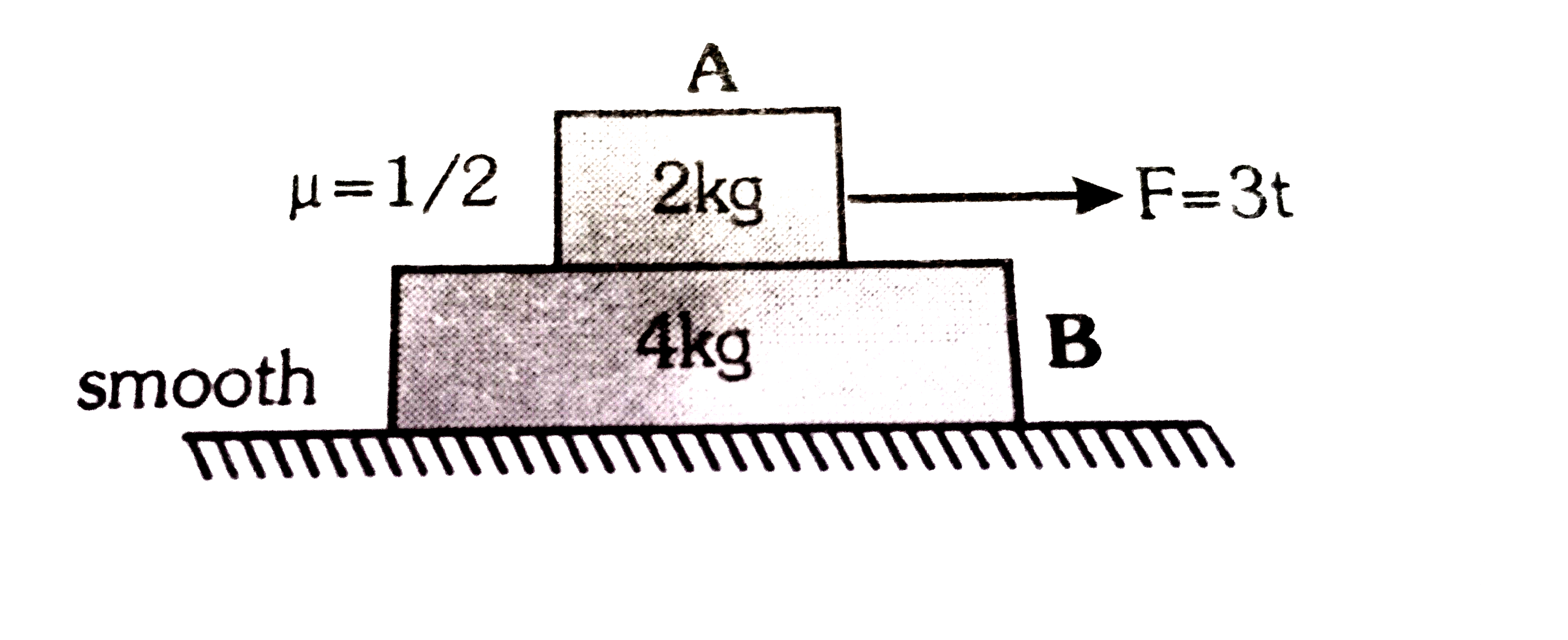
For shown situation draw a graph showing...

For shown situation draw a graph showing acceleration of A and B on y-axis and time on x-axis `(g=10ms^(-2))`

Text Solution

Verified by Experts
limiting friction between A & B, `f_(1)=mum_(A)g=((1)/(2))(2)(10)=10N`
Block B moves due to friction only. So maximum acceleration of B,
`a_(max)=(f_(L))/(m_(B))=10/42.5ms^(-2)`
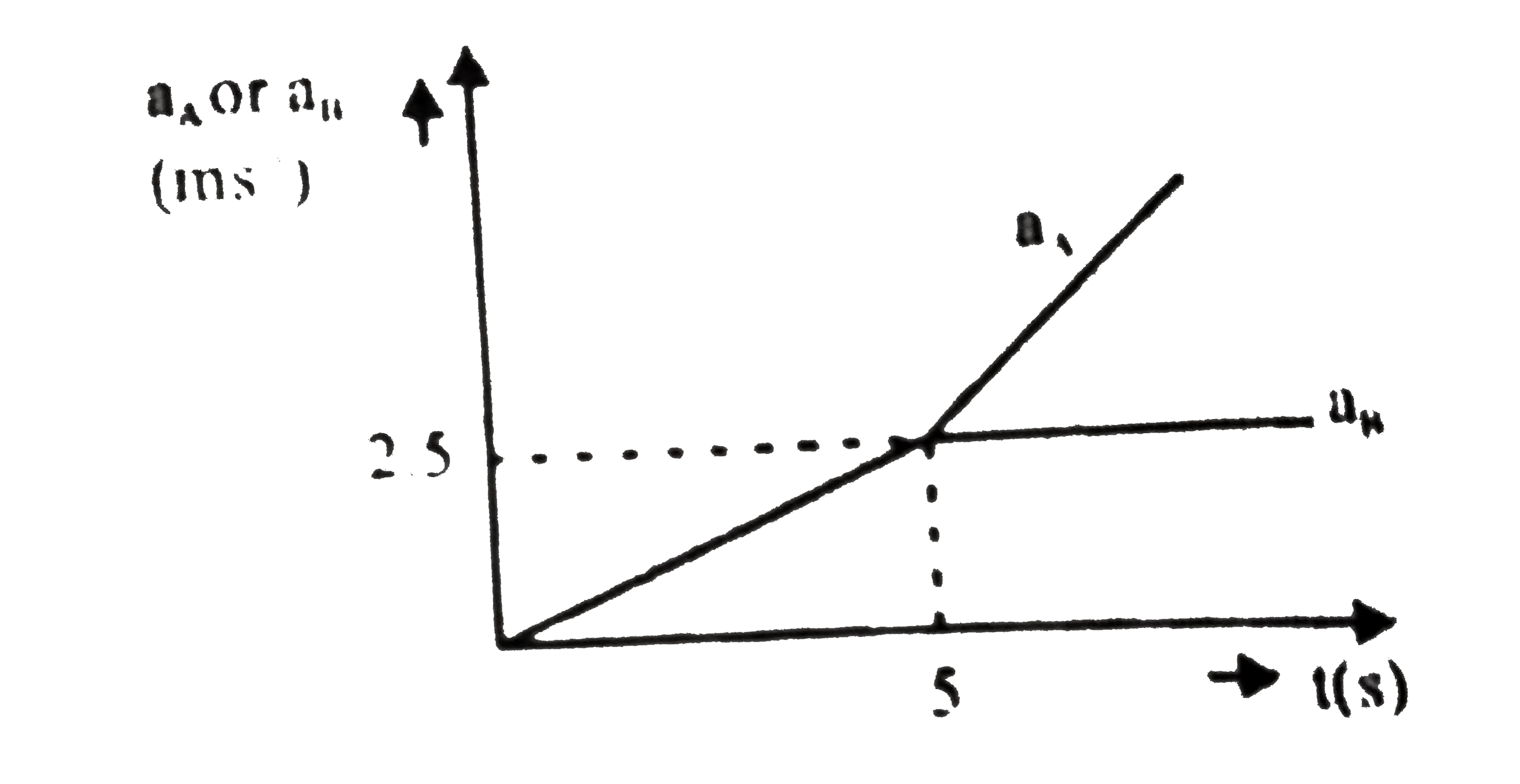
So both the blocks move together till the common acceleration becomes `2.5 ms^(-2)` after that acceleations of B will become constant while that of A will go on increasing. Slipping will starts between A & B at `2.5 ns^(-2)`
`implies2.5=(F)/(m_(A)+m_(B))=(3t)/(6)impliest=5s`
Hence for `t le5s,a_(A)=a_(B)=(F)/(m_(A)+m_(B))=(3t)/(6)=t/2`
and for `tgt5sa_(B)=2.5ms^(-2),a_(A)=(F-f_(1))/(m_(A))=(3t-10)/(2)=3/2t-5`
Promotional Banner

Topper's Solved these Questions

  • NEWTON'S LAWS OF MOTION & FRICTION

    ALLEN|Exercise EXERCISE (S-1)|23 Videos
  • NEWTON'S LAWS OF MOTION & FRICTION

    ALLEN|Exercise EXERCISE (S-2)|9 Videos
  • MOTION IN A PALNE

    ALLEN|Exercise SOLVED EXAMPLE|28 Videos
  • NEWTONS LAWS OF MOTION

    ALLEN|Exercise EXERCISE-III|28 Videos

Similar Questions

Explore conceptually related problems

Two blocks A and B of masses 2kg and 4kg are placed one over the other as shown in figure. A time varying horizontal force F =2t is applied on the upper block as shown in figure. Here t is in second and F is in newton. Drow a graph showing acceleration of A and B on y-axis and time on x-axis.Coefficient of friction between A and B is mu =(1)/(2) and the horizontal surface over which B is placed smooth. (g =10m//s^(2))

A particle starts with uniform acceleration. Draw a graph taking the displacement(s) of the particle along y-axis and time(t) along x-axis. What is the curve known as?

The slope of the graph showing the variation of potential difference V on X-axis and current Y-axis gives conductor

In a given figure the acceleration of M is (g=10ms^(-2))

Two graphs of the same projectile motion (in the xy-plane) projected from origin are shown. X-axis is along horizontal direction and y-axis is vertically upwards. Take g = 10 ms^(-2) . , The projection speed is :

Two graphs of the same projectile motion (in the xy-plane) projected from origin are shown. X-axis is along horizontal direction and y-axis is vertically upwards. Take g = 10 ms^(-2) . Projection angle with the horizontal is :

Two graphs of the same projectile motion (in the xy-plane) projected from origin are shown. X-axis is along horizontal direction and y-axis is vertically upwards. Take g = 10 ms^(-2) . , Maximum height attained from the point of projection is

A body starts from the origin with an acceleration of 6 ms^-2 along the x - axis and 8 ms^-2 along the y - axis. Find its distance from the origin after 4 s .

The graph of the linear equation 2x-y=4 cuts x-axis at

Figure shows the displacement time graph of a particle moving on the X-axis

