Home
Class 12
PHYSICS
The coefficient of static and kinetic fr...

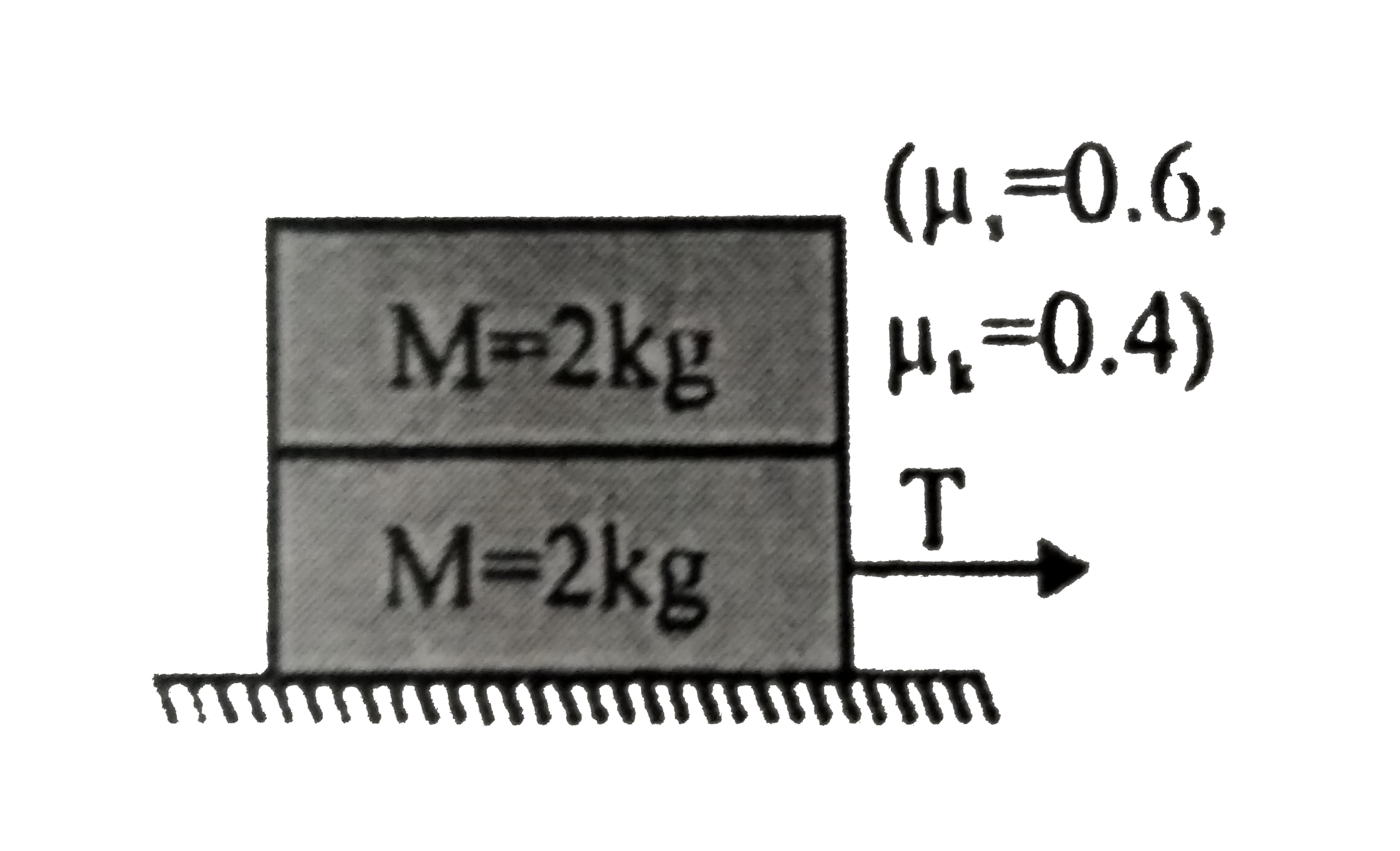
The coefficient of static and kinetic friction between the two blocks and also between the lower block and the ground are `mu_(s)=0.6 and mu_(k)=0.4` Find the value of tension T applied on the lower block at which the upper block begins to slip relative to lower block.

Text Solution

Verified by Experts

The correct Answer is:

40 N
Promotional Banner

Topper's Solved these Questions

  • NEWTON'S LAWS OF MOTION & FRICTION

    ALLEN|Exercise EXERCISE (O-1)|51 Videos
  • NEWTON'S LAWS OF MOTION & FRICTION

    ALLEN|Exercise EXERCISE (O-2)|31 Videos
  • NEWTON'S LAWS OF MOTION & FRICTION

    ALLEN|Exercise EXERCISE (S-1)|23 Videos
  • MOTION IN A PALNE

    ALLEN|Exercise SOLVED EXAMPLE|28 Videos
  • NEWTONS LAWS OF MOTION

    ALLEN|Exercise EXERCISE-III|28 Videos

Similar Questions

Explore conceptually related problems

Two blocks of masses'm' and 'M' are arranged as shown in the figure. The coefficient of friction between the two blocks is ' mu ', where as between the lower block and the horizontal surface is zero. Find the force 'F' to be applied on the upper block, for the system to be under equilibrium ?

A small block of mass m is projected on a larger block of mass 10 m and length l with a velocity v as shown in the figure. The coefficient of friction between the two block is mu_(2) while that between the lower block and the ground is mu_(1) . Given that mu_(2) gt 11 mu_(1) . (a) Find the minimum value of v , such that the mass m falls off the block of mass 10 m . (b) If v has minimum value, find the time taken by block m to do so.

The block of mass M and are arrenged as the situation in fig is shown.The coefficient of friction between two block is mu and that between the bigger block and the ground is mu find the acceleration of the block

A block of mass m is kept on an another block of mass M. The coefficient of friction between the blocks varies as mu=(mu_(0)+kx) while friction between lower block and ground is zero. A time varying force F = 10t is applied horizontally on the upper block. Find time t_(0) when relative motion will start between the blocks. (x is relative displacement between the blocks.)

These questions consists of two statements each printed as Assertion and Reason. While answering these question you are required to choose any one of the following four responses Assertion In the system of two blocks of equla masses as shown, the coefficient of friction between the blocks (mu_(2)) is less than coefficient of friction (mu_(1)) between lower block and ground. For all values of force F applied on upper block, lower block remains at rest. Reason Frictional force on lower block due to upper block is not sufficient to overcome the frictional force on lower block due to ground.

For the two blocks shown in the adjacent figure, an external force of 18N is applied on the lower block. Find the acceleratiion of the upper block.

The coefficient of static friction between the two blocks shown in figure is mu and the table is smooth. What maximum horizontal forced F can be applied to he block of mass M so that the block move together?

The coefficient of static friction between the two blocks shown in figure is mu and the table is smooth. What maximum horizontal forced F can be applied to he block of mass M so that the block move together?

A slab of 40 kg lying on a frictionales floor and a block of 10 kg rests on the slab as shown in the figure. The coefficients of static and kinetic friction between the slab and the block are 0.6 and 0.4 respectively. If a force of 100 N is applied on the block, then the acceleration the slab will be (g = 10 m//s^(2))

A block of mass m is kept over another block of mass M and the system rests on a horizontal surface. A constant horizontal force F acting on the lower block produces an acceleration (F)/(2(m+M)) in the sytem. The two blocks always move together. Consider displacement d of the system. a. Find the work done by friction on bigger block. b. Find the coefficient of kinetic friction between the bigger block and the horizontal surface. c. Find the frictional acting on the smaller block. d. Find the work done by the force of friction on the smaller block by the bigger block. e. Find the work done by static friction on bigger block.
