Home
Class 12
PHYSICS
A block is kept on a rough surface and a...

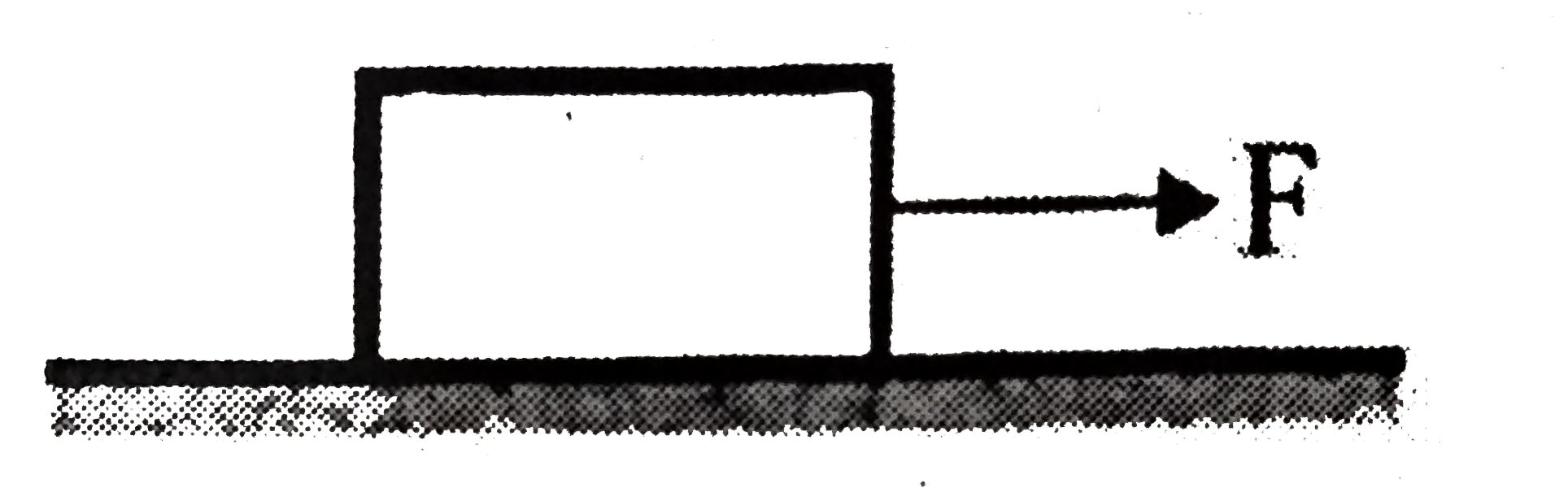
A block is kept on a rough surface and applied with a horizontal force as shown which is gradually increasing for zero. The coefficient of static and kinetic friction are `1//sqrt3` then

A

When F is less then the limiting friction, angle made by net force on the block by the surfce is less then `30^(@)` with vertical.

B

When the block is just about to move, the angle made by net force by the surface on the block become equal to `30^(@)` with vertical.

C

When the block starts to accelerate, the angle made by net force by the surface on the block becomes constant and equal to `30^(@)` vertical.

D

The angle made by net force with vertical on the block by the surface, depends on the mass of the block.

Text Solution

Verified by Experts

The correct Answer is:

A, B, C, D
Promotional Banner

Topper's Solved these Questions

  • NEWTON'S LAWS OF MOTION & FRICTION

    ALLEN|Exercise EXERCISE (JM)|6 Videos
  • NEWTON'S LAWS OF MOTION & FRICTION

    ALLEN|Exercise EXERCISE (JA)|4 Videos
  • NEWTON'S LAWS OF MOTION & FRICTION

    ALLEN|Exercise EXERCISE (O-1)|51 Videos
  • MOTION IN A PALNE

    ALLEN|Exercise SOLVED EXAMPLE|28 Videos
  • NEWTONS LAWS OF MOTION

    ALLEN|Exercise EXERCISE-III|28 Videos

Similar Questions

Explore conceptually related problems

A system of two blocks is placed on a rought horizontal surface as shown in figure below The coefficient of staic and kinetic friction at two surfaces are shown A force F is horizontal applied on the upper block as shown .Let f_(1) ,f_(2) represent the frictional force between upper and lower surface of contact respectively and a_(1),a_(2) represent the acceleration of 3kg and 2kg block respectively For relative motion to be there between two blocks the minimum value of F should be

A system of two blocks is placed on a rought horizontal surface as shown in figure below The coefficient of staic and kinetic friction at two surfaces are shown A force F is horizontal applied on the upper block as shown .Let f_(1) ,f_(2) represent the frictional force between upper and lower surface of contact respectively and a_(1),a_(2) represent the acceleration of 3kg and 2kg block respectively For F= 12N mark the correct option

A block is sliding on a rough horizontal surface. If the contact force on the block is sqrt2 times the frictional force, the coefficient of friction is

A block of mass 10 kg is kept on a rough inclined plane as shown in the figure. A force of 3 N is applied on the block. The coefficient of static friction between the plane and the block is 0.6 What should be the minimum value of force P, such that the block doesnot move downward? (take g=10ms^(-2) )

A block of mass 10 kg is kept on a rough inclined plane as shown in the figure. A force of 3 N is applied on the block. The coefficient of static friction between the plane and the block is 0.6 What should be the minimum value of force P, such that the block doesnot move downward? (take g=10ms^(-2) )

A block is in limiting equilibrium on a rough horizontal surface. If the net contact force is sqrt(3) times the normal force, the coefficient of static friction is

A block of mass 20kg is placed on a rough horizontal plane and a horizontal force of 12N is applied. If coefficient of friction is 0.1 the frictional force acting on it is,

A wooden block of mass M resting on a rough horizontal surface is pulled with a force T at an angle q to the horizontal. If m is coefficient of kinetic friction between the block and the surface, the acceleration of the block is

A force of 750 N is applied to a block of mass 102 kg to prevent it from sliding on a plane with an inclination angle 30^@ with the horizontal. If the coefficients of static friction and kinetic friction between the block and the plane are 0.4 and 0.3 respectively, then the frictional force acting on the block is

A time varying force F = 5t is applied on a block kept on a rough horizontal surface. Mass of block is 10 kg, coefficient of static and kinetic friction between block and horizontal surface are 0.3 and 0.2 respectively. Take g = 10 m//s^(2) Find the time at which slipping starts between block and the surface beneath it.

ALLEN-NEWTON'S LAWS OF MOTION & FRICTION-EXERCISE (O-2)
  1. Consider a block suspended from a light string as shown in the digure....

    Text Solution

    |

  2. A block of weight 9.8N is placed on a table. The table surface exerts...

    Text Solution

    |

  3. A block of mass m is suspended from a fixed support with the help of a...

    Text Solution

    |

  4. A block A and wedge B connected through a string as shown. The wedge B...

    Text Solution

    |

  5. Two blocks A and B of mass 2 kg and 4 kg respectively are placed on a ...

    Text Solution

    |

  6. A block is kept on a rough surface and applied with a horizontal force...

    Text Solution

    |

  7. A block placed on a rough horizontal surface is pushed with a force F ...

    Text Solution

    |

  8. A block is placed over a plank. The coefficient of friction between th...

    Text Solution

    |

  9. A block is released from rest from point on a rough inclined place of ...

    Text Solution

    |

  10. In the given figure both the bocks have equal mass. When the thread is...

    Text Solution

    |

  11. A block of mass m is placed on a smooth horizontal floor is attached t...

    Text Solution

    |

  12. A block of mass m is placed on a smooth horizontal floor is attached t...

    Text Solution

    |

  13. A block of mass m is placed on a smooth horizontal floor is attached t...

    Text Solution

    |

  14. When F = 2N, the frictional force between 5 kg block and ground is

    Text Solution

    |

  15. When F = 2N, the frictional force between 10 kg block 5 kg block is

    Text Solution

    |

  16. The maximum F which will not cause motion of any of the blocks is

    Text Solution

    |

  17. The maximum acceleration of 5 of kg block is :-

    Text Solution

    |

  18. The acceleration of 10 kg block when F = 30 N is

    Text Solution

    |

  19. In the figure shown ,acceleration of 1 is x (upwards). Acceleration of...

    Text Solution

    |

  20. Velocity of there particless A.B and C varies with time t as , v(A) =(...

    Text Solution

    |
