Home
Class 12
PHYSICS
A disc in which serval grooves are cut a...

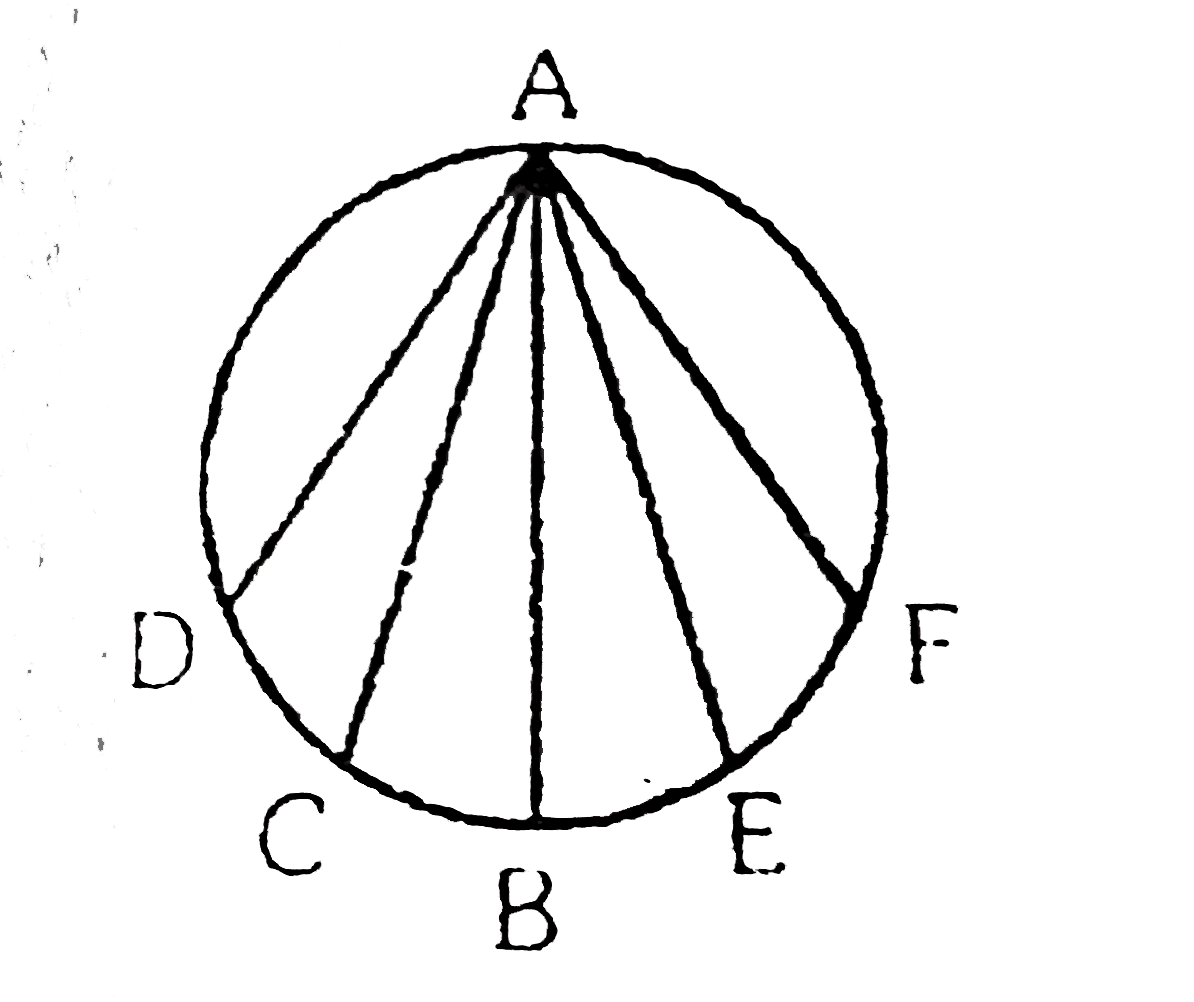
A disc in which serval grooves are cut along the chord drawn from a point 'A', is arranged in a vertical plane several particles starts slipping from 'A' along the grooves simultaneously. Assuming friction and resistance negligible, the time taken in reaching the edge of disc will be :-

A

A.Maximum in groove AB

B

B.Maximum in groove AD

C

C.Same in all groove

D

D.According to the heights of B,C,D,E,F

Text Solution

Verified by Experts

The correct Answer is:
C

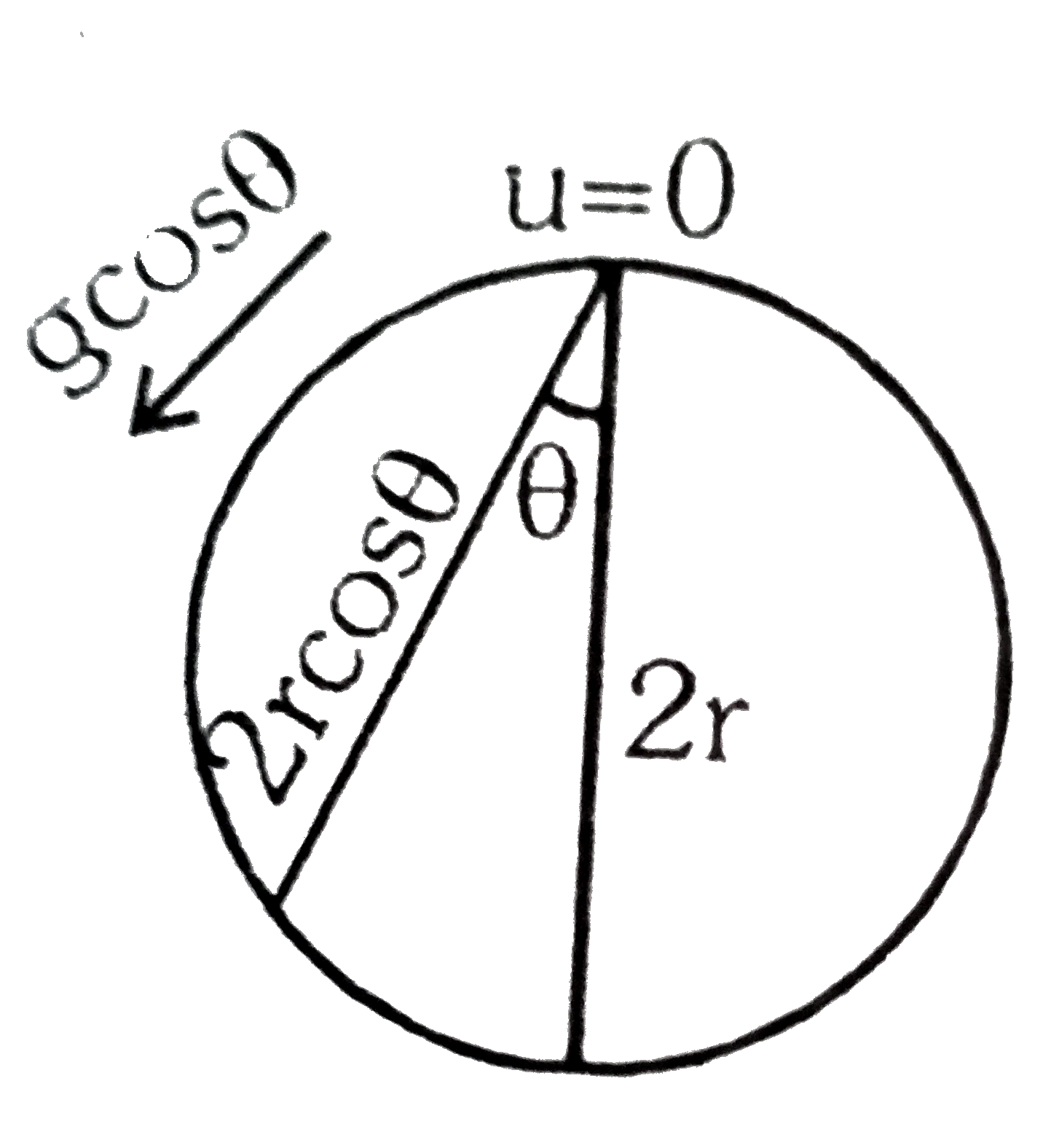
Using `s=ut+(1)/(2)at^(2)`
`2r cos theta=0+(1)/(2)g cos thetat^(2)`
`t=sqrt((4r)/(g))=` constant
which does not depend upon `theta`
Promotional Banner

Topper's Solved these Questions

  • MOTION IN A PALNE

    ALLEN|Exercise EXERCISE-3|40 Videos
  • MOTION IN A PALNE

    ALLEN|Exercise SOLVED EXAMPLE|28 Videos
  • MOTION IN A PALNE

    ALLEN|Exercise EXERCISE-1|99 Videos
  • KINEMATICS-2D

    ALLEN|Exercise Exercise (O-2)|46 Videos
  • NEWTON'S LAWS OF MOTION & FRICTION

    ALLEN|Exercise EXERCISE (JA)|4 Videos

Similar Questions

Explore conceptually related problems

A vehicle is driven along a straight horizontal track by a motor which exerts a constant driving force. The vehicle starts from rest at t=0 and the effects of friction and air resistance are negligible. If the kinetic eneryg of the vehicle at time t is E and power developed by the motor is P, which of the following graphs are correct?

A table with smooth horizontal surface is fixed in a cabin that rotates with a uniform angular velocity omega in a circular pathof radius R. A smooth groove AB of length L(ltltR) is made on the surface of the table. The groove makes an angle theta with the radius OA of the circle in which the cabin rotates. A small particle is kept at the point A in the groove and is released to move along AB. Find the time taken by tehparticle to reach the point B.

A table with smooth horizontal surface is fixed in a cabin that rotates with a uniform angular velocity omega in a circular pathof radius R. A smooth groove AB of length L(ltltR) is made on the surface of the table. The groove makes an angle theta with the radius OA of the circle in which the cabin rotates. A small particle is kept at the point A in the groove and is released to move along AB. Find the time taken by tehparticle to reach the point B.

A long straight wire carries a current I_(0) , at distance a and b=3a from it there are two other wires, parallel to the former one, which are interconnected by a resistance R (figure).A connector slides without friction along the wires with a constant velocity v .Assuming the resistance of the wires,the connector, the sliding contacts and the self-inductance of the frame to be negligible. The point of application (distance from the long wire) of magnetic force on sliding wire due to the long wire is (2a)/(lnx) from long wire.Then find out value of x .

A frictionless wire is fixed between A and B inside of a hollow sphere of radius R as shown. A beam slips along the wire starting from the rest at point A . The time taken by the beam to slip from A to B will be

Consider an elliptically shaped rail PQ in the vertical plane with OP = 3 m and OQ = 4 m. A block of mass 1 kg is pulled along the rail from P to Q with a force of 18 N, which is always parallel to line PQ (see the figure given). Assuming no frictional losses, the kinetic energy of the block when it reaches Q is: (n xx 10) joules. The value of n is (take acceleration due to gravity = 10 ms^(-2) ) https://haygot.s3.amazonaws.com/questions/113759.jpg

A person wants to roll a solid non-conducting spherical ball of mass m and radius r on a surface whose coefficient of static friction is mu . He placed the ball on the surface wrapped with n turns of closely packed conducting coils of negligible mass at the diameter. By some arrangement he is able to pass a current i through the coils in anti-clockwise direction when viewed downwards from point P . A constant horizontal magnetic field vecB is present throughout the space along the positive x direction as shown in the figure. (Assume mu is large enough to help pure rolling motion and initially the plane of the coils is perpendicular to the y -axs) If current i is passed through the coil then

A rod of mass m can rotate without friction about axis sliding (also without friction) along a conducting ring of radius b arranged in a vertical plane as shown in the . The entire arrengement is placed in a uniform magnetic field with the inducetion B perpendicular to the plane of the ring. The axis and the conductor are connected to teh terminals of a current source. Determine (a) according to which law current I flowing in the rod must vary for the rod to rotate at a constant angular speed. Being to measure the time from the instant when the rod is in its right-hand horizontal position. Consider the current to be positive when it flows from the axis of rotation toward the ring. (b) what emf E of the source must be applied to maintain the required current? Consider the total resistance of the circuit to be constant and equal to R . Disergard the inductance of teh circuit.

A person wants to roll a solid non-conducting spherical ball of mass m and radius r on a surface whose coefficient of static friction is mu . He placed the ball on the surface wrapped with n turns of closely packed conducting coils of negligible mass at the diameter. By some arrangement he is able to pass a current i through the coils in anti-clockwise direction when viewed downwards from point P . A constant horizontal magnetic field vecB is present throughout the space along the positive x direction as shown in the figure. (Assume mu is large enough to help pure rolling motion and initially the plane of the coils is perpendicular to the y -axs) The angular velocity of the ball when it is has rotated through an angle theta is (thetalt180^(@))

A vertical disc has three grooves directed along chords AB, AC and AD. Three bodies begin to slide down the respective grooves from A simultaneously. If AB > AC > AD, the respective time intervals to reach the bottoms of the respective grooves t_1, t_2 and t_3 are

ALLEN-MOTION IN A PALNE-EXERCISE-2
  1. A particle id dropped from trst from a large height. Assume g to be co...

    Text Solution

    |

  2. A body is released from the top of a smooth inclined plane of inclinat...

    Text Solution

    |

  3. A disc in which serval grooves are cut along the chord drawn from a po...

    Text Solution

    |

  4. A body is slipping from an inclined plane of height h and length l . I...

    Text Solution

    |

  5. A bead is free to slide down a smooth wire tightly stretched between p...

    Text Solution

    |

  6. Three particles A, B and C are situated at the vertices of an equilate...

    Text Solution

    |

  7. A particle starts from rest with constant acceleration. The ratio of s...

    Text Solution

    |

  8. In the graph shown in fig. the time is plotted along x-axis. Which qu...

    Text Solution

    |

  9. A particle of mass m is projected with a velocity v making an angle of...

    Text Solution

    |

  10. In case of a projectile fired at an angle equally inclined to the hori...

    Text Solution

    |

  11. A cannon of mass 5m (including a shell of mass m) is at rest on a smoo...

    Text Solution

    |

  12. The range of a projectile when fired at 75^(@) with the horizontal is ...

    Text Solution

    |

  13. A particle is projected with a velocity u making an angle theta with t...

    Text Solution

    |

  14. The velocity at the maximum height of a projectile is (sqrt(3))/(2) ti...

    Text Solution

    |

  15. What is the ratio of P.E. w.r.t. ground and K.E. at the top most point...

    Text Solution

    |

  16. A ball is thrown at an angle theta with the horizont its horizontal ra...

    Text Solution

    |

  17. A student is able to throw a ball vertically to maximum height of 40 m...

    Text Solution

    |

  18. Three projectile A, B and C are thrwon from the same point in the same...

    Text Solution

    |

  19. A projectile is thrown with an initial velocity (ahati+bhati)m s^(-1)....

    Text Solution

    |

  20. The equation of projectile is y = sqrt(3)x - (g)/(2)x^(2), the angle o...

    Text Solution

    |

