Home
Class 12
PHYSICS
Three particles A, B and C are situated ...

Three particles A, B and C are situated at the vertices of an equilateral triangle ABC of side d at time `t=0.` Each of the particles moves with constant speed v. A always has its velocity along AB, B along BC and C along CA. At what time will the particles meet each other?

A

`(d)/(u)` seconds

B

`(2d)/(3u)` seconds

C

`(2d)/sqrt(3u)` seconds

D

`dsqrt(3u)` seconds

Text Solution

Verified by Experts

The correct Answer is:
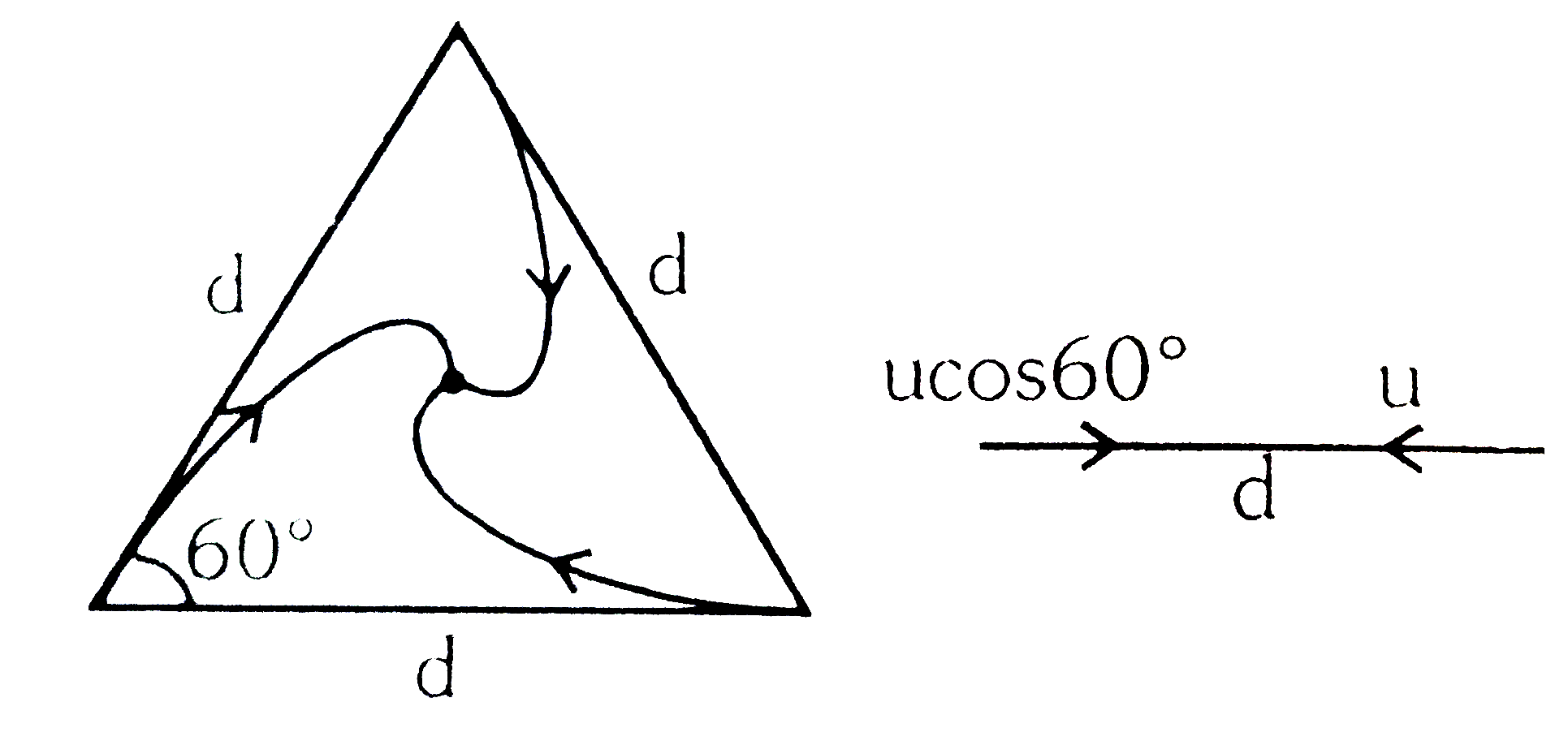
B


`d_("rel")=d`
`u_("rel")=u+u cos 60^(@)=(3u)/(2)`
time
For general `d_("rel")=` side of polygon
`u_("rel")=u+u cos theta [theta= "Interior angle"]`
`t=("side of polygon")/(u+ucos theta)`
Promotional Banner

Topper's Solved these Questions

  • MOTION IN A PALNE

    ALLEN|Exercise EXERCISE-3|40 Videos
  • MOTION IN A PALNE

    ALLEN|Exercise SOLVED EXAMPLE|28 Videos
  • MOTION IN A PALNE

    ALLEN|Exercise EXERCISE-1|99 Videos
  • KINEMATICS-2D

    ALLEN|Exercise Exercise (O-2)|46 Videos
  • NEWTON'S LAWS OF MOTION & FRICTION

    ALLEN|Exercise EXERCISE (JA)|4 Videos

Similar Questions

Explore conceptually related problems

Four particles A, B, C and D are situated at the corner of a square ABCD of side a at t-0. Each of particles moves with constant speed (v). A always has its velocity along AB, B along BC, C along CD~ and D along DA . At what time will these particles meet each other ?

Three particles A, B, Care located at the comers of an equilateral triangle as shown in figure. Each of the particle is moving with velocity v. Then at the instant shown, the relative angular velocity of

Three particles, each of mass m are situated at the vertices of an equilateral triangle ABC of side l (as shown in the figure). The moment of inertia of the system about a line AX perpendicular to AB and in the plane of ABC, will be:

Three particles, each of mass m are situated at the vertices of an equilateral triangle ABC of side L as shown in the figure. Find the moment of inertia of the system about the line AX perpendicular to AB in the plane of ABC

Three particles, each of mass m are fixed at the vertices of an equilateral triangle of side length a . The only forces acting on the particles are their mutual gravitational forces. Then answer the following questions. Force acting on particle C , due to particle A and B

Three particles A,B and C each of mass m are lying at the corners of an equilateral triangle of side L . If the particle A is released keeping the particles B and C fixed , the magnitude of instantaneous acceleration of A is

A particle moves with constant speed v along a circular path of radius r and completes the circle in time T. The acceleration of the particle is

Find the centre of mass of three particle at the vertices of an equilateral triangle. The masses of the particle are 100g, 150 g, and 200g respectively. Each side of the equilateral triangle is 0.5m along.

Three identical particles are located at the vertices of an equilateral triangle. Each particle moves along a meridian with equal speed towards the centroid and collides inelastically. (a) all the three particles will bounce back along the meridians with lesser speed. (b) all the three particles will become stationary. (c) all the particles will continue to move in their original directions but with lesser speed (d) nothing can be said

Six particles situated at the corners of a regular hexagon of side a move at a constant speed v. Each particle maintains a direction towards the particle at the next corner. Calculate the time the particles will take to meet each other.

ALLEN-MOTION IN A PALNE-EXERCISE-2
  1. A body is slipping from an inclined plane of height h and length l . I...

    Text Solution

    |

  2. A bead is free to slide down a smooth wire tightly stretched between p...

    Text Solution

    |

  3. Three particles A, B and C are situated at the vertices of an equilate...

    Text Solution

    |

  4. A particle starts from rest with constant acceleration. The ratio of s...

    Text Solution

    |

  5. In the graph shown in fig. the time is plotted along x-axis. Which qu...

    Text Solution

    |

  6. A particle of mass m is projected with a velocity v making an angle of...

    Text Solution

    |

  7. In case of a projectile fired at an angle equally inclined to the hori...

    Text Solution

    |

  8. A cannon of mass 5m (including a shell of mass m) is at rest on a smoo...

    Text Solution

    |

  9. The range of a projectile when fired at 75^(@) with the horizontal is ...

    Text Solution

    |

  10. A particle is projected with a velocity u making an angle theta with t...

    Text Solution

    |

  11. The velocity at the maximum height of a projectile is (sqrt(3))/(2) ti...

    Text Solution

    |

  12. What is the ratio of P.E. w.r.t. ground and K.E. at the top most point...

    Text Solution

    |

  13. A ball is thrown at an angle theta with the horizont its horizontal ra...

    Text Solution

    |

  14. A student is able to throw a ball vertically to maximum height of 40 m...

    Text Solution

    |

  15. Three projectile A, B and C are thrwon from the same point in the same...

    Text Solution

    |

  16. A projectile is thrown with an initial velocity (ahati+bhati)m s^(-1)....

    Text Solution

    |

  17. The equation of projectile is y = sqrt(3)x - (g)/(2)x^(2), the angle o...

    Text Solution

    |

  18. The equation of projectile is y=16x-(x^(2))/(4) the horizontal range i...

    Text Solution

    |

  19. If a projectile is fired at an angle theta with the vertical with velo...

    Text Solution

    |

  20. If R is the maximum horizontal range of a particle, then the greatest ...

    Text Solution

    |

