Home
Class 12
CHEMISTRY
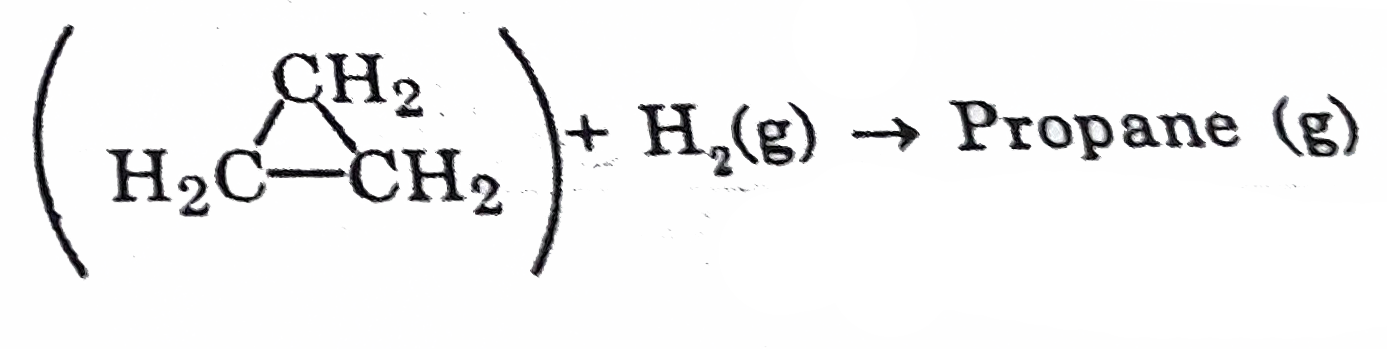
Calculate DeltaH for the reaction - Cycl...

Calculate `DeltaH` for the reaction - Cyclopropane (g)
Given : `{:("Bond","Bond enthalpy"),("(C-C)",330 k//J" mol"),("(C-H)",410 k//J" mol"),("(H-H)",440kJ//" mol"):}`

A

`-50k//J mol`

B

`50k//Jmol`

C

`360k//Jmol`

D

`-360k//Jmol`

Text Solution

Verified by Experts

The correct Answer is:

A
Promotional Banner

Topper's Solved these Questions

Similar Questions

Explore conceptually related problems

Bond energies can be obtained by using the following relation: DeltaH (reaction) = sum Bond energy of bonds, broken in the reactants -sum Bond energy fo bonds, formed in the products Bond enegry depends on three factors: a. Greater is the bond length, lesser is the bond enegry. b. Bond energy increases with the bond multiplicity. c. Bond enegry increases with electronegativity difference between the bonding atoms. Use the bond enegries to estimate DeltaH for this reaction: H_(2)(g) +O_(2)(g) rarr H_(2)O_(2)(g) {:("Bond","Bond energy"),(H-H,436 kJ mol^(-1)),(O-O,142 kJ mol^(-1)),(O=O, 499kJ mol^(-1)),(H-O,460kJ mol^(-1)):}

Using the bond enthalpy data given below, calculate the enthalpy change for the reaction C_(2)H_(4)(g)+H_(2)(g)rarrC_(2)H_(6)(g) {:("Data":,"Bond",,"Bond enthalpy",),(,C-C,,336KJmol^(-1),),(,C=C,,606KJmol^(-1),),(,C-H,,410KJ mol^(-1),),(,H-H,,431KJ mol^(-1),):}

Calculate DeltaH^(@) ("in" kJmol^(-1)) for the reaction CH_(2)Cl_(2)(g)rarrC(g)+2H(g)+2Cl(g). The average bond enthalpie of C-H and C-C1 bonds are 414 kJ mol^(-1) .

The net enthalpy change of a reaction is the amount of energy required to break all the bonds in reactant molecules minus amount of energy required to form all the bonds in the product molecules. What will be the enthalpy change for the following reaction ? H_(2) (g) + Br_(2) (g) rarr 2HBr (g) . Given that, bond energy of H_(2), Br_(2) and HBr is 435 kJ mol^(-1), 192 kJ mol^(-1) and 368 kJ mol^(-1) respectively

Using the bond enthalpy data given below, calculate the enthalpy of formation of acetone (g). Bond enegry C-H = 413.4 kJ mol^(-1) , Bond enegry C-C = 347.0 kJ mol^(-1) , Bond enegry C=O = 728.0 kJ mol^(-1) , Bond enegry O=O = 495.0 kJ mol^(-1) , Bond enegry H-H = 435.8 kJ mol^(-1) , Delta_("sub")H^(Theta)C(s) = 718.4 kJ mol^(-1)

Calculate the enthalpy of formation of water, given that the bond energies of H-H, O=O and O-H bond are 433 kJ mol^(-1), 492 kJ mol^(-1) , and 464 kJ mol^(-1) , respectively.

Calculate the enthalpy change during the reaction : H_(2(g))+Br_(2(g))rarr 2HBr_((g)) Given, e_(H-H)=435kJ mol^(-1),e_(Br-Br)=192kJ mol^(-1) and e_(H-Br)=368kJ mol^(-1).

The enthalpy of atomisation for the reaction CH_(4) (g) rarr C (g) + 4H (g) " is " 1665 kJ mol^(-1) . What is the bond energy of C - H bond ?

Calculate the enthalpy of formation of ammonia from the following bond energy data: (N-H) bond = 389 kJ mol^(-1), (H-H) bond = 435 kJ mol^(-1) , and (N-=N)bond = 945.36kJ mol^(-1) .

ALLEN-TEST PAPERS-CHEMISTRY
  1. Calculate solubility (in moles/litre) of a saturated aqueous solution ...

    Text Solution

    |

  2. Given 0.158 mol of acidified Aluminium dichromate will oxidise how man...

    Text Solution

    |

  3. Calculate DeltaH for the reaction - Cyclopropane (g) Give...

    Text Solution

    |

  4. Which of the following metallurgical process for the extraction of ind...

    Text Solution

    |

  5. Which of the following compound gives yellowish white turbidity with d...

    Text Solution

    |

  6. Which of following shows highest rate of decarboxylation in presence o...

    Text Solution

    |

  7. Aoverset("KCN")toBoverset(H(3)O+)underset(NH(3)//Delta)toCoverset(Br(2...

    Text Solution

    |

  8. Choose the incorrect statement (s )-

    Text Solution

    |

  9. Three different solutions of oxidising agents KMnO(4),K(2)Cr(2)O(7) " ...

    Text Solution

    |

  10. Which of the following reactions (s) is/are correctly represented to p...

    Text Solution

    |

  11. The CORRECT statement (s) is/are:

    Text Solution

    |

  12. Which of following gives positive carbylamine test ?

    Text Solution

    |

  13. Correct set of reaction which produce carbanion intermediate is/are

    Text Solution

    |

  14. Acylation followed by clemenson reduction is more suitable to get alky...

    Text Solution

    |

  15. Arrhenius studies the effect of temperature on the rate of a reaction...

    Text Solution

    |

  16. Arrhenius studies the effect of temperature on the rate of a reaction...

    Text Solution

    |

  17. Which of the following sulphide(s) does/do not liberate H(2)S on warmi...

    Text Solution

    |

  18. Which of the following oxide is basic?

    Text Solution

    |

  19. Select the INCORRECT statement .

    Text Solution

    |

  20. Select the INCORRECT statement regarding hydrolysis of SF(4)

    Text Solution

    |
