Home
Class 12
PHYSICS
A large heavy box is sliding without fri...

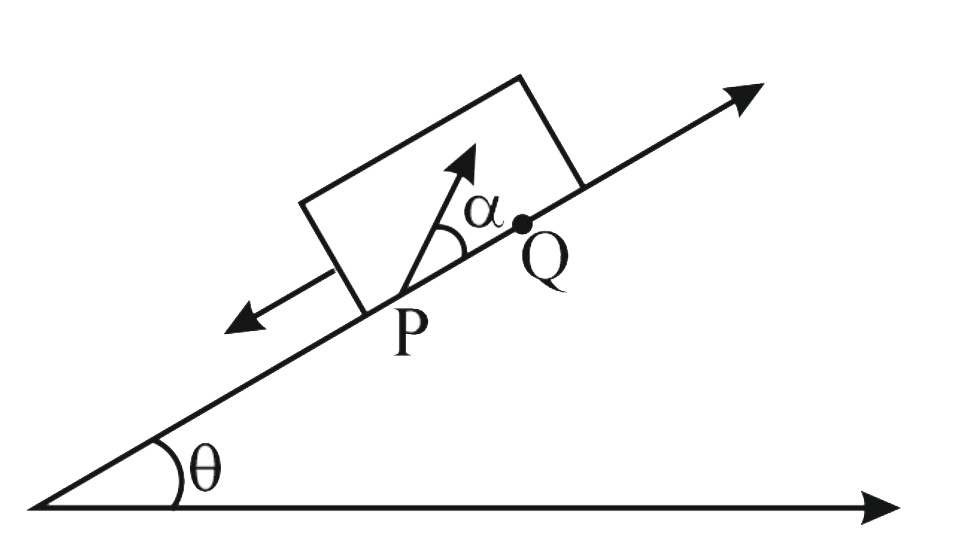
A large heavy box is sliding without friction down a smooth plane of inclination `theta.` From a point P on the bottom of the box, a particle is projected inside the box. The initial speed of the particle with respect to the box is u and the direction of projection makes an angle `alpha` with the bottom as shown in the figure:

Find the distance along the bottom of the box between the point of projection P and the point Q where the particle lands.
[Assume that the particle does not hit any other surface of the box. Neglect air resistance]

Text Solution

Verified by Experts

The correct Answer is:

(i) `(u^(2) sin 2 alpha)/(g cos theta)` (ii) `v=(u cos (alpha+0))/(cos theta)`
Promotional Banner

Topper's Solved these Questions

Similar Questions

Explore conceptually related problems

A large , heavy box is sliding without friction down a smooth plane of inclination theta . From a point P on the bottom of the box , a particle is projected inside the box . The initial speed of the particle with respect to the box is u , and the direction of projection makes an angle alpha with the bottom as shown in Figure . Find the distance along the bottom of the box between the point of projection p and the point Q where the particle lands . ( Assume that the particle does not hit any other surface of the box . Neglect air resistance .

A large , heavy box is sliding without friction down a smooth plane of inclination theta . From a point P on the bottom of the box , a particle is projected inside the box . The initial speed of the particle with respect to the box is u , and the direction of projection makes an angle alpha with the bottom as shown in Figure . (a) Find the distance along the bottom of the box between the point of projection p and the point Q where the particle lands . ( Assume that the particle does not hit any other surface of the box . Neglect air resistance .) (b) If the horizontal displacement of the particle as seen by an observer on the ground is zero , find the speed of the box with respect to the ground at the instant when particle was projected .

A large , heavy box is sliding without friction down a smooth plane of inclination theta . From a point P on the bottom of the box , a particle is projected inside the box . The initial speed of the particle with respect to the box is u , and the direction of projection makes an angle alpha with the bottom as shown in Figure . (a) Find the distance along the bottom of the box between the point of projection p and the point Q where the particle lands . ( Assume that the particle does not hit any other surface of the box . Neglect air resistance .) (b) If the horizontal displacement of the particle as seen by an observer on the ground is zero , find the speed of the box with respect to the ground at the instant when particle was projected .

A particle is projected at an angle theta with an initial speed u .

A particle is projected with speed u at angle theta to the horizontal. Find the radius of curvature at highest point of its trajectory

A particle of mass m is projected with speed u at an angle theta with the horizontal. Find the torque of the weight of the particle about the point of projection when the particle is at the highest point.

A particle of mass m is projected with speed u at an angle theta with the horizontal. Find the torque of the weight of the particle about the point of projection when the particle is at the highest point.

A particle of mass m , initial speed u and angle of projection theta is projected as shown in the figure. Average torque on the projectile between initial and final positions P and Q about the point of projection is

A particle is projected on an inclined plane with a speed u as shown in (Fig. 5.61). Find the range of the particle on the inclined plane. .

A particles is projected horizontally with a speed v from the top of a plane inclined at an angle tehta to the horizontal as shown in the figure. (a) Hwo far from the point of projection will the particle strike the plane ? (b) Find the time taken by the particel to hit the plane. (c) What is the velocity of particle just before it hits the plane ?
