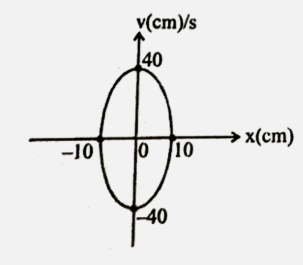
A
B
C
D
Text Solution
Verified by Experts
The correct Answer is:



Topper's Solved these Questions
RACE
ALLEN|Exercise Basic Maths (Oscillations) (Energy & spring pendulum)|17 VideosRACE
ALLEN|Exercise Basic Maths (Oscillations) (Simple pendulum and types of SHM)|17 VideosRACE
ALLEN|Exercise Basic Maths (Thermal Physics) (Thermodynamic process)|20 VideosNEWTONS LAWS OF MOTION
ALLEN|Exercise EXERCISE-III|28 VideosSIMPLE HARMONIC MOTION
ALLEN|Exercise Example|1 Videos
Similar Questions
Explore conceptually related problems
ALLEN-RACE-Basic Maths (Dscillations) (Kinematics of SHM)
- Two particles executing SHM of same frequency meet at x=+(sqrt(3)A)/(2...
Text Solution
|
- A particle is executing SHM with time period T. Starting from mean pos...
Text Solution
|
- A particle executes simple harmonic motion according to equation 4(d^(...
Text Solution
|
- The plot of velocity (v) versus displacement (x) of a particle executi...
Text Solution
|
- Figure shows the position -time graph of an object in SHM. The correct...
Text Solution
|
- A particle executes SHM according to equation x= 10 (cm) cos [2pi t + ...
Text Solution
|
- A particle of mass m in a unidirectional potential field have potentia...
Text Solution
|
- A particle executing simple harmonic motion has angular frequence 6.28...
Text Solution
|
- A body makes angular simple harmonic motion of amplitude pi//10rad and...
Text Solution
|
- The vertical motion of a ship at sea is described by the equation (d^2...
Text Solution
|
- The equation of motion of a particle of mass 1g is (d^(2)x)/(dt^(2)) +...
Text Solution
|
- The time taken by a particle performing SHM to pass from point A and B...
Text Solution
|
- The phase difference between two SHM y(1) = 10 sin (10 pi t + (pi)/(3)...
Text Solution
|
- A small mass executes SHM around a point O with amplitude A & time per...
Text Solution
|
- Two SHM are represcnted by equations y(1)=6cos(6pit+(pi)/(6)),y(2)=3(s...
Text Solution
|
- The phase difference between displacement and acceleration of particle...
Text Solution
|
- The acceleration of a particle moving along x-axis is a=-100x+50. It i...
Text Solution
|
- The acceleration of a certain simple harmonic oscillator is given by ...
Text Solution
|
- A particle executes simple harmonic motion with a time period of 16 s ...
Text Solution
|
- Two particles P and Q describe S.H.M. of same amplitude a, same freque...
Text Solution
|