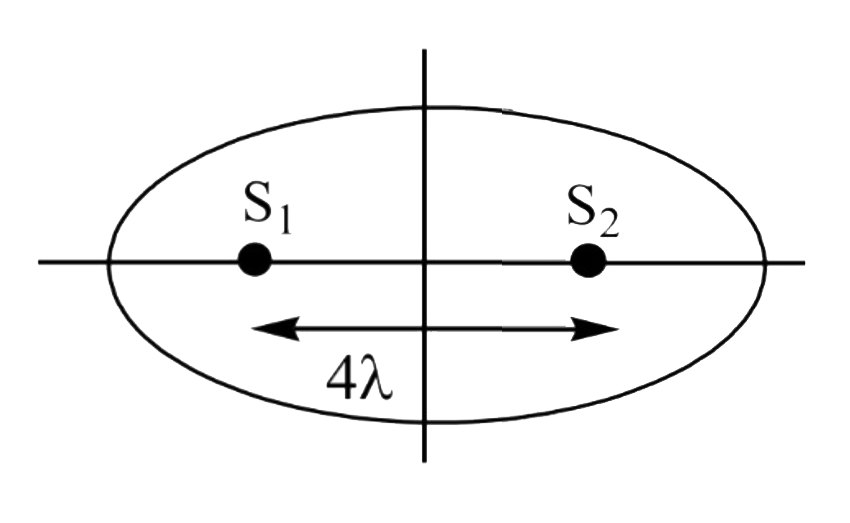
A
B
C
D
Text Solution
Verified by Experts
The correct Answer is:



Topper's Solved these Questions
RACE
ALLEN|Exercise Basic Maths (Wave Motion & Dopplers Effect) (Stationary waves & doppler effect, beats)|24 VideosRACE
ALLEN|Exercise Basic Maths (Wave Motion & Dopplers Effect) (Fundamental)|25 VideosNEWTONS LAWS OF MOTION
ALLEN|Exercise EXERCISE-III|28 VideosSIMPLE HARMONIC MOTION
ALLEN|Exercise Example|1 Videos
Similar Questions
Explore conceptually related problems
ALLEN-RACE-Basic Maths (Wave Motion & Dopplers Effect) (Superposition of waves interfarence, beats)
- Four tuning forks of frequencies 200,201,204 and 206 Hz are sounded to...
Text Solution
|
- S1 , S2 are two coherent sources (having initial phase difference zero...
Text Solution
|
- Three waves producing displacement in the same direction of same frequ...
Text Solution
|
- Two coherent sources of different intensities send waves which interf...
Text Solution
|
- IF two tuning forks A and B are sounded together, they produce 4 beats...
Text Solution
|
- When two progressive waves of intensity I(1) and I(2) but slightly dif...
Text Solution
|
- A vibrating tuning fork of frequency v is placed near the open end of ...
Text Solution
|
- Two waves are given by y(1)=asin(omegat-kx) and y(2)=a cos(omegat-kx)....
Text Solution
|
- Two pulses in a stretched string whose centres are initially 8 cm apar...
Text Solution
|
- Two turning forks of frequencies n(1) and n(2) produces n beats per s...
Text Solution
|
- In the figure , the intensity of waves arriving at D from two coherent...
Text Solution
|
- When a guitar string is sounded with a 440 Hz tuning fork, a beat freq...
Text Solution
|
- If two waves of same frequency and same amplitude superimpose and prod...
Text Solution
|
- Two waves are represented by: y(1)=4sin404 pit and y(2)=3sin400 pit. T...
Text Solution
|
- 41 tuning forks are arranged such that every fork gives 5 beats with t...
Text Solution
|