Home
Class 12
CHEMISTRY
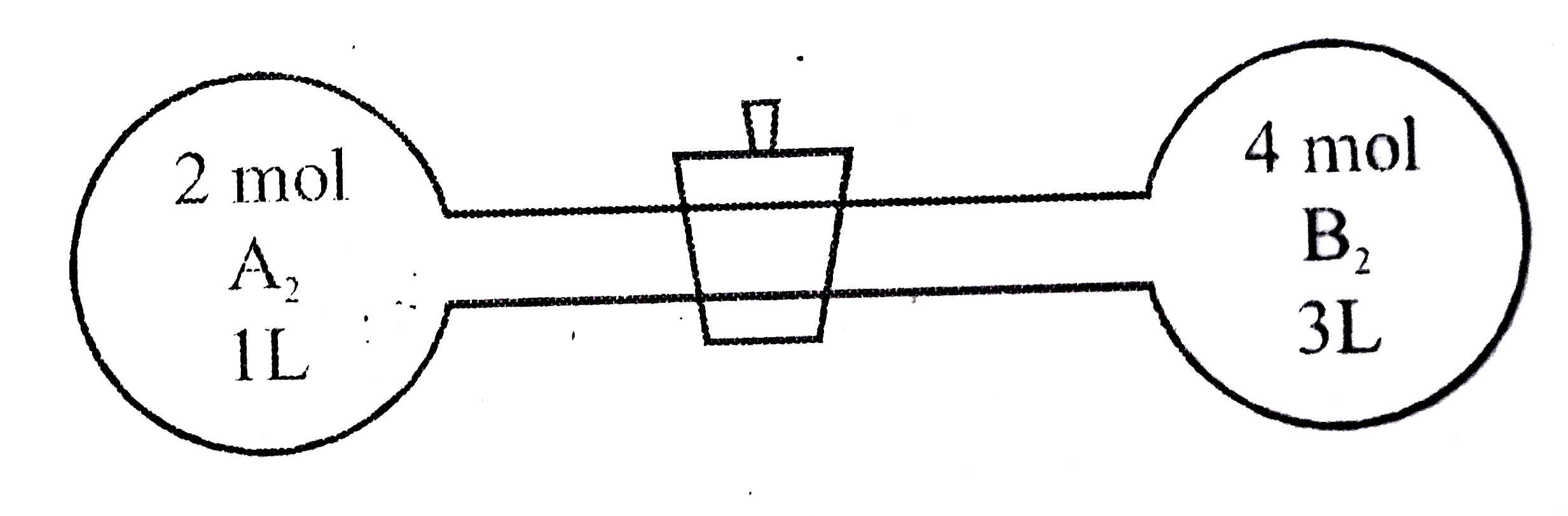
When A2 and B2 are allowed to react, the...

When `A_2` and `B_2` are allowed to react, the equilibrium constant of the reaction at `27^@C` is `K_C = 4`

What will be the equilibrium concentration of AB?

A

`1.33 M `

B

`2.66 M`

C

`0.66 M`

D

`0.33 M`

Text Solution

Verified by Experts

The correct Answer is:

D
Promotional Banner

Topper's Solved these Questions

Similar Questions

Explore conceptually related problems

When A_(2) and B_(2) are allowed to react, the equilibrium constant of the reaction at 27^(@)C is found (K_(c)=4) . A_(2(g))+B_(2(g))hArr2AB_((g)) what will be the equilibrium concentration of AB?

The equilibrium constant (K) for the reaction. A+2BhArr2C+D is:

In the reaction A+B hArr C+D , What will happen to the equilibrium if concentration of A is increased ?

The equilibrium constant for a reaction A+2B hArr 2C is 40 . The equilibrium constant for reaction C hArr B+1//2 A is

For the reaction, A+B hArr 2C, 2 mol of A and 3 mol of B are allowed to react. If the equilibrium constant is 4 at 400^(@)C , what will be the moles of C at equilibrium?

The equilibrium constant for the reactions A+B hArr AB is 0.5 at 200K . The equilibrium constant for the reaction AB hArr A+B would be

If the equilibrium for a reaction is 4.0 what will be the equilibrium constant for the reverse reaction.

The unit of equilibrium constant K_(c) for the reaction A+B hArr C would be

A + B hArrC + D . If finally the concentrations of A and B are both equal but at equilibrium concentration of D will be twice of that of A then what will be the equilibrium constant of reaction.

A + B hArrC + D . If finally the concentrations of A an d B are both equal but at equilibrium concentration of D will be twice of that of A then what will be the equilibrium constant of reaction.

ALLEN-TEST PAPER 3-CHEMISTRY
  1. In the reaction , A(s) +B(g) + "heat" hArr 2C(s) + 2D(g) at equili...

    Text Solution

    |

  2. For which of the following gaseous reactions, the relationship log KC/...

    Text Solution

    |

  3. At which temperature, P C K K KP/KC value will be 1/4 for dissociatio...

    Text Solution

    |

  4. Equilibrium constants for (a) N2 + O2 hArr 2NO and (b) NO + 1/2O2 hArr...

    Text Solution

    |

  5. At t^@C temperature, the observed vapour density of A is 17.5 for the ...

    Text Solution

    |

  6. For the reaction A((s)) + 2B((g)) ƒhArr 3C((g)) . At constant pressur...

    Text Solution

    |

  7. Which of following does not show common ion effect ?

    Text Solution

    |

  8. For the reaction 3A(g)+B(g) hArr 2C(g) at a given temperature , Kc=9.0...

    Text Solution

    |

  9. When A2 and B2 are allowed to react, the equilibrium constant of the r...

    Text Solution

    |

  10. The dissociation constant fo acetic acid at a given temperature is 1.6...

    Text Solution

    |

  11. 6.0 g weak acid HA (mol.mass=60 g/mol.) is dissolved in water and form...

    Text Solution

    |

  12. PbOhArrPb+1/2O2, K=2xx10^(-1) ZnOhArr +1/2 O2 K=2xx10^2 CuOhArr +...

    Text Solution

    |

  13. The value of K(c) for the reaction 3O(2)(g) hArr 2O(2)(g) is 2.0 xx 10...

    Text Solution

    |

  14. Acidic strength of CH3 COOH in presence of CH3 COONa :-

    Text Solution

    |

  15. Equilibrium constant K(C) for the following reaction at 800 K is, 4 NH...

    Text Solution

    |

  16. In a flask colourless N2O4 is in equilibrium with brown coloured NO2. ...

    Text Solution

    |

  17. A + B hArr C + D, Kc = 5 If at some time the concentration of A, B, C...

    Text Solution

    |

  18. For pure water (pH=7), K(w) at 298 is 10^(-14). On adding some acid t...

    Text Solution

    |

  19. What should be the concentration of a weak electrolyte AB, When its de...

    Text Solution

    |

  20. Which of the following statement for pure water is wrong ?

    Text Solution

    |
