Home
Class 11
PHYSICS
A plank with a box on it at one end is g...

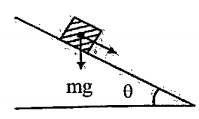
A plank with a box on it at one end is gradually raised about the other end. As the angle of invlination with the horizontal reaches `30^@` , the box starts to slip and slides 4.0 m down the plank in 4.0s.The coefficients of static and kinetic friction between the box and the plank will be, respectively:
.

A

0.4 and 0.3

B

0.6 and 0.6

C

0.6 and 0.5

D

0.5 and 0.6

Text Solution

Verified by Experts

Promotional Banner

Topper's Solved these Questions

  • KINEMATICS

    SARAS PUBLICATION|Exercise EXAMPLE|23 Videos
  • MOTION OF SYSTEM OF PARTICLES AND RIGID BODY

    SARAS PUBLICATION|Exercise EXAMPLE |35 Videos

Similar Questions

Explore conceptually related problems

A wooden block is kept on a polished wooden plank and the inclination of the plank is gradually increased. It is found that the block starts slipping when the plank makes an angle of 18^@ with the horizontal. However, once started the block can continue with uniform speed if the inclination is reduced to 15^@ . Find the coefficients of static and kinetic friction between the block and the plank.

A body slipping on a rough horizontal plane moves wioth a deceleationof 4.0 m/s^ . What is cofficient of kineic friction between the block and the plane?

See Fig. A mass of 4 kg rests on a horizontal plane. The plane is gradually inclined until at an angle theta = 15^@ with the horizontal, the mass just begins to slide. What is the coefficient of static friction between the block and the surface ?

A block of mass 2.5 kg is kept on a rough horizontal surface. It is found that the block does not slide if a horizontal force less than 15 N is applied to it. Also it is found that it takes 5 seconds to slide through the first 10 m if a horizontal force of 15 N is applied and the block is gently pushed to start the motion. Taking g=10 m/s^2 , calculate the coefficient of static and kinetic friction between the block and the surface.

A rectangular box lies on a rough inclined surface. The coefficient of friction between the surface and the box is mu . Let the mass of the box be m. (a) At what angle of inclination theta of the plane to the horizontal will the box just start to slide down the plane? (b) What is the force acting on the box down the plane, if the angle of inclination of the plane is increased to a gt theta . (c) What is the force needed to be applied upwards along the plane to make the box either remain stationary or just move up with uniform speed? (d) What is the force needed to be applied upwards along the plane to mu_k kgf make the box move up the plane with acceleration a?

A block A of mass m_1 rests on a horizontal table . A light string connected to it passes over a frictionless pulley at the edge of table and from its other end another block B of mass m_2 is suspended . The coefficient of kinetic friction between the block and the table is mu . When the block A is sliding on the table the tension in the string is :

A boy (30 kg) sitting on his horse whips it. The horse speeds up at an average acceleration of 2.0 m/s^2 . A. If the boy does not slide back, what is the force of friction exerted by the horse on the boy? b.If the boy slides back during the acceleration, what can be said about the coefficient of static friction between the horse and the boy. Take g = 10 m/s^2

The coefficient of static friction between a block of mass m and an incline is mu_s=0.3 , a. What can be the maximum angle theta of the incline with the horizontal so that the block does not slip on the plane? b. If the incline makes an angle theta/2 with the horizontal, find the frictional force on the block.

In a children's park a heavy rod is pivoted at the centre and is made to rotate about the pivot so that the rod always remains horizontal. Two kids hold the rod near the ends and thus rotate with the rod figure. Let the mas of each kid be 15 kg, the distance between the points of the rod where the two kids hold it be 3.0 m and suppose that the rod rotates at the rate of 20 revolutions per minute. Find the force of friction exerted by the rod on one of the kids.

