Home
Class 9
CHEMISTRY
How will you separate a mixture containi...

How will you separate a mixture containing kerosene and petrol (difference in their boiling points is more than `25^ @C`), which are miscible with each other ?

Text Solution

Verified by Experts
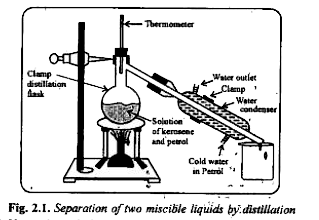
We can separate a mixture containing kerosene and petrol by distillation. To do so, take the mixture in a distillation flask. Fit it with a thermometer. Arrange the apparatus as shown in fig. 2.1. Heat the mixture slowly keeping 4 close watch at the thermometer. Petrol vaporises, condenses in the condenser and can be collected from the condenser outlet. Kerosene is left behind in the distillation flask.
Promotional Banner

Topper's Solved these Questions

  • IS MATTER AROUND US PURE

    SWAN PUBLICATION|Exercise EXERCISES|49 Videos
  • IS MATTER AROUND US PURE

    SWAN PUBLICATION|Exercise IMPORTANT Q/A|16 Videos
  • ATOMS AND MOLECULES

    SWAN PUBLICATION|Exercise IMPORTANT Q/A|27 Videos
  • MATTER IN OUR SURROUNDINGS

    SWAN PUBLICATION|Exercise IMPORTANT Q/A|15 Videos

Similar Questions

Explore conceptually related problems

How will you separate : Kerosene oil from a mixture of kerosene oil and petrol ?

How would you separate : Kerosene oil from a mixture of kerosene oil and petrol ?

Two intersecting lines can intersect each other at more than one point.

For a dilute solution containing 2.5 g of a non volatile non electrolyte solution in 100 g of water, the elevation in boiling point at 1 atm pressure is 2^@C . Assuming concentration of solute is much lower than the concentration of solvent, the vapour pressure (take k b = 0.76 K Kg mol^-1 )

Three beakers labelles as A, B and C each containing 25 mL of water were taken. A small amount of NaOH, anhydrous CuSO_4 and NaCl were added to the breakers A, B and C respectively. It was observed that there was an increase in the temperature of the solutions containers in beaker A, and B, where in case of beaker C, the temperature of the solution falls. Which one of the following statements(s) is(are) correct? (i) In beaker A and B, exothermic process has occured. (ii)In beaker A and B, endothermic process has occured. (iii) In beaker C exothermic process as occured. (iv) In beaker C endothermic process has occured.

Read the given passage and answers following questions : Thomas Graham in 1861, during his work on diffusion found that certain substances such as gelatin, albumin, glue,etc. Diffused at very low rate and were called colloids. The colloid particles have the size in the range of 1 to 100nm consisting of dispersed phase and dispersion medium. The dispersed phase or dispersion medium may be solid, liquid or even a gas. Depending upon the nature of dispersion medium or dispersed phase, 8 types of systems are possible except for a gas dispersed in another gas because the gases are completely miscible with each other. The substances which have strong interaction with the dispersion medium are called lyophilic colloids while those which do not pass into colloidal state readily are called lyophobic colloids. Lyophobic sols are much less stable and are irreversible. Answer the following questions : Which type of colloids are more stable?

Thomas Graham in 1861, during his work on diffusion found that certain substances such as gelatin, albumin, glue, etc. Diffused at very low rate and were called colloids. The colloid particles have the size in the range of 1 to 100 nm consisting of dispersed phase and dispersion medium. The dispersed phase or dispersion medium may be solid, liquid or even a gas. Depending upon the nature of dispersion medium or dispersed phase, 8 types of systems are possible except for a gas dispersed in another gas because the gases are completely miscible with each other. The substances which have strong interaction with the dispersion medium are called lyophilic colloids while those which do not pass into collpidal state readily are called lyophobic colloids. Lyophobic sols are much less stable and are irreversible . Which type of colloids are more stable ?

Read the given passage and answers following questions : Thomas Graham in 1861, during his work on diffusion found that certain substances such as gelatin, albumin, glue,etc. Diffused at very low rate and were called colloids. The colloid particles have the size in the range of 1 to 100nm consisting of dispersed phase and dispersion medium. The dispersed phase or dispersion medium may be solid, liquid or even a gas. Depending upon the nature of dispersion medium or dispersed phase, 8 types of systems are possible except for a gas dispersed in another gas because the gases are completely miscible with each other. The substances which have strong interaction with the dispersion medium are called lyophilic colloids while those which do not pass into colloidal state readily are called lyophobic colloids. Lyophobic sols are much less stable and are irreversible. Answer the following questions : How many types systems are possible depending upon the nature of dispersion medium?

Thomas Graham in 1861, during his work on diffusion found that certain substances such as gelatin, albumin, glue,etc. Diffused at very low rate and were called colloids. The colloid particles have the size in the range of 1 to 100nm consisting of dispersed phase and dispersion ,( medium. The dispersed phase or dispersion medium may be solid, liquid 6r even a gas. Depending upon the nature of dispersion medium or dispersed phase, 8 types of systems are possible except for a gas dispersed in another gas because the gases are completely miscible with each other. The substances which have strong interaction with the dispersion medium are called lyophilic colloids while those which do not pass into collofdalstate readily are called lyophobic colloids. Lyophobic sols are much less stable and are irreversible. How many types of systems are possible depending upon the nature of dispersion medium?

