

Home
Class 12
PHYSICS
A body having specific charge 8 mu C//g ...

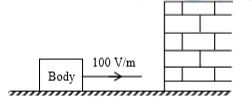
A body having specific charge `8 mu C//g` is resting on a frictionless plane at a distance 10 cm from the wall (as shown in the figure). It starts moving towards the wall when a uniform electric field of 100 V/m is applied horizontally towards the wall. If the collision of the body with the wall is perfectly elastic, then the time period of the motion will be ______ s.

Promotional Banner

Topper's Solved these Questions

  • JEE MAINS 2021

    JEE MAINS PREVIOUS YEAR|Exercise PHYSICS (SECTION - A) |40 Videos
  • JEE MAINS 2021

    JEE MAINS PREVIOUS YEAR|Exercise PHYSICS (SECTION - B) |20 Videos
  • JEE MAINS 2021

    JEE MAINS PREVIOUS YEAR|Exercise Physics (Section B )|10 Videos
  • JEE MAINS 2020

    JEE MAINS PREVIOUS YEAR|Exercise PHYSICS|246 Videos
  • JEE MAINS 2022

    JEE MAINS PREVIOUS YEAR|Exercise PHYSICS (SECTION -B)|10 Videos

Similar Questions

Explore conceptually related problems

A block having mass 'm' ad carge q is resting on a fractionless plane at distance L from the wall as shown in fig.Discuss the motion of the block when a uniform electric field E is applied horizontally towards the wall assuming that collision of the block with the wall is perfectly elastic.

A block having mass m and charge Q is resting on a frictionless plane at a distance d from fixed large non-conducting infinite sheet of uniform charge density -sigma as shown in Figure. Assuming that collision of the block with the sheet is perfectly elastic, find the time period of oscillatory motion of the block. Is it SHM ?

A sphere of mass m slides with velocity v on as frictionless surface towards a smooth inclined wall as shown in figure. If the collision with the wall is perfectly elastic find a. the impulse imparted by the wall on the sphere b the impulse imparted by the floor on the sphere.

A vessel contains 6xx 10^(26) molecules m ^(-3). Mass of each molecule is 6xx10^(-27) kg. Assume that, on an average, one-sixth of the molecules move with a velocity 10^(3) m/s perpendicularly towards each wall. If the collisions with the walls are perfectly elastic, then which of the following is correct?

In the figure, the block of mass m, attached to the spring of stiffness k is in correct with the completely elastic wall, and the compression in the spring is e. The spring is compressed further by e by displacing the block towards left and is then released. If the collision between the block and the wall is completely eleastic then the time period of oscillation of the block will be

A block is attached to a spring and is placed on a horizontal smooth surface as shown in which spring is unstretched. Now the spring is given an initial compression 2x_(0) an block is released from rest. Collision with the wall PQ are elastic. Find the time period of motion of the block:

Figure shown a block P of mass m resting on a smooth horizontal surface, attached to a spring of force constant k which is rigidly fixed on the wall on left side, shown in the figure . At a distance l to the right of the block there is a rigid wall. If block is pushed towards loft so that spring is comparessed by a distance 5l//3 and when released, if will starts its oscillations. If collision of block with the wall is consdered to be perfectly elastic. Find the time period of oscillation of the block.

Two balls each of mass 'm' are moving with same velocity v on a smooth surface as shown in figure. If all collisions between the balls and balls with the wall are perfectly elastic, the possible number of collisions between the balls and wall together is

A block of mass 100 g attached to a spring ofstiffness 100 N//Mis lying on a frictionless floor as shown. The block is moved to compress the spring by 10 cm and released. If the collation with the wall is elastic then find the time period of oscillations.

JEE MAINS PREVIOUS YEAR-JEE MAINS 2021-PHYSICS (SECTION-B)
  1. In an LCR series circuit, an inductor 30 mH and a resistor 1 Omega are...

    Text Solution

    |

  2. The amplitude of wave disturbance propagating in the positive x-direc...

    Text Solution

    |

  3. A body having specific charge 8 mu C//g is resting on a frictionless p...

    Text Solution

    |

  4. In the reported figure, heat energy absorbed by a system in going thro...

    Text Solution

    |

  5. A circular disc reaches from top to bottom of an inclined plane of len...

    Text Solution

    |

  6. A rod of mass M and length L is lying on a horizontal frictionless sur...

    Text Solution

    |

  7. An object viewed from a near point distance of 25 cm, using a microsc...

    Text Solution

    |

  8. The frequency of a car horn encountered a change from 400 Hz to 500 Hz...

    Text Solution

    |

  9. A carrier wave V(c)(t)=160 sin (2 pi xx 10^(6) t) volts is made to var...

    Text Solution

    |

  10. In a given circuit diagram, a 5 V zener diode along with a series resi...

    Text Solution

    |

  11. The position of the centre of mass of a uniform semi-circular wire of ...

    Text Solution

    |

  12. In an electric circuit, a call of certain emf provides a potential dif...

    Text Solution

    |

  13. The total charge enclosed in an incremental volume of 2 xx 10^(-9) m^3...

    Text Solution

    |

  14. Three particce P,Q and R are moving along the vectors vecA = hati + ha...

    Text Solution

    |

  15. The centre of a wheel rolling on a plane surface moves with a speed v0...

    Text Solution

    |

  16. A ray of light passing through a prism (mu = sqrt3)suffers minimum dev...

    Text Solution

    |

  17. The area of cross-section of a railway track is 0.01 m^2 . The temper...

    Text Solution

    |

  18. Three students S1, S2 and S3 perform an experiment for determining th...

    Text Solution

    |

  19. In 5 minutes, a body cools from 75^@C to 65^@C at room temperature o...

    Text Solution

    |

  20. A system consists of two types of gas molecules A and B having same nu...

    Text Solution

    |