Home
Class 12
PHYSICS
Assertion A : If A, B, C, D are four poi...

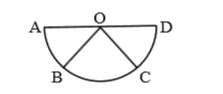
Assertion A : If A, B, C, D are four points on a semi-circular arc with centre at 'O' such that
`|vec(AB)| = |vec(BC)|=|vec(CD)|`, then
`vec(AB) +vec(AC) +vec(AD) =4 vec(AO) +vec(OB) +vec(OC)`
Reason R : Polygon law of vector addition yields
`vec(AB) +vec(BC) +vec(CD) +vec(AD)=2vec(AO)`

In the light of the above statements, choose the most appropriate answer from the options given below :

A

A is correct but R is not correct.

B

A is not correct but R is correct.

C

Both A and R are correct and R is the correct explanation of A.

D

Both A and R are correct but R is not the correct explanation of A.

Text Solution

Verified by Experts

The correct Answer is:

D
Promotional Banner

Topper's Solved these Questions

  • JEE MAINS 2021

    JEE MAINS PREVIOUS YEAR|Exercise PHYSICS (SECTION-B)|40 Videos
  • JEE MAINS 2021

    JEE MAINS PREVIOUS YEAR|Exercise PHYSICS (SECTION - A) |40 Videos
  • JEE MAINS 2020

    JEE MAINS PREVIOUS YEAR|Exercise PHYSICS|246 Videos
  • JEE MAINS 2022

    JEE MAINS PREVIOUS YEAR|Exercise PHYSICS (SECTION -B)|10 Videos

Similar Questions

Explore conceptually related problems

A, B, C, D are four points in the space and satisfy |vec(AB)|=3, |vec(BC)|=7, |vec(CD)|=11 and |vec(DA)|=9 . Then find the value of vec(AC)*vec(BD) .

ABCDE is a pentagon prove that vec(AB)+vec(BC)+vec(CD)+vec(DE)+vec(EA)=vec0

If ABCDE is a pentagon, then vec(AB) + vec(AE) + vec(BC) + vec(DC) + vec(ED) + vec(AC) is equal to

Let O be the centre of a regular pentagon ABCDE and vec(OA) = veca , then vec(AB) +vec(2BC) + vec(3CD) + vec(4DE) + vec(5EA) is equals:

Let O be the centre of a regular pentagon ABCDE and vec(OA) = veca , then vec(AB) +vec(2BC) + vec(3CD) + vec(4DE) + vec(5EA) is equals:

In a triangle ABC, if taken in order, consider the following statements 1. vec(AB) + vec(BC) + vec(CA) = vec(0) 2 vec(AB) + vec(BC) - vec(CA) = vec(0) 3. vec(AB)- vec(BC) + vec(CA) = vec(0) 4. vec(BA)- vec(BC) + vec(CA) = vec(0) How many of the above statements are correct?

In Fig. ABCDEF is a ragular hexagon. Prove that vec(AB) +vec(AC) +vec(AD) +vec(AE) +vec(AF) = 6 vec(AO) .

In a regular hexagon ABCDEF, prove that vec(AB)+vec(AC)+vec(AD)+vec(AE)+vec(AF)=3vec(AD)

Orthocenter of an equilateral triangle ABC is the origin O. If vec(OA)=veca, vec(OB)=vecb, vec(OC)=vecc , then vec(AB)+2vec(BC)+3vec(CA)=

In a right angled triangle hypotenuse AC= p, then vec(AB). vec(AC ) + vec(BC) .vec(BA) + vec(CA). vec(CB) equal to ?
