Home
Class 12
CHEMISTRY
What is temperature coefficient of a rea...

What is temperature coefficient of a reaction ? Why temperature coefficient for most of the reactions at room temperature is nearly two ?

Text Solution

Verified by Experts
Temperature Coefficient is the ratio of two rates of reactions or rate constants that differ by 10 K.
Temperature coefficient = `("Rate of reaction at 310K")/("Rate of reaction at 300 K")`
For most of the reactions its value is approximately 2. This can be explained as follows.
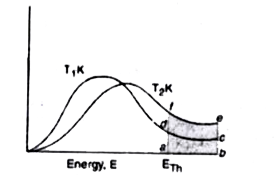
We know that for the rise in temperature from 300 K to 310 K, the average kinetic energy of the molecules increases by 3% only as it is directly proportional to the temperature. On the other hand, the most reactions, the rate constant doubles i.e., increases by 100% for a `10^@` C rise near room temperature. This can be explained by assuming that certain threshold energy is required for the molecules to react. This is illustrated in figure where the fraction of the colliding molecules possessing different relative energies is plotted.
From the figure it is clear that with the increase in temperature the peak of the curve gets shifted towards the right and the curve at lower temperature. This indicates that the number of molecules with higher energy content have increase with increase in temperature.
The minimum energy (`E_(Th)`) required for the effective collisions is also shown in the diagram and the number of molecules possessing energies equal to on greater than bit, is proportional to area abed at temperature `T_1` and area abef at temperature `T_2`. In the figure, the area abef is roughly twice as large as abcd. Since the rate of reaction depends upon the number of molecules which possess energies higher than threshold energy (for effective collisions), it may be interpreted that the fraction of molecules possessing energy more than threshold energy has increased approximately two times and thereby, increases the rate by two times for a rise in temperature of 10 K.
Thus, we may conclude that increase in the rate of reaction with the rise in temperature is mainly due to the increase in number of effective collisions.
Promotional Banner

Topper's Solved these Questions

  • CHEMICAL KINETICS

    BETTER CHOICE PUBLICATION|Exercise Numerical Problems|63 Videos
  • BIOMOLECULES

    BETTER CHOICE PUBLICATION|Exercise QUESTION BANK|85 Videos
  • CHEMISTRY IN EVERYDAY LIFE

    BETTER CHOICE PUBLICATION|Exercise QUESTIONS|76 Videos

Similar Questions

Explore conceptually related problems

The temperature coefficient of a reaction is:

Why is N_2 less reactive at room temperature ?

What is temperature coefficient of resistance of the material of conductor ?

why is nitrogen less reactive at room temperature?

What is the effect of temperature on rate of a reaction.

Temperature coefficient of a reaction is ‘2. When temperature is increased from 30^@C to 90^@C , the rate of reaction is increased by

BETTER CHOICE PUBLICATION-CHEMICAL KINETICS-Numerical Problems
  1. What is temperature coefficient of a reaction ? Why temperature coeffi...

    Text Solution

    |

  2. The rate constant of a reaction is 1.5 xx 10^7 sec^(-1) at 50^@C and 4...

    Text Solution

    |

  3. The rate constant for the decomposition of N2O6, N2O6 rarr N2O4+1/...

    Text Solution

    |

  4. The first order rate constant for the decomposition of ethyl iodide by...

    Text Solution

    |

  5. The three fourth of a first order reaction is completed in 32 minutes....

    Text Solution

    |

  6. 60% of a first order reaction was completed in 60 minutes. When was it...

    Text Solution

    |

  7. A first order reaction is 75% complete in 60 min. Find the half-life o...

    Text Solution

    |

  8. Ammonia and oxygen react at high temperature as : 4 NH (3)(g) to 4NO (...

    Text Solution

    |

  9. The reaction 2 N (2) O (5) (g) to NO (2) (g) + O (2) (g) takes place i...

    Text Solution

    |

  10. A reaction 3X rarr 2Y+Z procees in a closed vessel. The rate of disapp...

    Text Solution

    |

  11. A first order reaction is 50% complete in 69.3 minutes. Calculate the ...

    Text Solution

    |

  12. A first order reaction is 20% complete in the 10 minutes. Calculate th...

    Text Solution

    |

  13. A first order reaction is 15% complete in 20 minutes. How long will it...

    Text Solution

    |

  14. A first order reaction is 20% complete in the 10 minutes. Calculate th...

    Text Solution

    |

  15. A first order reaction is 15% complete in 20 minutes. How long will it...

    Text Solution

    |

  16. A first order reaction is 40% complete in 50 minutes. In what time wil...

    Text Solution

    |

  17. The rate constant for the first order reactior becomes three times whe...

    Text Solution

    |

  18. The rate constant for a first order reaction becomes six times when th...

    Text Solution

    |

  19. The rate constant for a first order reaction becomes six times when th...

    Text Solution

    |

  20. For the reaction : N (2) + 3H(2) to 2 NH (3) The rate of reaction meas...

    Text Solution

    |

  21. The decomposition of hydrogen peroxide in the presence of iodide ion h...

    Text Solution

    |

